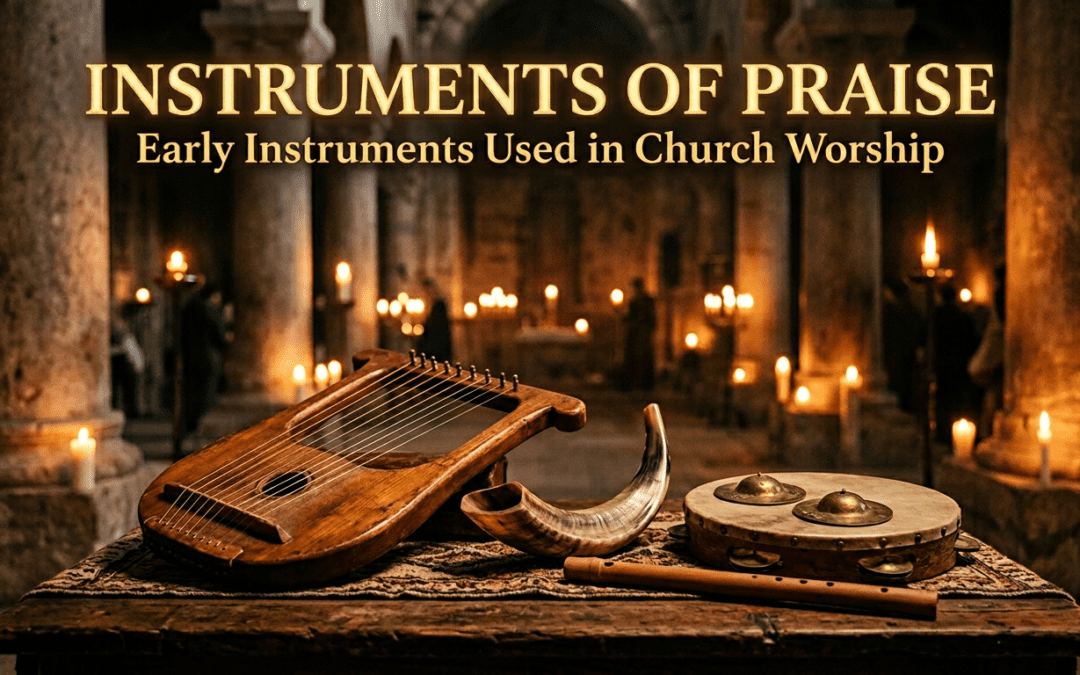
Long before electric guitars filled sanctuaries and praise bands took the stage, the people of God worshiped with instruments carved from bone, hammered from metal, and stretched from animal skin. The sounds of the kinnor, shofar, timbrel, and chalil echoed through ancient tabernacles and temple courts — instruments that the Lord Himself authorized for His praise. Understanding these early instruments deepens our appreciation for worship and connects us to thousands of years of sacred music history.
The Biblical Foundation for Instrumental Worship
The use of musical instruments in worship is not a modern invention — it is deeply rooted in Scripture. Psalm 150:3–5 issues a sweeping invitation: “Praise Him with the sound of the trumpet; praise Him with the harp and lyre. Praise Him with tambourine and dancing; praise Him with strings and flute. Praise Him with resounding cymbals; praise Him with clashing cymbals.” This single psalm names nearly every major category of ancient instrument — winds, strings, and percussion — validating them all as vehicles of worship.
King David organized the Levites as a dedicated musical corps for the temple. In 1 Chronicles 15:16, he instructed the leaders to appoint singers and instrumentalists “to lift up their voices with joy, accompanied by musical instruments — harps, lyres, and cymbals.” These were not casual jam sessions; they were consecrated acts of covenant worship appointed by God through His prophet.
1. The Kinnor — The Lyre of King David
The kinnor (Hebrew: כִּנּוֹר) is the most frequently mentioned stringed instrument in the entire Old Testament, appearing 42 times. It is often translated as “harp” in English Bibles, but scholars widely agree it was actually a type of lyre — a wooden frame instrument with strings stretched between two curved arms. The kinnor is the very first instrument referenced in Genesis 4:21, where Jubal is called “the father of all who play the harp and flute.”
King David is most famously associated with this instrument. When the troubled King Saul was tormented by an evil spirit, his servants sought “a man who is skilled in playing the lyre” — and David, described as a skilled player, was brought to the palace. “And whenever the harmful spirit from God was upon Saul, David took the lyre and played it with his hand. So Saul was refreshed and was well, and the harmful spirit departed from him” (1 Samuel 16:23). The kinnor was also central to Temple worship, played by the Levites during the dedication of Solomon’s Temple (2 Chronicles 5:12).
Josephus described the kinnor as having ten strings made from sheep intestine, played with a plectrum — though David was known to play it with his hand. Modern musicians have reconstructed the kinnor based on depictions from the Bar Kokhba coins and ancient Israeli imagery. Psalm 33:2 specifically calls for giving thanks to the Lord upon the kinnor: “Give thanks to the LORD with the lyre; make melody to him with the harp of ten strings!”
2. The Shofar — The Ram’s Horn Trumpet
Few instruments carry as much spiritual weight as the shofar — an ancient wind instrument made from a ram’s horn (or the horn of any kosher animal except bovine). The shofar lacks pitch-altering devices, meaning all tonal variation comes from the player’s breath and lip technique, similar to the modern bugle. Its piercing, haunting call has announced the most significant moments in Israel’s history.
The shofar gathered the people of Israel at Mount Sinai for the giving of the Law (Exodus 19:13–17), proclaimed the Year of Jubilee (Leviticus 25:9–10), and brought down the walls of Jericho as Joshua’s priests blew seven shofars around the city (Joshua 6:4–5). King David inserted the shofar into the Temple orchestra, and it was sounded when the Ark of the Covenant was brought to Jerusalem (2 Samuel 6:15). The shofar also appears in prophetic and eschatological contexts — in 1 Corinthians 15:52, Paul writes that “at the last trumpet” (likely referencing the shofar tradition) the dead will be raised.
Unlike most other Temple instruments that fell silent after the Temple’s destruction, the shofar survived and remains central to Jewish worship today, blown on Rosh Hashanah and at the close of Yom Kippur. For the early church, its sound evoked themes of God’s voice, divine summons, and the coming of the Lord — themes that remain deeply meaningful for Christian worshipers today.
3. The Timbrel — The Tambourine of Praise
The timbrel — also called a tambourine — was the primary percussion instrument of ancient Israel and one of the most joyful tools of worship. It consisted of a circular wooden frame with a stretched skin membrane, often fitted with pairs of small metal jingles or rattles, making it essentially the ancient equivalent of the modern tambourine. Simple, portable, and expressive, the timbrel was particularly associated with women and with spontaneous, celebratory praise.
Its most celebrated moment is in Exodus 15:20–21, when “Miriam the prophetess, Aaron’s sister, took a timbrel in her hand, and all the women followed her with timbrels and dancing. And Miriam sang back to them: ‘Sing to the LORD, for He is highly exalted; the horse and rider He has thrown into the sea.'” This spontaneous eruption of praise at the Red Sea is one of the Bible’s most vivid worship scenes — and the timbrel was at the center of it. Psalm 150:4 also calls for praising God “with tambourine and dancing.”
The timbrel also appeared in prophetic worship gatherings. In 1 Samuel 10:5, the prophet Samuel described a procession of prophets coming down from a high place, “preceded by harps, tambourines, flutes, and lyres, and they will be prophesying.” Music — including the timbrel — was understood as an atmosphere-creator for spiritual encounter, preparing hearts to receive the Spirit of God.
4. The Nevel — The Psaltery or Harp
The nevel (Hebrew: נֵבֶל) is the second most commonly mentioned stringed instrument in the Old Testament, appearing approximately 27–38 times. It is often translated as “psaltery,” “harp,” or “viol” in English translations, and was likely a larger, louder instrument than the kinnor. Scholars believe the nevel was a frame harp or large lyre — possibly with up to ten or twelve strings — played by plucking with the fingers or a plectrum.
David appointed the Levites to play the nevel in the Temple: “They are to play their lyres and harps, Asaph is to sound the cymbals, and Benaiah and Jahaziel the priests are to blow the trumpets regularly before the ark of the covenant of God” (1 Chronicles 16:5). Psalm 144:9 declares, “I will sing a new song to you, O God; on a ten-stringed harp I will make music to you.” The nevel was considered a holy instrument — 2 Chronicles 7:6 calls them “the LORD’s musical instruments, which King David made for praising the LORD.”
5. The Chalil — The Ancient Flute
The chalil (Hebrew: חָלִיל) was an ancient wind instrument similar to a flute, oboe, or clarinet — a simple pipe fashioned from reed, cane, or bone. Modern English Bibles typically translate it as “flute” or “pipe,” though most musicologists believe it was actually a double-reed instrument closer to an oboe. Its clear, penetrating tone lent itself to both joyful celebrations and mournful laments, giving it a remarkable versatility among ancient Hebrew instruments.
The chalil appears in some of Scripture’s most vivid worship moments. At Solomon’s coronation in 1 Kings 1:40: “All the people followed him, playing flutes and rejoicing greatly, so that the earth shook with the sound.” Isaiah 30:29 anticipates eschatological worship involving the chalil: “You will sing as on the night you celebrate a holy festival; your hearts will rejoice as when people go up with flutes to the mountain of the LORD.” The instrument also appeared alongside prophets (1 Samuel 10:5) and in pilgrimages to the Temple.
6. The Silver Trumpets — Hatzotzerah
In Numbers 10:2–10, God commanded Moses to make two silver trumpets (Hebrew: hatzotzerah) for specific sacred purposes: calling the congregation to assembly, signaling the breaking of camp, announcing wars, and marking the appointed feasts and new moons. These were not the same as the shofar — the hatzotzerah were straight metal instruments crafted by skilled craftsmen, blown by the priests themselves. Only the sons of Aaron were permitted to sound them.
The silver trumpets remind us that even instrument-making was a sacred act. God specified their material, their makers, and their purpose. At the dedication of Solomon’s Temple, “120 priests sounded trumpets” simultaneously — and the moment was so powerful that “the house of the LORD was filled with a cloud, so that the priests could not stand to minister because of the cloud, for the glory of the LORD filled the house of God” (2 Chronicles 5:12–14). The sound of the trumpets preceded the manifest presence of God.
7. The Cymbals — Percussive Praise
Ancient cymbals in the Bible were smaller than modern orchestral cymbals, likely resembling modern finger cymbals or castanets — small copper discs clapped together or attached to clappers. They were used enthusiastically in Temple worship. Asaph, one of the chief Levitical musicians appointed by David, was specifically designated as a cymbal player (1 Chronicles 15:19). Psalm 150:5 calls for praise with both “resounding cymbals” and “clashing cymbals,” suggesting different sizes or playing techniques.
The cymbals were used when the Ark of the Covenant was brought to Jerusalem (Ezra 3:10–13) and during the rededication of the Temple under Hezekiah (2 Chronicles 29:25). It is worth noting that Paul’s reference to a “noisy gong or clanging cymbal” in 1 Corinthians 13:1 was not a criticism of cymbal worship — it was a rhetorical statement that any spiritual gift exercised without love becomes empty noise.
The Pipe Organ: Bridge to Christian Worship
While the instruments above are rooted in Old Testament worship, the pipe organ became the defining instrument of Christian church music for over a millennium. Developed as the hydraulis (water organ) in Alexandria around 246 BC by Ktesibios, the organ was initially an engineering marvel used for entertainment and civic events. It was a Byzantine emperor’s gift — a pipe organ was sent to Pepin the Short, King of the Franks, in 757 AD — that began the instrument’s journey into Western church music.
Pope Vitalian I (657–672 AD) is widely credited with introducing the organ into Christian worship in Rome, though it did not become widespread until around 900–1000 AD, when the first pipe organs began appearing in monastic churches and cathedrals across Europe. By the 1400s, organs were well-established throughout European churches. The famous Winchester Monastery organ (980 AD) had 400 pipes and required 70 monks working as wind-makers to produce sound. Martin Luther embraced the organ as a vehicle for Gospel proclamation, while reformers like John Calvin and Ulrich Zwingli rejected it — sparking the “worship wars” that continued for centuries.
Early Church Caution About Instruments
It is important to acknowledge that the early church (approximately 100–500 AD) was largely unaccompanied in its worship. Most Church Fathers between AD 100 and 500 did not accept the use of musical instruments in Christian gatherings. This was not because instruments were inherently sinful, but because in the Roman Empire, instruments like the aulos (flute) and kithara (lyre) were deeply associated with pagan worship rites, immoral feasts, theatrical nudity, and debauchery. Early Christians — acutely aware of pagan influence — chose to worship with only the human voice, following the tradition of Jewish synagogue worship.
Saint John Chrysostom wrote sharply, “Where aulos-players are, there Christ is not,” and Jerome similarly distanced the church from instrument-playing. For these early believers, the instrument of worship was the sanctified human voice — the psalmos and hymnos referenced in Ephesians 5:19 and Colossians 3:16. Over time, as the church grew more culturally established, the theological conversation around instruments shifted, and by the medieval period, instruments — beginning with the organ — gradually found their way back into Christian worship spaces.
What These Instruments Teach Us
The diversity of early worship instruments — from the delicate strings of the kinnor to the thunderous blast of the shofar — reveals a profound truth: God welcomes every dimension of human creativity and expression in worship. Strings, winds, and percussion each represent different facets of praise. The intimate lyre speaks of individual devotion; the trumpet announces proclamation and war; the tambourine bursts with spontaneous joy; the cymbals punctuate corporate celebration.
Psalm 150 — the final, triumphant psalm of the Psalter — uses nearly every ancient instrument category as a call to total, all-encompassing praise. It concludes with the ultimate statement: “Let everything that has breath praise the LORD. Praise the LORD!” Whether our sanctuary is filled with ancient lyres, pipe organs, or modern worship bands, the heart of worship has never changed: glorify the God who created both music and the worshipers who play it.
Frequently Asked Questions
What was the first musical instrument used in worship in the Bible?
The first recorded instance of an instrument used in worship is the timbrel (tambourine) played by Miriam after the crossing of the Red Sea in Exodus 15:20–21. While Jubal in Genesis 4:21 is called the father of harp and flute players, the timbrel at the Red Sea is the first specific worship context in Scripture.
Did the early Christian church use instruments in worship?
For the first several centuries, most Christian worship was a cappella — voice-only. The early Church Fathers largely rejected instruments due to their strong associations with pagan worship and immorality in Roman culture. The organ gradually entered Christian worship beginning around the 7th–10th centuries AD.
What is the difference between the kinnor and the nevel?
Both are stringed instruments, but the kinnor was a smaller, lighter lyre — the personal instrument of David. The nevel was larger and louder, likely a frame harp or psaltery. They were often played together in Temple worship, representing different registers of sound in the Levitical orchestra.
Why is the shofar still used in worship today?
The shofar holds a unique place because it is one of the few ancient instruments with an unbroken tradition of religious use. For Jewish worshipers, it is commanded for Rosh Hashanah and Yom Kippur. Many Christian churches have also embraced the shofar as a powerful symbol of God’s voice, spiritual awakening, and the coming of Christ.
When did the pipe organ enter the church?
Pope Vitalian I introduced the pipe organ into Christian worship in Rome around AD 670. However, widespread adoption in Western churches didn’t occur until around 900–1000 AD, beginning in monasteries and cathedrals. By the 14th–15th centuries, the organ was nearly universal in Catholic churches across Europe.
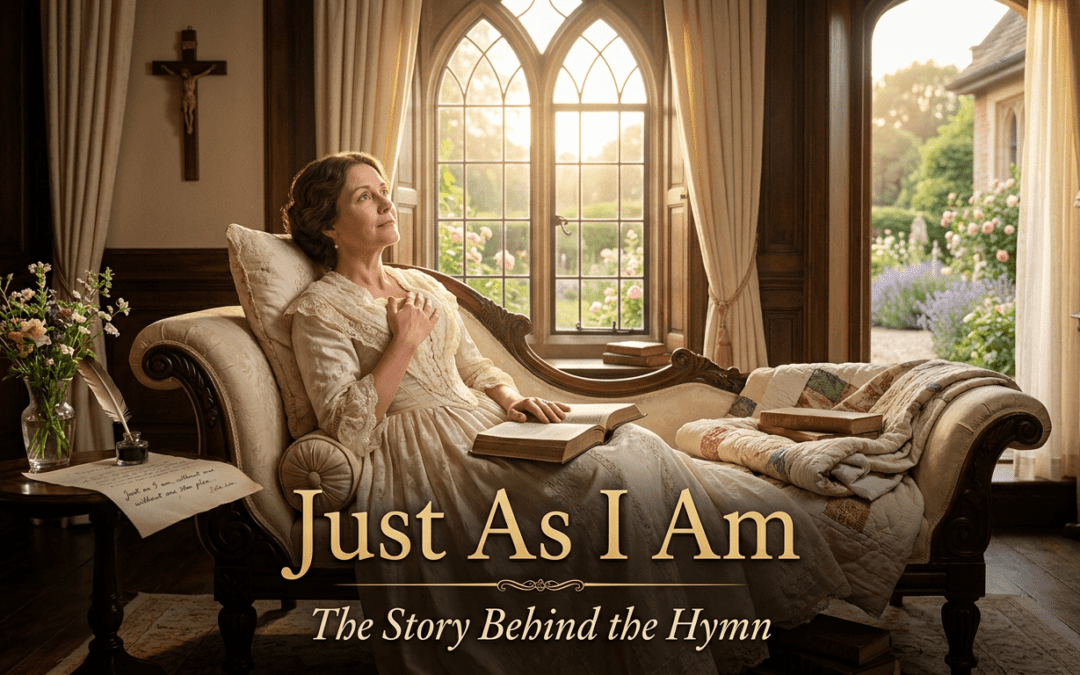
Few hymns in the history of Christian worship have moved as many hearts or prompted as many decisions of faith as Just As I Am. Written in 1835 by Charlotte Elliott, this beloved hymn has stood the test of time, appearing in hymnals across denominational lines and echoing through revival tents, church sanctuaries, and personal quiet times for nearly two centuries.
The Story Behind the Hymn
Charlotte Elliott was an English poet and hymnist who wrote Just As I Am during a period of deep personal struggle. Suffering from poor health and feeling spiritually restless, she wrestled with whether she was worthy enough to come to God. It was the encouragement of Swiss evangelist César Malan that led her to the life-changing realization: she could come to Christ exactly as she was — not after cleaning up her life, not after earning worthiness, but just as she was.
That moment of surrender became the seed of one of the most powerful invitational hymns ever penned. Elliott wrote the words as a reminder — first to herself, then to the world — that God’s grace meets us where we are.
The Lyrics and Their Meaning
Each verse of the hymn builds on the theme of coming to God with nothing held back. The opening verse arrives without excuse, relying solely on Christ’s atoning sacrifice. Subsequent verses address coming with doubt and fear, a burdened soul, blindness and poverty of spirit, and finally — full yielding and surrender.
The repeated refrain, O Lamb of God, I come!, is both a cry and a confidence — the voice of a soul that has stopped striving and started trusting.
Its Role in Christian History
Perhaps no figure is more associated with Just As I Am than the late evangelist Billy Graham. For decades, this hymn was sung at the close of every Billy Graham Crusade as thousands of people responded to the gospel invitation. The hymn became synonymous with the moment of decision — that sacred space between conviction and commitment.
Countless testimonies have been shared by people who found faith while this hymn played in the background. It has accompanied altar calls in small rural churches and stadium-sized evangelistic events alike. Its message transcends culture, background, and era.
Why This Hymn Still Matters Today
In an age of performance and self-improvement, Just As I Am is a radical countercultural statement. It reminds us that God does not require us to fix ourselves before coming to Him. The gospel is not a reward for the righteous — it is a rescue for the broken.
At Victory Baptist Church in Carthage, we treasure hymns like this one because they carry deep theological truth in memorable, singable form. They connect us to generations of believers who came before us and anchor us in the unchanging Word of God.
Whether you are hearing this hymn for the first time or the hundredth, the invitation remains the same: Come. Just as you are. God’s grace is greater than your failures, His mercy wider than your doubts, and His love deeper than your shame.
Sing It, Pray It, Live It
Take time this week to sing or read through Just As I Am slowly and prayerfully. Let each verse be a prayer. Let the refrain be your response. If you have never placed your faith in Jesus Christ, this hymn is an open door — a personal invitation from a God who loves you unconditionally.
And if you are a longtime believer who has grown weary or distant, let these words call you back to the simplicity of the cross: just as I am, Thy love unknown has broken every barrier down — now to be Thine, yea Thine alone, O Lamb of God, I come.
We would love to worship alongside you. Join us at Victory Baptist Church in Carthage for our Sunday services and experience the joy of congregational hymn singing together.
How a vacation drive through Scotland during Queen Elizabeth’s Silver Jubilee gave Pastor Jack Hayford a song that would reshape congregational worship for generations — and why it still rings out in churches around the world more than four decades later
Introduction: When Royalty Points to a Greater King
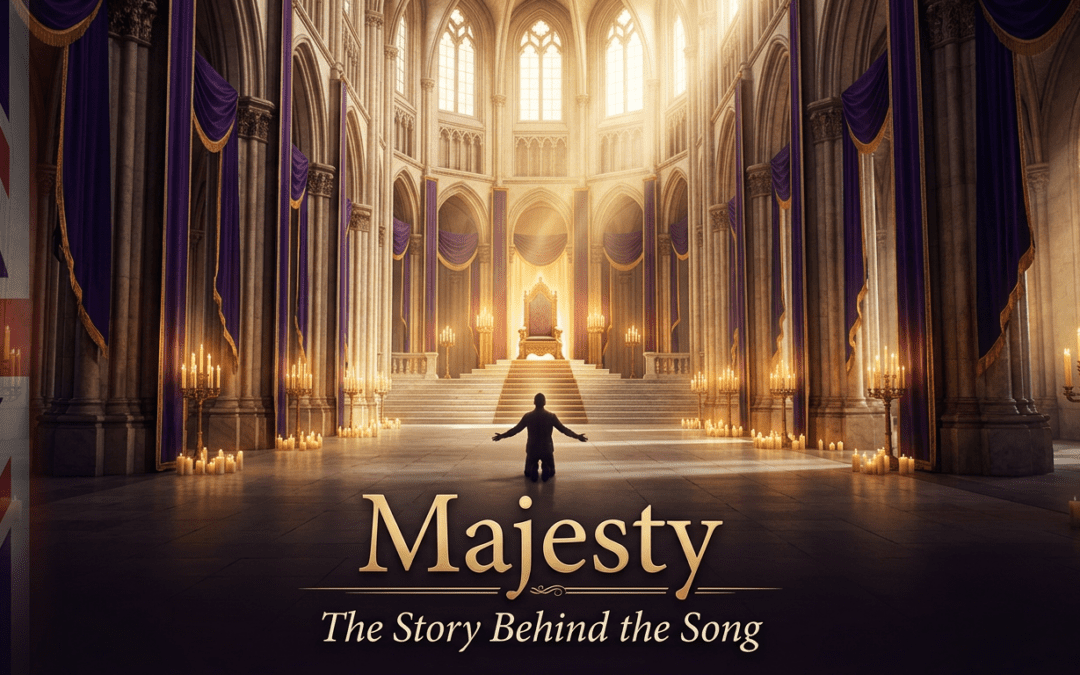
There is something about the sight of genuine royalty that does something to the human heart. The flags. The fanfare. The processions. The sense that the person before you occupies an entirely different order of existence from ordinary life — that they carry in their person a dignity and authority that commands reverence. Even people who claim to have no interest in monarchy find themselves stopping in their tracks when the royal standard appears on the horizon.
In the summer of 1977, an American pastor named Jack Hayford was driving through the rolling landscape of Great Britain — through England, Wales, and up into Scotland — experiencing exactly that sensation. The entire country was alive with color and celebration. Queen Elizabeth II was marking the 25th anniversary of her coronation, and the British people’s love for their monarch filled every street and village with a warmth and loyalty that this Californian found deeply moving. But as Jack and his wife Anna drove from castle to castle, from one symbol of royal majesty to the next, something more than admiration for the Queen began stirring in his heart.
A question formed: If people respond to earthly royalty with this kind of loyalty, dedication, and joy — what should our response to the King of all kings look like? From that question came the song “Majesty, Worship His Majesty” — a forty-five-word expression of royal praise that would become one of the most widely sung worship songs of the 20th century, one of only a handful of contemporary worship songs included in The United Methodist Hymnal, and the song most closely associated with the name of one of America’s most beloved “pastors to pastors.”
Jack Hayford: Pastor, Teacher, and “Pastor to Pastors”
Jack William Hayford was born on June 25, 1934, in Los Angeles, California — entering the world with a life-threatening illness that his family believed was healed through miraculous intercession. That experience of divine intervention at the very beginning of his life set the tone for everything that followed: a life lived in constant awareness of a God who is not distant, not indifferent, and not limited by human expectations.
Hayford felt called to ministry early and pursued it with extraordinary dedication. He was ordained in the International Church of the Foursquare Gospel and earned his theological training at Life Pacific University (then known as LIFE Bible College), where he later served as president from 1977 to 1982. But it was as a local church pastor that he made his most enduring mark.
In 1969, Jack and Anna Hayford arrived at a struggling Foursquare congregation in Van Nuys, California — the First Foursquare Church of Van Nuys — with just 18 members. Over the next thirty years, under his pastoral leadership and worship philosophy, it grew into one of the largest and most influential churches in southern California, eventually known as The Church on the Way, with a membership exceeding 12,000. Christianity Today magazine described him as “the Pentecostal Gold Standard” — a man who combined charismatic conviction with theological depth, pastoral warmth, and ecumenical generosity that drew leaders from every tradition to his door. He was, by widespread consensus, a “pastor to pastors” — the person other leaders called when they needed wisdom, prayer, or simply someone who had navigated every season of ministry with integrity intact.
Over the course of his life, Hayford authored more than 50 books, wrote more than 500 hymns and choruses, founded The King’s University in 1997 (originally in Los Angeles, later in Southlake, Texas), and served as President of The International Church of the Foursquare Gospel from 2004 to 2009. He married his beloved Anna in 1955; they were together for 63 years until her death in 2018. He later married Valarie Lemire. He died peacefully in his San Fernando Valley home on January 8, 2023, at the age of 88, having eaten dinner with his wife and spoken with one of his grandchildren the evening before. His memorial service was held on February 18, 2023.
Of all his hundreds of compositions, one song stood above the rest. One song became so identified with his name that when people across the world learned of his passing, the tribute they returned to again and again was not a Scripture, not a book title, not a sermon — but a song. That song was “Majesty.”
The Origin Story: A Royal Vacation and a Royal Revelation
In his own words, from his essay “The Birth of Majesty” published on his official ministry website, Jack Hayford describes the song’s genesis:
“In 1977 my wife Anna and I spent our vacation in Great Britain, traveling throughout the land from the south country and Wales to the northern parts of Scotland. It was the year of the Silver Jubilee — the 25th anniversary of Queen Elizabeth’s coronation — and the spirit of celebration and honor for royalty was everywhere. The enthusiasm of the English people for their monarch was infectious. I began to realize that Christ wants His church to have the same sense of loyalty and fellowship.”
The couple visited historic sites including Blenheim Palace — the birthplace of Winston Churchill and one of England’s grandest stately homes — and traveled north through Wales into Scotland, where the castles and highland landscapes added a further dimension of ancient majesty to the journey. The flags were flying. The people were celebrating. And everywhere they went, the symbols of royalty — the heraldry, the pageantry, the unashamed public deference to a sovereign — were on full display.
As they drove, something shifted in Hayford’s understanding. The Foursquare Church’s official tribute after his death put it this way: he became mindful “that the provisions of Christ for the believer not only included the forgiveness for sin, but provided a restoration to a royal relationship with God as sons and daughters born into the family through His Majesty, Our Savior Jesus Christ.” He was filled, he later wrote, “with a powerful sense of Christ Jesus’ royalty, dignity, and majesty.” He seemed to feel something new of what it meant to belong to the King.
Then, on one of those drives — the precise location lost to memory but the moment itself unforgettable — the opening lyrics and melody of “Majesty” came to his heart all at once. He did not stop the car. He continued driving and asked Anna, who had a notebook beside her on the seat, to write down the words and melody line as he dictated them. “Because of this,” Hayford later wrote with obvious delight, “she still laughingly insists that she ‘wrote’ ‘Majesty’!”
The basic structure of the song was complete in that car. After returning home to Van Nuys, California, Hayford refined and completed it. It was first published in 1978 (some sources cite 1981 for the formal copyright registration with Rocksmith Music) and was introduced to the wider world through the growing worship music movement of the late 1970s and early 1980s. CCLI (Christian Copyright Licensing International) assigned it song number 1527 — a number that places it among the earliest contemporary worship songs to be formally licensed for congregational use.
The Scripture Foundation
Hayford’s favorite Scripture — the one he identified as most closely connected to “Majesty” — was Psalm 93:1:
“The LORD reigns, He is robed in majesty; the LORD is robed in majesty and armed with strength.” — Psalm 93:1
But the song draws from a wider stream of royal praise passages throughout Scripture. One of the most relevant is 1 Chronicles 29:11, which David prayed at the dedication of the temple materials he had assembled for his son Solomon:
“Yours, O Lord, is the greatness and the power and the glory and the majesty and the splendor, for everything in heaven and earth is yours. Yours, O Lord, is the kingdom; you are exalted as head over all.” — 1 Chronicles 29:11
The song also echoes Revelation 4 and 5, where the heavenly throne room erupts in the declaration that the Lamb who was slain is worthy to receive “power and riches and wisdom and strength and honor and glory and blessing” (Revelation 5:12). Hayford was not simply drawing a poetic analogy between British royalty and Christ’s kingship. He was pointing to the reality that the entire biblical narrative culminates in the enthronement of the King of all kings — and that earthly royalty, at its best, is a pale shadow of that ultimate sovereignty.
The phrase “Jesus who died, now glorified, King of all kings” is the song’s most explicitly Christological statement. It compresses the entire gospel into seven words: death, resurrection, and eternal reign. The One who stooped to die is the same One now exalted to the throne. Earthly majesty is temporary. His is eternal.
Lyrical Analysis: Every Word Counts
“Majesty” is one of the shortest major worship songs ever written. At just 45 words, it packs extraordinary theological density into an almost crystalline economy of language. There is not a filler word in the entire text. Let’s examine it line by line.
Majesty, worship His Majesty; Unto Jesus be all glory, honor and praise.
The song opens with its title word as a direct command: worship His Majesty. “Majesty” here is not primarily an adjective describing God — it is a title, a throne name. It declares that the One being addressed occupies the supreme position of royal authority in the universe. The second line does what no earthly court would dare do: it directs ALL glory, honor, and praise to Jesus — not to the institution, not to the church, not to the leader, not to any tradition. Everything flows to Him.
Majesty, kingdom authority, Flows from His throne, unto His own, His anthem raise.
“Kingdom authority” is a carefully chosen phrase. Hayford understood worship not merely as an emotional experience but as a political act — an alignment of the worshipper with the sovereign rule of Christ over all things. When believers gather to worship, they are not simply expressing private feelings. They are acknowledging a kingdom, affirming a throne, and placing themselves within the order of that kingdom as “His own.” The phrase “His own” is both intimate (we belong to Him) and royal (we are His subjects, His inheritance). “His anthem raise” calls the congregation to active proclamation — not passive reception of blessing, but active declaration of the King’s greatness.
So exalt, lift up on high the name of Jesus; Magnify, come glorify, Christ Jesus the King.
The bridge functions as a musical fanfare — a trumpet call to worship. Three verbs in quick succession: exalt, magnify, glorify. All three are transitive — they require an object, and in each case, the object is the same Person. Jesus. Christ Jesus the King. Hayford has been careful throughout the song to be explicitly Christological rather than generically theistic. This is not a song about a vague divine presence or a spiritual force. It is a song about a named Person — Jesus — who has a specific identity: He is the Christ, the anointed one, the long-awaited Messiah; and He is the King, the sovereign ruler of all creation.
Majesty, worship His Majesty; Jesus who died, now glorified, King of all kings.
The final section returns to the opening declaration and then closes with the hymn’s most theologically packed line: “Jesus who died, now glorified, King of all kings.” Past tense — died. Present tense — glorified. Eternal title — King of all kings. The crucifixion is not denied or minimized. It is the very foundation of the glorification. He is King precisely because He was willing to die. The title “King of all kings” draws from Revelation 19:16, where Christ is revealed at His return with the name “King of Kings and Lord of Lords” written on His robe and on His thigh. Hayford was inviting every congregation that sang this song to rehearse the confession of the New Jerusalem — to practice, in the present tense, the worship that will fill eternity.
Timeline: The Life of a Song
Year
Event
1934
Jack William Hayford born June 25 in Los Angeles, California
1955
Marries Anna Smith; begins full-time ministry
1969
Appointed founding pastor of The Church on the Way, Van Nuys, CA — 18 members at founding
1977
“Majesty” composed during vacation drive through England, Wales, and Scotland during Queen Elizabeth’s Silver Jubilee; Anna writes down the words while Jack drives
1977–1982
Hayford serves as President of Life Pacific University while also pastoring The Church on the Way
Song spreads rapidly through evangelical and charismatic churches; arranged by Eugene Thomas for broader use
1989
Included in The United Methodist Hymnal (#176) — one of very few contemporary worship songs to achieve formal denominational hymnal status
1990s
The Church on the Way grows to over 12,000 members; Hayford recognized as one of America’s leading megachurch pastors
1997
Hayford founds The King’s University in Los Angeles
1999
Steps down as senior pastor of The Church on the Way after 30 years
2004–2009
Serves as President of The International Church of the Foursquare Gospel
2018
Anna Hayford passes away after 63 years of marriage
January 8, 2023
Jack Hayford passes away peacefully at home at age 88; tributes pour in from around the world; “Majesty” rings out across thousands of churches in his honor
2023–present
“Majesty” continues to be sung in churches worldwide; listed in Our Great Redeemer’s Praise (United Methodist new collection); rated among top 100 contemporary hymns globally
Notable Recordings and Performances
Artist / Context
Notes
Jack Hayford / Church on the Way
Original congregational recording; introduced to the broader church through Foursquare and charismatic networks
Ron Kenoly
One of the earliest and most widely heard CCM recordings; introduced “Majesty” to a new generation of contemporary worshippers
Michael W. Smith
Performed live at numerous large-scale events; helped cement the song’s status as a cross-denominational standard
Maranatha! Music
Included on multiple praise compilations; spread the song into tens of thousands of evangelical churches through the 1980s–90s
Life Pacific University
Recorded a special remix of “Majesty” in tribute to Hayford in early 2023 following his passing; he was described as being “thrilled to hear it”
Various artists
Covered by choirs, worship teams, and solo artists across every denomination and on every continent
Hayford’s Own Interpretation: What the Song Means
In his essay “The Birth of Majesty,” Hayford offered his own theological interpretation of the song he had written. His words are worth reading in full:
“‘Majesty’ is not merely a call to worship the Lord — it is a declaration that He is worthy of that worship. He is fully worthy. ‘Majesty’ is also a statement of the fact that our worship, when begotten in spirit and in truth, can align us with His Throne in such a way that we draw on His life, power, and resources. His kingdom authority flows from His throne — and can flow from our lives as we worship Him.”
This interpretation reveals the profound pastoral purpose behind the song. Hayford was not simply writing a beautiful expression of adoration. He was writing a theological statement about the nature of worship itself: that genuine worship is not merely vertical (human being to God) but also transformational — it changes the worshipper, aligns them with heaven’s purposes, and enables them to live as citizens of the kingdom they declare. When we say “kingdom authority flows from His throne unto His own,” we are confessing that as His own — as His people — we have access to the power and authority of that kingdom. Worship is the doorway.
Hymnologist Donald Hustad, one of the most respected voices in 20th-century Christian music scholarship, noted that Hayford’s concern in writing the song was pastoral as much as theological: “We need to cultivate a sense of the majestic presence of God. He is a close friend, by his grace, but he is also the majestic, holy, awesome God of the universe and we need constant reminding not to take His royal presence lightly.”
Why “Majesty” Crossed Every Denominational Line
One of the most remarkable facts about “Majesty” is that it achieved something almost unheard of for a contemporary worship song written in the charismatic/Pentecostal tradition: it was formally included in The United Methodist Hymnal (#176). For a song to cross from the praise-and-worship world into one of the mainline Protestant church’s official hymnals is an extraordinarily rare achievement. It speaks both to the song’s theological clarity and its musical accessibility.
The reason is not hard to identify. “Majesty” contains no distinctively Pentecostal theology. It does not reference spiritual gifts, does not use charismatic vocabulary, and does not presuppose any particular worship style. What it does contain is something every Christian tradition agrees on: Jesus Christ is Lord. He died. He is glorified. He is King of all kings. He deserves all glory, honor, and praise. Those are not charismatic convictions. They are catholic — in the original sense of the word — convictions: held universally by the whole church across every tradition and every century.
Hayford himself was a deeply ecumenical figure. He was known for his ability to build bridges across denominational lines, and his ministry drew leaders from Baptist, Methodist, Lutheran, Anglican, and Catholic backgrounds who found in him a man who loved Jesus more than he loved a label. “Majesty” is the musical expression of that ecumenism: a song so Christologically focused, so theologically sound, and so musically simple that the whole church can sing it together.
Frequently Asked Questions
Who wrote the worship song “Majesty”?
“Majesty, Worship His Majesty” was written by Jack William Hayford (1934–2023), founding pastor of The Church on the Way in Van Nuys, California. It was composed in 1977 during a vacation in Great Britain and first published in 1978 by Rocksmith Music.
What inspired Jack Hayford to write “Majesty”?
The song was inspired by a 1977 vacation through England, Wales, and Scotland during Queen Elizabeth II’s Silver Jubilee — the 25th anniversary of her coronation. Observing the British people’s deep loyalty and reverence for their monarch, Hayford was moved to reflect on Christ’s far greater kingship and the church’s call to a similar — and even deeper — devotion.
What does “Majesty” mean theologically?
According to Hayford himself, “Majesty” is both a declaration that Christ is fully worthy of worship and a statement that genuine worship aligns the believer with God’s throne and His kingdom authority. The song affirms the death, resurrection, and eternal reign of Jesus Christ as the King of all kings.
Is “Majesty” in any denominational hymnals?
Yes. “Majesty” appears in The United Methodist Hymnal (#176) — one of very few contemporary worship songs written in the charismatic tradition to be formally included in a mainline Protestant hymnal. It has also appeared in Methodist, Foursquare, and many other denominational songbooks worldwide.
When did Jack Hayford die?
Jack Hayford passed away peacefully at his home in the San Fernando Valley, California, on January 8, 2023, at the age of 88. His memorial service was held on February 18, 2023, and was available to watch online. At the time of his passing, “Majesty” rang out across thousands of churches worldwide in tribute to his life and legacy.
Legacy: The Song That Outlived Its Author
Jack Hayford is gone, but “Majesty” is not. Every Sunday, in churches from Van Nuys to Nairobi, from Seoul to São Paulo, congregations rise to sing the forty-five words that came to a California pastor on a country road in Scotland in the summer of 1977. They may not know the story of the Silver Jubilee, the drive through the Highlands, or Anna Hayford’s laughing claim to have “written” the song from the passenger seat. But they know what the words mean.
They know that Jesus died. They know He is glorified. They know He is King of all kings. And in the act of singing those words together — of exalting, magnifying, and glorifying His name as a body — they do exactly what Hayford always said the song was designed to do: they align themselves with the throne, draw on His kingdom authority, and take their place as His own, raising His anthem.
That is the legacy of “Majesty.” Not a chart position. Not an award. Not a streaming number. A legacy of congregations, generation after generation, turning their faces toward the King and saying — because they believe it, because they choose it, because nothing in earth or heaven is more true — Majesty, worship His Majesty. Unto Jesus be all glory, honor and praise.
How a young Anglican vicar’s Trinity Sunday assignment gave the global church one of its most enduring confessions of faith — and how a Victorian composer’s perfect melody made it immortal
A Song Already Being Sung
Most worship songs begin with a human feeling. They open with “I” — what the singer has experienced, what the singer has received, what the singer is feeling in this moment. “Holy, Holy, Holy” does something altogether different. It does not begin with the worshipper at all. It begins with the throne room of God, where the song is already in progress, and it simply invites the congregation to join in.
That distinction — captured so beautifully by literary scholar Madeleine Forell Marshall, who observed that this hymn “does not initiate praise but is rather an invitation to join an endless song” — is the key to understanding why “Holy, Holy, Holy” has endured for nearly two centuries, crossed virtually every denominational line, and appeared in more hymnals than almost any other single text in the English language.
The hymn was written by Reginald Heber, an Anglican vicar, for a single Sunday on the church calendar. It outlasted him, outlasted the century in which he lived, and outlasted entire traditions of worship music that seemed far more contemporary and relevant. It has been sung by the Choir of King’s College Cambridge and by Hillsong United. It has appeared in Anglican, Baptist, Lutheran, Methodist, Presbyterian, Roman Catholic, and countless other hymnals. It has been performed by Steven Curtis Chapman, Sufjan Stevens, and the Mormon Tabernacle Choir. It is, by any measure, one of the greatest hymns ever written in the English language — and its story begins with a very ordinary assignment: prepare a hymn for Trinity Sunday.
Reginald Heber: The Man of Letters
Reginald Heber was born on April 21, 1783, in Malpas, Cheshire, England. From his earliest years, he was known as a man of exceptional literary gifts — described by those who knew him as “the man of letters.” He attended Brasenose College, Oxford, where his poetry won him two distinguished academic awards and where he developed the deep love of language and theology that would shape the rest of his life. At Oxford, he formed a close friendship with Henry Hart Milman, the poet and church historian who would later serve as a crucial curator of Heber’s hymn manuscripts after his death.
In 1807, Heber was appointed vicar of Hodnet, a small parish in Shropshire, England — a post he would hold until 1823. By all accounts, the years at Hodnet were among the richest of his life. He was a devoted pastor who cared deeply for his congregation, spending seven or eight hours each day in his study, reading Scripture, church history, theology, and the great literature of many cultures. His wife later recalled that he would begin every day with family devotions before retreating to that study, and it was in that context — rooted in disciplined biblical meditation — that Heber wrote a hymn or poem for every Sunday of the liturgical year.
This was a radical act in its day. Anglican authorities of the early 19th century largely disapproved of the singing of original hymns in worship services, preferring the older tradition of metrical psalms. There was considerable informal hymn-singing in parishes, but Heber understood that the church needed a stronger, richer congregational voice. He wrote hymns not to defy the authorities but to demonstrate — in text after magnificent text — what the church was missing. “Holy, Holy, Holy” was his argument made in song.
In 1823, Heber accepted the appointment as Bishop of Calcutta — a position of enormous responsibility that required him to oversee the Church of England’s work across all of India, Ceylon, and Australia. His health was already fragile, and the harsh conditions of India made them worse. He threw himself into the work with characteristic intensity: traveling constantly, preaching, training Indian clergy, and carrying the pastoral care of a diocese spanning half the globe. He died suddenly on April 3, 1826, at just 42 years of age, after what is believed to have been a stroke while visiting a congregation in Trichinopoly (modern-day Tiruchirappalli). He was found in a bathing pool, where he had apparently gone to relieve heat exhaustion after preaching to a large crowd.
Heber never saw “Holy, Holy, Holy” in print. The text was first published posthumously in A Selection of Psalms and Hymns for the Parish Church of Banbury (Third Edition, 1826), and then more definitively in the collection his widow edited: Hymns Written and Adapted to the Weekly Church Service of the Year (London, 1827) — one of the first hymnals in history to organize its contents by the church’s liturgical calendar. The manuscript of his hymns, in his own handwriting, was donated to the British Library in 1864 by his old friend Milman, where it remains today as Add MS 25704. It can be dated to approximately 1820–1821, placing the composition of “Holy, Holy, Holy” in the middle of his rich Hodnet years.
The Scripture Behind the Song
Heber drew the imagery and language of “Holy, Holy, Holy” primarily from two of the most dramatic throne-room visions in all of Scripture: Isaiah 6 and Revelation 4.
In Isaiah 6, the prophet is undone by a vision of God seated on a high and exalted throne, with the train of His robe filling the temple. Seraphim — six-winged creatures of fire — fly above Him, calling to each other in an unceasing antiphon:
“Holy, holy, holy is the LORD of hosts; the whole earth is full of His glory.” — Isaiah 6:3
In Revelation 4, the Apostle John is caught up into heaven and sees a similar scene: a throne blazing like jasper and carnelian, surrounded by 24 elders in white robes with golden crowns, a sea of glass like crystal before the throne, and four living creatures — cherubim — who cry out day and night without ceasing:
“Holy, holy, holy, Lord God Almighty, who was, and is, and is to come.” — Revelation 4:8
The elders, overwhelmed by the sight of God’s glory, fall down before the throne and cast their golden crowns before Him, crying: “Worthy are you, our Lord and God, to receive glory and honor and power.” This is the scene Heber is painting in verse two, where the “saints adore Thee, casting down their golden crowns around the glassy sea.”
The threefold “holy” — known in church history as the Trisagion or Tersanctus, and preserved in the Latin liturgy as the Sanctus — is one of the most ancient elements of both Jewish and Christian worship. It appears in Isaiah’s temple vision, in John’s heavenly vision, and in the worship traditions of the church stretching back to the earliest centuries of Christian prayer. By building his hymn on this foundation, Heber was not simply borrowing vivid imagery. He was connecting every congregation that sings this hymn to the longest unbroken chain of worship in human history.
A Verse-by-Verse Analysis
Verse 1 — The Morning Invitation
Holy, holy, holy! Lord God Almighty! Early in the morning our song shall rise to Thee; Holy, holy, holy! Merciful and Mighty! God in Three Persons, blessed Trinity!
The opening stanza does three things simultaneously: it declares the holiness of God, it frames worship as the first act of the day (“early in the morning”), and it makes the hymn’s Trinitarian confession explicit in its very first verse. “God in Three Persons, blessed Trinity” is not a conclusion saved for the end — it is the opening declaration. Heber is not working up to the Trinity; he begins there, because Trinity Sunday demanded nothing less.
The pairing of “merciful and mighty” in the third line is a masterstroke of theological balance. God is not merely powerful — a deity of raw force. Nor is He merely tender — a sentimental idea of divine friendliness. He is both: infinitely mighty in His sovereignty and infinitely merciful in His love. That combination is the heart of the Christian gospel, and Heber captures it in four words.
One feature unique to this text, noted by the Hymnology Archive, is that every single line ends with a rhyme on the same sound (y/ee): Almighty, Thee, Mighty, Trinity. Heber sustains this sound through all sixteen lines of the hymn — a feat of remarkable poetic discipline that gives the text an almost chant-like resonance, as if the very sounds of the words are reverberating in a great hall.
Verse 2 — Heaven Joins the Song
Holy, holy, holy! All the saints adore Thee, Casting down their golden crowns around the glassy sea; Cherubim and seraphim falling down before Thee, Which wert, and art, and evermore shalt be.
If the first verse places the congregation on earth at the beginning of the day, the second verse lifts their eyes to heaven and shows them who else is singing. The imagery is directly drawn from Revelation 4: the glassy sea, the golden crowns, the cherubim and seraphim prostrate before the throne. By including this stanza in congregational worship, Heber was accomplishing something profound: he was making ordinary Sunday morning worshippers aware that they are not the only ones singing.
The last line — “which wert, and art, and evermore shalt be” — is the hymn’s first fully eternal statement. God does not exist within time as we do; His being spans past, present, and future in perfect wholeness. This is the same language the four living creatures use in Revelation 4:8 (“who was, and is, and is to come”), and it sets up everything that follows in the hymn: a God this eternal, this holy, and this present is worthy of unceasing worship.
Verse 3 — The Honest Confession
Holy, holy, holy! Though the darkness hide Thee, Though the eye of sinful man Thy glory may not see, Only Thou art holy; there is none beside Thee, Perfect in power, in love, and purity.
This is the verse that separates “Holy, Holy, Holy” from lesser hymns of praise. Most songs of adoration keep the singer in a posture of uninterrupted triumph. Heber, with the pastoral sensitivity of a man who had read deeply and cared genuinely for struggling souls, inserts an honest admission: sinful human eyes cannot fully see God’s glory. There is a darkness. There is a limitation. We worship what we cannot fully comprehend.
But having acknowledged that darkness, Heber does not leave the singer there. The confession becomes a declaration of God’s unique holiness: “Only Thou art holy; there is none beside Thee.” The very limitation of human sight becomes a testimony to the incomparable nature of God. And then the stanza closes with one of the most compact and comprehensive theological statements in all of hymnody: “Perfect in power, in love, and purity.” Three attributes. Three perfections. The God who is beyond our sight is also beyond our ability to improve upon.
Verse 4 — All Creation Joins
Holy, holy, holy! Lord God Almighty! All Thy works shall praise Thy name in earth, and sky, and sea; Holy, holy, holy! Merciful and Mighty! God in Three Persons, blessed Trinity!
The fourth and final stanza is a return to the first — almost identical in language — but now the meaning has been dramatically expanded. Having traveled from morning worship on earth, to the throne room of heaven, through the honest admission of human sinfulness, and back to the eternal perfection of God, the congregation arrives at the grand finale: all creation — earth, sky, and sea — joins the song. The repetition of the first verse now feels inevitable, like the final chord of a great symphony: the same notes, but weighted with everything that came before.
This closing movement echoes Psalm 148, which calls on the sun, moon, stars, mountains, trees, animals, and all people to praise the LORD. It echoes the end of the Psalter in Psalm 150: “Let everything that has breath praise the LORD.” And it echoes the vision of Revelation 5:13, where every creature in heaven, earth, and sea cries out in worship. Heber was not simply concluding his hymn. He was placing every singing congregation inside the great chorus of all creation.
The Tune That Made It Immortal: NICAEA
Heber’s text is magnificent, but it found its true voice only when paired with the tune composed by John Bacchus Dykes for the first edition of Hymns Ancient and Modern in 1861. Dykes, who was at the time a minor canon and precentor at Durham Cathedral, had not originally been invited to contribute to the project. When he heard it was underway, he wrote to William Henry Monk, the musical editor, essentially asking if he could still send some tunes. The tune he submitted for Heber’s text became the most celebrated of his career.
Dykes named the tune NICAEA — a deliberate tribute to the First Council of Nicaea, held by the Emperor Constantine in A.D. 325, which formally defined and defended the doctrine of the Trinity against the Arian heresy. The naming was not accidental: a Trinity Sunday hymn defending Trinitarian doctrine, set to a tune honoring the council that established Trinitarian orthodoxy, constitutes one of the most elegant acts of theological coordination in the history of church music.
The tune opens with an ascending major triad — the three notes of a chord rising one by one — which hymnologists have long interpreted as a subtle musical homage to the Trinity itself. From there, NICAEA moves with what scholars have described as “solid harmonies and subtle chromaticism,” lend ing it a chant-like, processional character that suits the grandeur of the text perfectly. Few leaps and many repeated consecutive notes give it the feel of ancient plainchant modernized for the Victorian congregational voice.
Hymnologist Erik Routley, one of the 20th century’s most respected voices on church music, wrote of NICAEA: “It is the noblest of Dykes’s tunes, and on the strength of it alone Dykes earns immortality in the annals of hymnody. His other tunes may be indispensable and beyond price, but they are ‘of their age’ in a sense in which this is not.” The text and the tune have been virtually inseparable since 1861. To sing one is to hear the other.
Timeline: Two Centuries of Worship
Year
Event
1783
Reginald Heber born on April 21 in Malpas, Cheshire, England
c. 1807
Heber appointed vicar of Hodnet, Shropshire; begins writing hymns for every Sunday of the church year
c. 1820–1821
“Holy, Holy, Holy” composed at Hodnet; manuscript (Add MS 25704) preserved in the British Library
1823
Heber appointed Bishop of Calcutta, overseeing the Church of England in India, Ceylon, and Australia
1826
Heber dies suddenly in Trichinopoly, India, on April 3 at age 42. Hymn published posthumously in A Selection of Psalms and Hymns for Banbury
1827
Heber’s widow publishes Hymns Written and Adapted to the Weekly Church Service of the Year — one of the first liturgical hymnals organized by the church calendar
1861
John Bacchus Dykes composes the tune NICAEA for Hymns Ancient and Modern (first edition) — the text-tune pairing that becomes permanent
1864
Heber’s friend H.H. Milman donates original manuscript of hymns to the British Library
1906
Included in The English Hymnal, edited by Ralph Vaughan Williams; reaches new generations of worshippers
1986
Included in The New English Hymnal — still in active use in Anglican worship
Late 1990s–2000s
Hillsong United, Steven Curtis Chapman, and other contemporary artists record their own versions, introducing the hymn to new generations
2000s–2010s
Sufjan Stevens records an acclaimed version; the Choir of King’s College Cambridge performs it to worldwide audiences
Present
Hymnary.org lists the hymn in thousands of hymnals across denominations and languages; actively sung in churches worldwide
Notable Recordings and Covers
Artist / Ensemble
Style
Notable Feature
Choir of King’s College, Cambridge
Classical choral
Regarded as the definitive choral recording; Dykes’s four-part harmony unchanged
Mormon Tabernacle Choir
Grand choral
Massive orchestral arrangement; widely aired on TV and radio broadcasts
Steven Curtis Chapman
Contemporary Christian
Accessible CCM arrangement that brought the hymn to new audiences in the 1990s
Hillsong United
Modern worship
Demonstrates the hymn’s natural fit in contemporary congregational worship
Sufjan Stevens
Indie folk/art
Intimate, sparse arrangement; reached secular audiences unfamiliar with hymns
2nd Chapter of Acts
Jesus Movement
Early contemporary Christian recording that introduced the hymn to the 1970s CCM world
Norton Hall Band
Modern hymn
Popular among Reformed congregations; faithful to original melody with fresh arrangement
Why Tennyson Called It the World’s Greatest Hymn
The poet Alfred Lord Tennyson — the Poet Laureate of Great Britain during much of the Victorian era — is often cited as having called “Holy, Holy, Holy” the world’s greatest hymn. Whether the quote is precise or apocryphal, the claim has endured because it rings true to those who know the text. “Holy, Holy, Holy” is not the most emotionally expressive hymn ever written. It is not the most poetically dazzling. What it is, is the most theologically complete — and the most cosmically ambitious.
In four stanzas and sixty-four words per verse, Heber manages to: address God as Triune, place the singer in a morning act of devotion, transport them to the eternal throne room of heaven, honestly confess the limits of sinful human perception, describe three of God’s defining perfections, and finally gather all creation into one grand chorus of praise. No other hymn in the English language accomplishes all of that in the same space, with the same simplicity, and with the same architectural elegance.
It is the rare kind of writing where you cannot remove a single word without losing something irreplaceable. Every line is weight-bearing. Every image is load-bearing theology dressed as poetry. That is why it has been called the world’s greatest hymn — and why, two hundred years after a young Anglican vicar in rural Shropshire first wrote it for a single Sunday service, it is still being sung, in every language and in every corner of the earth, by the people who know that the song in heaven has never stopped.
Legacy: The Hymn That Outlasted Its Century
“Holy, Holy, Holy” is not merely a beloved old hymn. It is an act of theological formation disguised as a song. Every time a congregation sings it, they are confessing the Trinity, rehearsing the imagery of heaven, acknowledging the limits of sinful human sight, and joining their voices to the eternal worship of the cherubim and seraphim who have never — not for a single moment — stopped their song. The hymn does not grow old because the God it describes does not change.
Reginald Heber died at 42, far from home, in a country he had gone to serve out of love for Christ. He never heard his hymn set to Dykes’s immortal melody. He never saw it in a printed hymnal. He never knew that it would outlast the Victorian era, the British Empire, the rise and fall of entire theological movements, and still be sung by thousands of congregations on every continent in the 21st century.
But then, that is perhaps the most fitting thing of all. Heber didn’t write “Holy, Holy, Holy” to be remembered. He wrote it because he believed the most important thing a congregation could do on Trinity Sunday was look up — away from themselves, away from their circumstances, away from everything that feels so pressing and so permanent — and see the throne of God, and the sea of glass, and the endless cascade of heavenly worship, and know that the holiest sound in the universe is the one that has been ringing since before the world was made:
Holy, holy, holy — Lord God Almighty. All Thy works shall praise Thy name in earth, and sky, and sea. Holy, holy, holy — merciful and mighty, God in Three Persons, blessed Trinity.
Reginald Heber (1783–1826) was an Anglican bishop, poet, and hymn writer. “Holy, Holy, Holy” was composed c. 1820–1821 and published posthumously in 1826–1827. The tune NICAEA was composed by John Bacchus Dykes (1823–1876) for Hymns Ancient and Modern (1861). The hymn is listed in Hymnary.org across thousands of hymnals in virtually every Christian denomination and has been described as appearing “in just about every hymnal.”
How a young man’s private moment with God — and a song he almost never shared — became one of the most beloved worship anthems in church history
The Unfinished Chorus That Changed Everything
It was the end of a long night at a Christian songwriters’ gathering, and Pete Sanchez Jr. had already played his two best songs. The room had heard dozens of writers perform throughout the evening, and the host was wrapping things up. Almost as an afterthought, he turned to Pete and asked: “Do you have anything else before we close?”
Pete hesitated. He had one more thing — but he wasn’t sure it counted. “I have this unfinished little chorus,” he said. “Let’s hear it,” the host replied.
So Pete sat at the piano and began to play and sing something simple, something he had been turning over in private for months — something he had never intended for anyone else’s ears:
“For Thou, O Lord, art high above all the earth…Thou art exalted far above all gods…”
And then came the chorus:
“I exalt Thee… I exalt Thee… I exalt Thee, O Lord!”
Something happened in that room that Pete Sanchez later described as an “out of body experience.” The entire gathering — every songwriter, every musician present — rose to their feet. Hands went up. The room filled with worship. Nobody asked. Nobody prompted them. They simply couldn’t stay seated.
The unfinished little chorus had found its congregation. And it would never be just Pete’s again.
Pete Sanchez Jr.: A Man Called Back to the Psalms
To understand “I Exalt Thee,” you have to understand the unusual circumstances that produced it. Pete Sanchez Jr. was, by his mid-twenties, already an accomplished Christian musician. He had served as a music director, a youth director, and a touring musician with a Christian group called One Song. By any measure of ministry career, he was doing well.
But Pete was newly married and wrestling with something personal. He had come from a divorced family — a wound that cut deep — and he was determined above all else to be a good husband and a good father. The ministry career, the performance, the platform — none of it mattered if his home fell apart. So he made a quiet, deliberate decision: he withdrew from active ministry.
He turned instead to the Psalms. Not as a songwriter looking for raw material, but as a man looking for God. His plan was straightforward: he would meditate on each psalm, one by one, and write a song that expressed what he found. It was a private discipline — a daily act of devotion between him and the Lord, with no audience in mind and no publication planned.
He worked his way through the psalter slowly, prayerfully. And then he arrived at Psalm 97:9.
The Verse That Stopped Him Cold
Psalm 97:9, in the King James Version that Pete was reading, reads:
“For thou, LORD, art high above all the earth: thou art exalted far above all gods.”
The verse stopped him. Something about it felt immense — not just as poetry, but as a declaration of reality. This was not a polite religious sentiment. This was a cosmological claim: that the God of Israel towers above every power, every competing claim, every false god that has ever seduced a human heart. The word translated “exalted” in Hebrew is nā’lāh — to be lifted up to an incomparable height, to be set apart as supreme.
Pete went to his piano. A melody came quickly — but only part of a song. He had a verse, but no chorus. He had a declaration about God, but no personal response to it. The song felt incomplete, unresolved, like a question without an answer.
He set it aside. He came back to it. He set it aside again. For the next 18 months, he kept returning to those opening lines, unable to finish what he had started. Later, he would explain it simply: “The only way I can explain it is, in that moment, it seemed like I stepped into another place… it was a divine encounter.” The chorus — “I exalt Thee, I exalt Thee, I exalt Thee, O Lord” — finally came. Not as clever songwriting. As response. As worship that had been waiting for its moment.
He copyrighted the song in 1976. And then, for years, he kept it mostly to himself.
Lyrical Analysis: What the Song Says and Why It Matters
The Verse — God’s Absolute Supremacy
For Thou, O Lord, art high above all the earth; Thou art exalted far above all gods.
These two lines are not metaphor — they are theological assertion drawn verbatim from Psalm 97:9. The psalmist is speaking into a world full of competing gods: the Baals of Canaan, the gods of Egypt, the idols of every nation surrounding Israel. His claim is total and uncompromising: none of them come close. The God of Abraham, Isaac, and Jacob is not the strongest among many strong gods — He is exalted far above all of them, in a category entirely His own.
The phrase “high above all the earth” also establishes God’s transcendence — He is not contained within creation, not subject to its limitations. He reigns from a position that is, by definition, above every earthly throne, every human power, every circumstance that threatens to feel larger than it is. This is the theological ground on which the rest of the song stands.
Psalm 97 as a whole is a royal coronation psalm — a song celebrating God’s kingship over the whole earth. It opens with “The Lord reigns; let the earth rejoice!” It describes His throne founded on righteousness and justice, clouds and darkness surrounding Him, fire going before Him, lightning illuminating the world. Verse 9 is its climactic declaration: after all the drama of the preceding verses, the conclusion is this — above everything, it is the Lord who is exalted.
The Chorus — From Declaration to Devotion
I exalt Thee! I exalt Thee! I exalt Thee, O Lord! I exalt Thee! I exalt Thee! I exalt Thee, O Lord!
This is where the song pivots from theology to participation. The verse tells us who God is. The chorus asks: now what will you do with that? It is an act of the will — “I exalt Thee” — not a passive observation. The worshipper is choosing, actively and repeatedly, to lift God above everything else in their life, above every competing priority, every alternative source of security and worth.
The repetition is not redundancy — it is liturgy. The six-fold “I exalt Thee” builds like a wave, each declaration reinforcing the one before it, until the act of exaltation becomes something felt as much as said. This is the ancient logic of Hebrew poetry: not to convey information with each repetition, but to immerse the singer deeper and deeper into the reality being declared.
The word “exalt” itself — from the Latin exaltare, meaning “to raise up high” — is a strong, physical-sounding word. It implies active lifting, not passive acknowledgment. You don’t accidentally exalt someone. You make a choice. You set them in a position of honor. Every time the chorus is sung, the worshipper is consciously repositioning God above themselves, above their circumstances, above every competing claim on their allegiance.
The Structural Genius of Simplicity
One of the most fascinating things about “I Exalt Thee” — noted by worship scholars and music ministers alike — is that most of the Christian world only ever learned the chorus. The verse, which provides the entire theological foundation for the chorus’s declaration, became largely invisible as the song migrated into congregational worship. As one observer noted, this is both its greatest strength and its most significant vulnerability.
The strength: a six-word chorus that anyone can learn in thirty seconds has the power to unite an entire congregation, regardless of background or musical ability, in a single act of worship. The vulnerability: without the verse, “I exalt Thee” could become a worship reflex rather than a worship conviction — a song you sing because it sounds beautiful, rather than a song you sing because you have first been staggered by the reality it proclaims.
Pete Sanchez designed both parts to work together. The verse provides the theological argument; the chorus provides the personal response. Sung together, they form a complete arc of worship: behold who God is, then respond to who He is. That arc — statement followed by surrender — is the heartbeat of biblical praise throughout the Psalter.
Timeline: The Life of a Song
Year
Event
1975
Pete Sanchez Jr. writes the verse of “I Exalt Thee” during a personal Psalms devotional study, based on Psalm 97:9
1975–1976
Over 18 months, Pete keeps returning to the unfinished song until the chorus finally arrives in a moment he calls a “divine encounter”
1976
Pete copyrights “I Exalt Thee”
Mid-1970s
At a Christian songwriters’ gathering, Pete reluctantly shares the “unfinished chorus” — the entire room rises in spontaneous worship; he later receives a cassette of the song being sung in 10 languages
1983
Trumpeter and gospel singer Phil Driscoll records “I Exalt Thee” as the title track of his album on Sparrow Records; the album receives a Grammy nomination for Best Male Gospel Performance
1984
Phil Driscoll wins the GMA Dove Award for Instrumentalist of the Year largely on the strength of the album
1986
Pete Sanchez Jr. releases his own worship album I Exalt Thee! on Integrity’s Hosanna! Music label — further cementing the song in the praise and worship movement
1987–1990s
Integrity’s Hosanna! Music distributes the song globally through its direct-mail worship series; it becomes a staple of charismatic and evangelical worship worldwide
1990s
Petra records the song; it enters the CCM mainstream and is sung in churches across denominations
1998
Phil Driscoll re-records the album as I Exalt Thee: 1998 under his own label, adding new tracks
2000s
Hillsong Worship incorporates “I Exalt Thee” into live worship sets; Gateway Worship features Pete Sanchez in a Song Story teaching series
2022
Gateway Worship releases a full “I Exalt Thee Song Story” video featuring Dr. Pete Sanchez telling the origin story
2024
Dr. Pete Sanchez visits Mill City Church in Fort Collins, Colorado, personally sharing the story behind the song nearly 50 years after writing it
2025
Pete Sanchez receives a Distinguished Alumni Award; “I Exalt Thee” continues to be sung globally in countless languages
Phil Driscoll and the Song That Found the World
For nearly a decade after Pete Sanchez wrote “I Exalt Thee,” the song existed in a relatively small orbit — beloved by those who encountered it, but not yet globally known. That changed in 1983 when Phil Driscoll — a Grammy-winning trumpeter and gospel vocalist who had played with Blood, Sweat & Tears before his conversion — recorded it as the title track of his Sparrow Records album.
Driscoll’s version was extraordinary. His trumpet playing elevated the song into something majestically orchestral, and his powerful gospel voice gave the simple chorus an emotional weight that matched its theological depth. The album received a Grammy nomination for Best Male Gospel Performance and won Driscoll the 1984 GMA Dove Award for Instrumentalist of the Year. Suddenly, “I Exalt Thee” was being heard by millions of people who had never encountered Pete Sanchez.
This pattern — a song written in obscurity, released quietly, then catapulted into global worship through a single high-profile recording — is one that echoes throughout church music history. But what makes “I Exalt Thee” particularly remarkable is what happened next: it did not remain a CCM radio hit. It migrated into the pews and became a congregational anthem — a song that ordinary people in ordinary churches around the world could sing together and mean.
Integrity’s Hosanna! Music and the Global Spread
The song’s deepest penetration into the global church came through Integrity’s Hosanna! Music — the pioneering worship music label founded in 1985 that became the primary vehicle for distributing praise and worship music directly to churches through a subscription model. Pete Sanchez Jr. was not merely a songwriter in this ecosystem — he became an integral part of it, eventually serving as Vice President and Dean of the Integrity Worship Institute.
Through Hosanna! Music’s direct-to-church cassette and CD series, “I Exalt Thee” reached denominations and traditions that might never have heard it through CCM radio — Pentecostal churches in Africa, Baptist congregations in South America, charismatic fellowships across Asia. Pete Sanchez later recalled receiving a cassette of the song being sung in ten different languages, sent to him by a missionary who had carried it to the ends of the earth. The man who withdrew from ministry to protect his family had, through one act of private devotion, reached more people than most full-time ministers ever would.
Sanchez went on to become Executive Pastor of Worship for New Life Church in Colorado Springs and a professor of worship at multiple universities in the United States and Belgium — a career of remarkable breadth built, in part, on the foundation of a song he almost didn’t share.
Legacy and Modern Worship
“I Exalt Thee” occupies a unique place in the history of modern Christian worship. It was not born in a recording studio, a church growth movement, or a worship conference. It was born in a man’s apartment, in a season of deliberate withdrawal, in a private act of biblical meditation. That origin gives it a character that is different from many worship songs written for a stage and a sound system — it is, at its core, a song of intimacy and surrender.
Over the last four decades, it has been recorded and performed by artists spanning the entire spectrum of Christian music, from Phil Driscoll’s orchestral gospel to Petra’s rock arrangements, from Hillsong’s stadium worship to quiet acoustic renditions at small-group Bible studies. Gateway Worship has featured it extensively in their training resources. Hillsong Worship has incorporated it into their live sets. Countless churches around the world include it in weekly worship without knowing anything about the man who wrote it or the story behind it.
Notable Recordings and Covers
Artist
Recording / Context
Year
Phil Driscoll
Title track, I Exalt Thee (Sparrow Records); Grammy nominated
1983
Pete Sanchez Jr.
I Exalt Thee! album, Integrity’s Hosanna! Music
1986
Petra
Recorded and performed widely through the CCM era
1990s
Phil Driscoll
I Exalt Thee: 1998 — re-recorded album with bonus tracks
1998
Hillsong Worship
Featured in live worship sets globally; medley with “A Thousand Hallelujahs”
2000s–present
Gateway Worship
Song Story teaching series featuring Pete Sanchez Jr.
2022
Various artists
Sung in 10+ languages across six continents in churches of every denomination
Ongoing
The Man Who Almost Kept It to Himself
There is a haunting quality to the origin story of “I Exalt Thee” that deserves a moment of reflection. Pete Sanchez Jr. wrote this song with no intention of sharing it. He considered it unfinished. He thought it was too small — just a private chorus, not a real song. When he finally did share it, it was only because someone pressed him at the last moment, at the end of a long night, when he was the last person at the microphone.
This is one of the recurring patterns in the history of great worship songs: the writer almost didn’t write it, almost didn’t finish it, almost didn’t share it. The song that transforms millions begins in obscurity, reluctance, or apparent incompleteness. The songwriter who thinks they have nothing to offer turns out to have the very thing the room — and eventually the world — needed to hear.
Pete Sanchez withdrew from ministry to be a good husband and father. He did not withdraw to write a worship anthem. He withdrew to be faithful in a small, private, unglamorous way — meditating on the Psalms, one by one, day by day. The song came as a byproduct of that faithfulness. It was not manufactured. It was discovered, the way you discover something that was already there, waiting to be found.
He said the only way he could explain the moment the chorus finally came was that he had stepped into another place. For those who have sung “I Exalt Thee” in worship and felt that same displacement — that sudden, overwhelming sense of standing before something infinitely larger than yourself — his description rings true. The song doesn’t just describe that experience. It transports you into it.
Why This Song Still Moves Us
Nearly fifty years after Pete Sanchez wrote “I Exalt Thee” in the quiet of his apartment, the song continues to be sung in churches around the world, in languages its author could never have imagined, by people whose names he will never know. The reasons for its endurance are not mysterious.
First, it is rooted directly in Scripture. Every word of the verse is drawn from Psalm 97:9 — not paraphrased, not interpreted, but lifted almost verbatim from the ancient text. When you sing “I Exalt Thee,” you are singing the Bible. That gives the song an authority and a resonance that no amount of clever songwriting can manufacture.
Second, it does something theologically essential: it places God in His proper position before the worshipper enters anything else. Before petitions. Before problems. Before praise for what God has done. “I Exalt Thee” begins with who God is — exalted, supreme, high above all the earth — and invites the worshipper to orient their entire life around that reality. This is what theologians call doxology: starting with God, not with our needs.
Third — and perhaps most powerfully — the song carries the weight of its own origin story. Every time it is sung, it is, in some sense, the continuation of that night at the songwriters’ gathering when an entire room rose to its feet without being asked. The worship that began in Pete Sanchez’s apartment, spilled into that gathering, traveled around the world in ten languages, and continues to echo in churches everywhere — has never stopped. It simply keeps spreading, one voice at a time, one congregation at a time, finding its way into hearts that are ready to say, with everything they have:
I exalt Thee. I exalt Thee. I exalt Thee, O Lord.
Pete Sanchez Jr. founded Gabriel Music Incorporated in 1991, a music publishing company named after the biblical angel. He served for many years as Executive Pastor of Worship at New Life Church in Colorado Springs, Colorado, and as a professor of worship at universities in both the United States and Belgium. He holds a Doctor of Ministry degree. “I Exalt Thee,” written in 1975 and copyrighted in 1976, remains one of the most widely sung worship songs in the history of the modern church.
How Matt and Beth Redman wrote one of the most beloved worship anthems of the 21st century in the ash-filled days following September 11, 2001 — and why it continues to give millions of believers a voice in their darkest moments
Introduction: A Song Born from the Ashes
On September 11, 2001, two airplanes hit the Twin Towers in New York City, and the world changed. Within days, churches across America were overflowing. People who had not stepped inside a sanctuary in years returned, searching for something — comfort, answers, meaning, or simply a place to grieve. Pastors rose to the moment with some of the finest preaching many of their congregations had ever heard. But Matt Redman noticed something else: the songs weren’t there.
Visiting church after church in the weeks following the attacks, the British worship leader and his wife Beth found themselves in congregations that had powerful biblical preaching but an almost total absence of worship songs equipped to respond to pain, lament, and grief. There were plenty of songs for seasons of joy. There were almost none for the road marked with suffering. That absence — that silence where a song should have been — is what gave birth to “Blessed Be Your Name.”
More than two decades later, “Blessed Be Your Name” remains one of the most sung worship songs in the world. It won the GMA Dove Award for Worship Song of the Year. It spent 68 weeks on the Billboard Christian Songs chart. It has been recorded by dozens of artists including Tree63, Newsboys, Michael W. Smith, and countless church worship bands. And it continues to be the song that millions of Christians reach for when life falls apart — because it was written specifically for that moment.
Matt Redman: The Man Behind the Music
To understand “Blessed Be Your Name,” you have to understand the man who wrote it — and that story begins not with triumph, but with tragedy.
Matthew James Redman was born on February 14, 1974, in England. When he was just seven years old, his father took his own life. The loss was devastating. But in the months that followed, a group from America visited the family, bringing with them a vibrant, expressive form of worship music that Matt had never encountered before. In the midst of profound grief, worship became a lifeline. “I learnt early on,” Redman later recalled, “that when you come to the throne room of God it’s not only a place of reverence — it’s a place of refuge.”
At age ten, Matt attended a Luis Palau Mission to London gathering in 1984 and converted to Christianity. The music that had comforted him in childhood became his calling. Encouraged by youth leader Mike Pilavachi at St. Andrew’s Chorleywood, he began leading worship as a teenager. By twenty, he was recording his first album. In 1993, he co-founded Soul Survivor with Pilavachi — a global Christian movement and annual music festival aimed at young people — which would become one of the most influential youth worship gatherings in the world.
Matt is married to Beth Redman, a gifted songwriter and author in her own right. Together, they have five children and live in southern California. Beth is the co-writer of “Blessed Be Your Name,” co-author of the books God Knows My Name and Finding God in Hard Times, and a Dove Award winner in her own right. “Blessed Be Your Name” would not exist without her voice and her partnership.
To date, Matt Redman has released 16 albums, written 8 books, won 13 Dove Awards (including Songwriter of the Year in 2013), and earned two Grammy Awards for his 2011 song “10,000 Reasons (Bless the Lord).” Three of his albums have reached No. 1 on Billboard’s Christian album chart. His songs have been covered by Michael W. Smith, Chris Tomlin, Jeremy Camp, Rebecca St. James, Tasha Cobbs Leonard, and Natasha Bedingfield, among dozens of others. He has performed at Madison Square Garden, Wembley Stadium, and the Royal Albert Hall. He has led worship in South Africa, Japan, India, Australia, and the Czech Republic.
But of all the songs in his catalog, none has reached as many people in as many different circumstances as “Blessed Be Your Name.” It is the song most closely identified with his name — and the song most clearly born from his own story.
The Origin Story: September 2001
On September 15, 2001 — just four days after the 9/11 attacks — Matt and Beth Redman flew into Los Angeles to begin a planned sabbatical break in California. In his own words, from his book Blessed Be Your Name:
“Four days earlier we’d watched with the rest of the world, gripped by those terrible, nation-shaking events of 9/11. Over the next few days and weeks in the U.S., as we watched the news, talked with neighbors and visited many different churches, the full effect of the terrorist attacks began to unfold before us. Brokenness was everywhere, and many people sought some kind of comfort in the church.”
Redman was moved by the quality of the preaching he encountered. Pastors throughout the country delivered what he described as “biblical and powerful sermons,” speaking directly into the pain of a shocked nation with clarity and compassion. But something was noticeably absent. As he traveled from church to church — sometimes as a visitor, sometimes as a worship leader — a “worrying question” began to form:
“Where were the songwriters at such a time as this? Where were the musical poets and prophets to help the people of God find a voice in worship at this tragic time? The truth was, in most places we visited, there was a distinct lack of songs appropriate for this time. As songwriters and lead worshipers, we had a few expressions of hope at our disposal; but when it came to expressions of pain and lament, we had very little vocabulary to give voice to our heart cries.”
In an article for Today’s Christian magazine, writer Lindsay Terry documented what happened next. Matt turned to the one biblical voice he knew had faced total devastation and still chosen to worship: Job. In the first chapter of the Book of Job, a man loses his children, his servants, his livestock, and his property — all in a single day. His response is extraordinary:
“Then Job arose and tore his robe and shaved his head and fell on the ground and worshiped. And he said, ‘Naked I came from my mother’s womb, and naked shall I return. The LORD gave, and the LORD has taken away; blessed be the name of the LORD.'” — Job 1:20–21
Redman was gripped by that response. Not merely acceptance. Not resignation. Worship. In the middle of catastrophic loss, Job did not curse God, did not withdraw from God, did not demand explanations from God. He tore his robe, shaved his head, fell to the ground — and worshipped. “Blessed Be Your Name” was written as a musical companion to that ancient act of faith.
The song was completed in the weeks following 9/11 and recorded for Matt’s 2002 album Where Angels Fear to Tread, released on the Worship Together label. Track two. Five minutes and six seconds. A song that would take two more years to fully find its audience — but when it did, it spread like fire.
Lyrical Analysis: A Song for Every Season
“Blessed Be Your Name” is structured around a simple but profound theological framework: praise is not contingent on circumstances. The song moves through four contrasting scenarios — two seasons of blessing and two seasons of suffering — and asserts in each one that God deserves worship regardless of which season the singer currently inhabits. Here is a verse-by-verse analysis.
Verse 1 — The Land That Is Plentiful
Blessed be Your name In the land that is plentiful Where Your streams of abundance flow Blessed be Your name
The song opens in a good season — abundance, provision, streams of blessing. The imagery draws from Deuteronomy 8:7–8, where God promises Israel a land of streams and abundance. But notice that even here, in the easiest and most natural place to offer praise, the song is deliberate and intentional. “Blessed be Your name” is not a passive acknowledgment of good fortune. It is an active choice to direct gratitude toward God rather than hoarding it or attributing it to one’s own effort. Even in abundance, the posture of the heart matters.
Verse 2 — The Desert Place
Blessed be Your name When I’m found in the desert place Though I walk through the wilderness Blessed be Your name
The second verse mirrors the first with deliberate contrast. The “desert place” and “wilderness” are not merely metaphors — they are the biblical images of spiritual desolation, testing, and the absence of easy answers. Israel wandered the wilderness for forty years. Jesus was led there by the Spirit before beginning His ministry. The great heroes of faith all knew the desert. This verse does not say “Blessed be Your name because the desert is secretly a blessing.” It says: even here, even now, even in this — I will bless Your name. The contrast between verses one and two is the entire gospel in miniature: God is worthy of praise in both seasons, and the choice to praise in the desert is the more courageous and the more transformative act.
Pre-Chorus — The Turn
Every blessing You pour out I’ll turn back to praise. When the darkness closes in, Lord, still I will say…
These two lines are the hinge of the entire song. “I’ll turn back to praise” is a posture of constant redirection — every good thing received is consciously redirected back to God as an act of gratitude rather than being absorbed into self-satisfaction. And the second line makes the harder commitment: even when “the darkness closes in,” the choice to say “Blessed be Your name” remains. This is not emotional manipulation or forced positivity. It is a theological choice: God’s worthiness is not determined by current circumstances.
Verse 3 — The Sun and the Suffering
Blessed be Your name When the sun’s shining down on me, When the world’s all as it should be, Blessed be Your name. Blessed be Your name On the road marked with suffering, Though there’s pain in the offering, Blessed be Your name.
The third verse brings the contrast into its sharpest focus. “When the world’s all as it should be” — the easy days, the untroubled mornings, the seasons of health and wholeness. And then immediately: “on the road marked with suffering.” The phrase “though there’s pain in the offering” is particularly striking. It does not pretend that worship in suffering is painless. It acknowledges that this kind of praise costs something. It is a sacrifice of praise (Hebrews 13:15) — an offering that involves real cost, real grief, and real faith offered simultaneously.
The Bridge — The Core Theological Statement
You give and take away, You give and take away. My heart will choose to say: Lord, blessed be Your name.
This bridge is where Job 1:21 becomes song. “The Lord gave, and the Lord has taken away; blessed be the name of the Lord.” Redman adds one crucial word that Job’s text implies but does not state: choose. “My heart will choose to say.” Worship in the dark is not an involuntary reflex. It is a decision. A conscious act of the will, aligned with the conviction that God is still good even when circumstances are not. Matt Redman himself has spoken about this word extensively: “Trust is a beautiful act of worship. It says to God, ‘I believe in You — in Your unfailing goodness and greatness — no matter what season of life I find myself in.'”
Timeline: The Life of a Song
Year
Event
1974
Matt Redman born February 14 in England
1981
Matt’s father dies by suicide; worship becomes his place of refuge at age 7
1984
Matt converts to Christianity at a Luis Palau Mission to London gathering, age 10
1993
Co-founds Soul Survivor with Mike Pilavachi — a global youth worship movement
September 11, 2001
9/11 terrorist attacks; Matt and Beth fly to California September 15 for sabbatical
Late 2001
“Blessed Be Your Name” written by Matt and Beth Redman in response to 9/11 and inspired by Job 1:21
2002
Song recorded as track 2 on Where Angels Fear to Tread (Worship Together); album released January 1, 2002
2003
South African band Tree63 releases cover as a single; begins climbing Billboard charts
2004
Tree63 version named No. 1 Adult Contemporary Christian radio single of the year by Billboard; peaks at No. 2 on Billboard Christian Songs chart; stays on chart 68 weeks. Newsboys cover the song for their Devotion album
2005
Wins GMA Dove Award for Worship Song of the Year. Included on WOW Hits 2005. Matt releases Blessed Be Your Name: The Songs of Matt Redman Vol. 1 compilation
2008
Tree63 includes the song on their greatest hits album Blessed Be Your Name: The Hits
2011
Matt releases “10,000 Reasons (Bless the Lord),” winning two Grammy Awards
2013
Matt wins 6 Dove Awards including Songwriter of the Year; recognized by Billboard as leading Christian artist
2020
Matt signs with Integrity Music; continues active recording and touring ministry
2024
Blessed Be Your Name: The Worship Songs of Matt Redman Vol. 1 re-released on Integrity Music
Notable Recordings and Covers
Artist
Year
Notable Achievement
Matt & Beth Redman
2002
Original recording on Where Angels Fear to Tread (Worship Together)
Tree63
2003–2004
Cover peaked No. 2 Billboard Christian Songs; spent 68 weeks on chart; No. 1 AC Christian song of 2004
Newsboys
2004
Recorded for Devotion album; introduced to rock/pop CCM audience
Michael W. Smith
2005+
Live performances reached broad evangelical audiences
Various Artists
2005
Included on WOW Hits 2005 — one of the best-selling Christian compilation series
Matt Redman
2014
Re-released with official lyric video (Survivor Records/Sparrow Records)
Church worship bands worldwide
Ongoing
One of the most consistently performed songs in CCLI licensing reports globally
The Theology of Suffering and Praise
One of the reasons “Blessed Be Your Name” has endured — and one of the reasons it connects so deeply in moments of personal pain — is that it takes suffering seriously as a theological category rather than explaining it away.
Many worship songs, particularly in the contemporary CCM tradition, deal primarily with victory, breakthrough, and the joy of salvation. These are genuine and important themes. But they leave the congregation without a voice in seasons of loss, illness, grief, and unanswered prayer. “Blessed Be Your Name” provides that voice without offering false comfort. It does not say “God will fix this.” It does not say “This isn’t really that bad.” It does not even say “Everything happens for a reason.” It says something far more radical: in the middle of what cannot be explained and may never be resolved, God is still worthy of worship.
Matt Redman himself has articulated the theological heart of the song clearly: “I think the Book of Job is really about something much grander than suffering — it’s about the sovereignty of God, of which suffering is a subcategory. At the end of chapter one it says: ‘The Lord gave and the Lord has taken away. May the name of the Lord be praised.’ Trust is a beautiful act of worship. It says to God, ‘I believe in You — in Your unfailing goodness and greatness — no matter what season of life I find myself in.'”
The Gospel Coalition’s Ray Ortlund has written extensively about Job 1:21, noting that Job “did not say ‘Blessed be the Lord’ but ‘Blessed be the name of the Lord.'” At issue, Ortlund observes, is not only Job’s personal reverence for God but “the name of the Lord in the world — how God would be thought about and spoken about and felt about.” Job’s response was not merely private endurance. It was a public act of witness: in the worst moment of his life, he declared that God had done nothing wrong. That declaration is what “Blessed Be Your Name” carries into congregational worship — the same bold, costly, countercultural witness.
Why This Song Still Matters
More than two decades after it was written in the shadow of the greatest terrorist attack in American history, “Blessed Be Your Name” continues to be sung in churches around the world. It is pulled out during cancer diagnoses and at memorial services. It is sung at mission conferences and in hospital rooms. It appears at youth events and at funerals. It is among the first songs a new worship leader learns and among the last songs a grieving congregation sings at a closing service.
The reason is simple: suffering never goes out of season. Every generation encounters its version of the road marked with suffering. Every congregation includes people in the desert place alongside people in the land that is plentiful. “Blessed Be Your Name” is one of the few worship songs capacious enough to hold both realities simultaneously — to speak with equal truth to the person whose world is all as it should be and the person whose world has just collapsed.
And at the center of it all is that single, powerful word: choose. “My heart will choose to say: Lord, blessed be Your name.” Not “my heart feels like saying.” Not “my heart automatically says.” Not “my circumstances compel me to say.” Choose. Worship in the dark is a decision — and it is the most powerful theological act available to a human being in pain. It is the same decision Job made, tearing his robe and falling to the ground, declaring that the God who gave was also the God who took away, and that in both the giving and the taking, the name of the Lord was blessed.
That is what this song is. That is why it was written. And that is why — long after many worship songs of the same era have faded from memory — “Blessed Be Your Name” is still being sung.
Frequently Asked Questions
Who wrote “Blessed Be Your Name”?
“Blessed Be Your Name” was written by Matt Redman and his wife Beth Redman. It appears on Matt’s 2002 album Where Angels Fear to Tread, released on the Worship Together label.
What is “Blessed Be Your Name” about?
The song is about choosing to worship God in every season of life — both in times of blessing and in times of suffering. It is rooted in Job 1:21, where Job praises God even after losing everything. The central message is that God is worthy of praise regardless of circumstances.
What inspired “Blessed Be Your Name”?
The song was written in the weeks following the September 11, 2001 terrorist attacks. Matt and Beth Redman were in the United States on sabbatical and were struck by the absence of worship music that could respond to grief and suffering. Inspired by the Book of Job and the biblical call to praise God in all circumstances, they wrote the song as a direct response to that gap.
What Bible verse is “Blessed Be Your Name” based on?
The song is primarily based on Job 1:21: “The LORD gave, and the LORD has taken away; blessed be the name of the LORD.” The bridge of the song — “You give and take away / my heart will choose to say / Lord, blessed be Your name” — is nearly a direct paraphrase of this verse.
What awards did “Blessed Be Your Name” win?
The song won the GMA Dove Award for Worship Song of the Year in 2005. Tree63’s cover version was named the No. 1 Adult Contemporary Christian radio single of 2004 by Billboard magazine, and the song spent 68 weeks on the Billboard Christian Songs chart, peaking at No. 2.