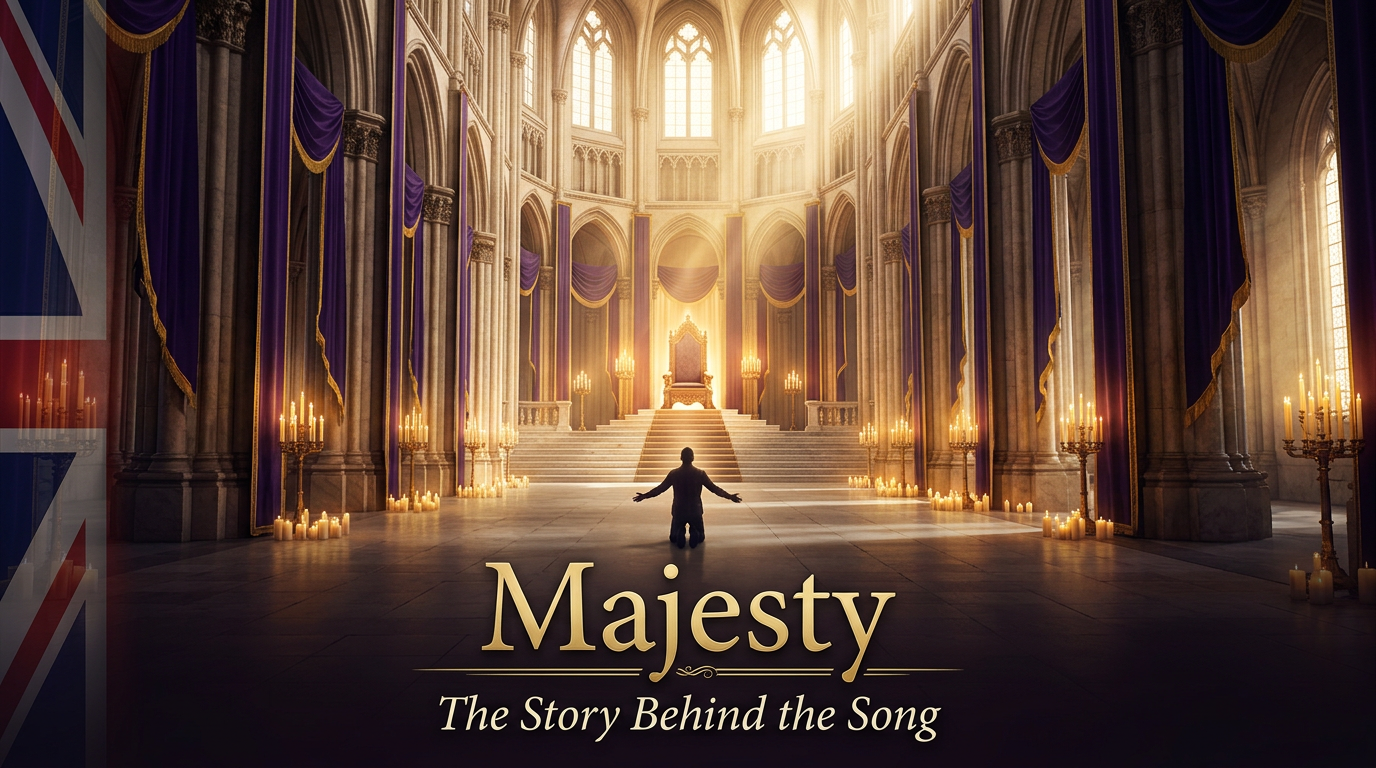
Majesty: The Story Behind the Song
How a vacation drive through Scotland during Queen Elizabeth’s Silver Jubilee gave Pastor Jack Hayford a song that would reshape congregational worship for generations — and why it still rings out in churches around the world more than four decades later
Introduction: When Royalty Points to a Greater King
There is something about the sight of genuine royalty that does something to the human heart. The flags. The fanfare. The processions. The sense that the person before you occupies an entirely different order of existence from ordinary life — that they carry in their person a dignity and authority that commands reverence. Even people who claim to have no interest in monarchy find themselves stopping in their tracks when the royal standard appears on the horizon.
In the summer of 1977, an American pastor named Jack Hayford was driving through the rolling landscape of Great Britain — through England, Wales, and up into Scotland — experiencing exactly that sensation. The entire country was alive with color and celebration. Queen Elizabeth II was marking the 25th anniversary of her coronation, and the British people’s love for their monarch filled every street and village with a warmth and loyalty that this Californian found deeply moving. But as Jack and his wife Anna drove from castle to castle, from one symbol of royal majesty to the next, something more than admiration for the Queen began stirring in his heart.
A question formed: If people respond to earthly royalty with this kind of loyalty, dedication, and joy — what should our response to the King of all kings look like? From that question came the song “Majesty, Worship His Majesty” — a forty-five-word expression of royal praise that would become one of the most widely sung worship songs of the 20th century, one of only a handful of contemporary worship songs included in The United Methodist Hymnal, and the song most closely associated with the name of one of America’s most beloved “pastors to pastors.”
Jack Hayford: Pastor, Teacher, and “Pastor to Pastors”
Jack William Hayford was born on June 25, 1934, in Los Angeles, California — entering the world with a life-threatening illness that his family believed was healed through miraculous intercession. That experience of divine intervention at the very beginning of his life set the tone for everything that followed: a life lived in constant awareness of a God who is not distant, not indifferent, and not limited by human expectations.
Hayford felt called to ministry early and pursued it with extraordinary dedication. He was ordained in the International Church of the Foursquare Gospel and earned his theological training at Life Pacific University (then known as LIFE Bible College), where he later served as president from 1977 to 1982. But it was as a local church pastor that he made his most enduring mark.
In 1969, Jack and Anna Hayford arrived at a struggling Foursquare congregation in Van Nuys, California — the First Foursquare Church of Van Nuys — with just 18 members. Over the next thirty years, under his pastoral leadership and worship philosophy, it grew into one of the largest and most influential churches in southern California, eventually known as The Church on the Way, with a membership exceeding 12,000. Christianity Today magazine described him as “the Pentecostal Gold Standard” — a man who combined charismatic conviction with theological depth, pastoral warmth, and ecumenical generosity that drew leaders from every tradition to his door. He was, by widespread consensus, a “pastor to pastors” — the person other leaders called when they needed wisdom, prayer, or simply someone who had navigated every season of ministry with integrity intact.
Over the course of his life, Hayford authored more than 50 books, wrote more than 500 hymns and choruses, founded The King’s University in 1997 (originally in Los Angeles, later in Southlake, Texas), and served as President of The International Church of the Foursquare Gospel from 2004 to 2009. He married his beloved Anna in 1955; they were together for 63 years until her death in 2018. He later married Valarie Lemire. He died peacefully in his San Fernando Valley home on January 8, 2023, at the age of 88, having eaten dinner with his wife and spoken with one of his grandchildren the evening before. His memorial service was held on February 18, 2023.
Of all his hundreds of compositions, one song stood above the rest. One song became so identified with his name that when people across the world learned of his passing, the tribute they returned to again and again was not a Scripture, not a book title, not a sermon — but a song. That song was “Majesty.”
The Origin Story: A Royal Vacation and a Royal Revelation
In his own words, from his essay “The Birth of Majesty” published on his official ministry website, Jack Hayford describes the song’s genesis:
“In 1977 my wife Anna and I spent our vacation in Great Britain, traveling throughout the land from the south country and Wales to the northern parts of Scotland. It was the year of the Silver Jubilee — the 25th anniversary of Queen Elizabeth’s coronation — and the spirit of celebration and honor for royalty was everywhere. The enthusiasm of the English people for their monarch was infectious. I began to realize that Christ wants His church to have the same sense of loyalty and fellowship.”
The couple visited historic sites including Blenheim Palace — the birthplace of Winston Churchill and one of England’s grandest stately homes — and traveled north through Wales into Scotland, where the castles and highland landscapes added a further dimension of ancient majesty to the journey. The flags were flying. The people were celebrating. And everywhere they went, the symbols of royalty — the heraldry, the pageantry, the unashamed public deference to a sovereign — were on full display.
As they drove, something shifted in Hayford’s understanding. The Foursquare Church’s official tribute after his death put it this way: he became mindful “that the provisions of Christ for the believer not only included the forgiveness for sin, but provided a restoration to a royal relationship with God as sons and daughters born into the family through His Majesty, Our Savior Jesus Christ.” He was filled, he later wrote, “with a powerful sense of Christ Jesus’ royalty, dignity, and majesty.” He seemed to feel something new of what it meant to belong to the King.
Then, on one of those drives — the precise location lost to memory but the moment itself unforgettable — the opening lyrics and melody of “Majesty” came to his heart all at once. He did not stop the car. He continued driving and asked Anna, who had a notebook beside her on the seat, to write down the words and melody line as he dictated them. “Because of this,” Hayford later wrote with obvious delight, “she still laughingly insists that she ‘wrote’ ‘Majesty’!”
The basic structure of the song was complete in that car. After returning home to Van Nuys, California, Hayford refined and completed it. It was first published in 1978 (some sources cite 1981 for the formal copyright registration with Rocksmith Music) and was introduced to the wider world through the growing worship music movement of the late 1970s and early 1980s. CCLI (Christian Copyright Licensing International) assigned it song number 1527 — a number that places it among the earliest contemporary worship songs to be formally licensed for congregational use.
The Scripture Foundation
Hayford’s favorite Scripture — the one he identified as most closely connected to “Majesty” — was Psalm 93:1:
“The LORD reigns, He is robed in majesty; the LORD is robed in majesty and armed with strength.” — Psalm 93:1
But the song draws from a wider stream of royal praise passages throughout Scripture. One of the most relevant is 1 Chronicles 29:11, which David prayed at the dedication of the temple materials he had assembled for his son Solomon:
“Yours, O Lord, is the greatness and the power and the glory and the majesty and the splendor, for everything in heaven and earth is yours. Yours, O Lord, is the kingdom; you are exalted as head over all.” — 1 Chronicles 29:11
The song also echoes Revelation 4 and 5, where the heavenly throne room erupts in the declaration that the Lamb who was slain is worthy to receive “power and riches and wisdom and strength and honor and glory and blessing” (Revelation 5:12). Hayford was not simply drawing a poetic analogy between British royalty and Christ’s kingship. He was pointing to the reality that the entire biblical narrative culminates in the enthronement of the King of all kings — and that earthly royalty, at its best, is a pale shadow of that ultimate sovereignty.
The phrase “Jesus who died, now glorified, King of all kings” is the song’s most explicitly Christological statement. It compresses the entire gospel into seven words: death, resurrection, and eternal reign. The One who stooped to die is the same One now exalted to the throne. Earthly majesty is temporary. His is eternal.
Lyrical Analysis: Every Word Counts
“Majesty” is one of the shortest major worship songs ever written. At just 45 words, it packs extraordinary theological density into an almost crystalline economy of language. There is not a filler word in the entire text. Let’s examine it line by line.
Majesty, worship His Majesty;
Unto Jesus be all glory, honor and praise.
The song opens with its title word as a direct command: worship His Majesty. “Majesty” here is not primarily an adjective describing God — it is a title, a throne name. It declares that the One being addressed occupies the supreme position of royal authority in the universe. The second line does what no earthly court would dare do: it directs ALL glory, honor, and praise to Jesus — not to the institution, not to the church, not to the leader, not to any tradition. Everything flows to Him.
Majesty, kingdom authority,
Flows from His throne, unto His own, His anthem raise.
“Kingdom authority” is a carefully chosen phrase. Hayford understood worship not merely as an emotional experience but as a political act — an alignment of the worshipper with the sovereign rule of Christ over all things. When believers gather to worship, they are not simply expressing private feelings. They are acknowledging a kingdom, affirming a throne, and placing themselves within the order of that kingdom as “His own.” The phrase “His own” is both intimate (we belong to Him) and royal (we are His subjects, His inheritance). “His anthem raise” calls the congregation to active proclamation — not passive reception of blessing, but active declaration of the King’s greatness.
So exalt, lift up on high the name of Jesus;
Magnify, come glorify, Christ Jesus the King.
The bridge functions as a musical fanfare — a trumpet call to worship. Three verbs in quick succession: exalt, magnify, glorify. All three are transitive — they require an object, and in each case, the object is the same Person. Jesus. Christ Jesus the King. Hayford has been careful throughout the song to be explicitly Christological rather than generically theistic. This is not a song about a vague divine presence or a spiritual force. It is a song about a named Person — Jesus — who has a specific identity: He is the Christ, the anointed one, the long-awaited Messiah; and He is the King, the sovereign ruler of all creation.
Majesty, worship His Majesty;
Jesus who died, now glorified, King of all kings.
The final section returns to the opening declaration and then closes with the hymn’s most theologically packed line: “Jesus who died, now glorified, King of all kings.” Past tense — died. Present tense — glorified. Eternal title — King of all kings. The crucifixion is not denied or minimized. It is the very foundation of the glorification. He is King precisely because He was willing to die. The title “King of all kings” draws from Revelation 19:16, where Christ is revealed at His return with the name “King of Kings and Lord of Lords” written on His robe and on His thigh. Hayford was inviting every congregation that sang this song to rehearse the confession of the New Jerusalem — to practice, in the present tense, the worship that will fill eternity.
Timeline: The Life of a Song
| Year | Event |
|---|---|
| 1934 | Jack William Hayford born June 25 in Los Angeles, California |
| 1955 | Marries Anna Smith; begins full-time ministry |
| 1969 | Appointed founding pastor of The Church on the Way, Van Nuys, CA — 18 members at founding |
| 1977 | “Majesty” composed during vacation drive through England, Wales, and Scotland during Queen Elizabeth’s Silver Jubilee; Anna writes down the words while Jack drives |
| 1977–1982 | Hayford serves as President of Life Pacific University while also pastoring The Church on the Way |
| 1978 | “Majesty” first published (© Rocksmith Music); CCLI song number 1527 assigned — among the earliest contemporary worship songs formally licensed |
| Early 1980s | Song spreads rapidly through evangelical and charismatic churches; arranged by Eugene Thomas for broader use |
| 1989 | Included in The United Methodist Hymnal (#176) — one of very few contemporary worship songs to achieve formal denominational hymnal status |
| 1990s | The Church on the Way grows to over 12,000 members; Hayford recognized as one of America’s leading megachurch pastors |
| 1997 | Hayford founds The King’s University in Los Angeles |
| 1999 | Steps down as senior pastor of The Church on the Way after 30 years |
| 2004–2009 | Serves as President of The International Church of the Foursquare Gospel |
| 2018 | Anna Hayford passes away after 63 years of marriage |
| January 8, 2023 | Jack Hayford passes away peacefully at home at age 88; tributes pour in from around the world; “Majesty” rings out across thousands of churches in his honor |
| 2023–present | “Majesty” continues to be sung in churches worldwide; listed in Our Great Redeemer’s Praise (United Methodist new collection); rated among top 100 contemporary hymns globally |
Notable Recordings and Performances
| Artist / Context | Notes |
|---|---|
| Jack Hayford / Church on the Way | Original congregational recording; introduced to the broader church through Foursquare and charismatic networks |
| Ron Kenoly | One of the earliest and most widely heard CCM recordings; introduced “Majesty” to a new generation of contemporary worshippers |
| Michael W. Smith | Performed live at numerous large-scale events; helped cement the song’s status as a cross-denominational standard |
| Maranatha! Music | Included on multiple praise compilations; spread the song into tens of thousands of evangelical churches through the 1980s–90s |
| Life Pacific University | Recorded a special remix of “Majesty” in tribute to Hayford in early 2023 following his passing; he was described as being “thrilled to hear it” |
| Various artists | Covered by choirs, worship teams, and solo artists across every denomination and on every continent |
Hayford’s Own Interpretation: What the Song Means
In his essay “The Birth of Majesty,” Hayford offered his own theological interpretation of the song he had written. His words are worth reading in full:
“‘Majesty’ is not merely a call to worship the Lord — it is a declaration that He is worthy of that worship. He is fully worthy. ‘Majesty’ is also a statement of the fact that our worship, when begotten in spirit and in truth, can align us with His Throne in such a way that we draw on His life, power, and resources. His kingdom authority flows from His throne — and can flow from our lives as we worship Him.”
This interpretation reveals the profound pastoral purpose behind the song. Hayford was not simply writing a beautiful expression of adoration. He was writing a theological statement about the nature of worship itself: that genuine worship is not merely vertical (human being to God) but also transformational — it changes the worshipper, aligns them with heaven’s purposes, and enables them to live as citizens of the kingdom they declare. When we say “kingdom authority flows from His throne unto His own,” we are confessing that as His own — as His people — we have access to the power and authority of that kingdom. Worship is the doorway.
Hymnologist Donald Hustad, one of the most respected voices in 20th-century Christian music scholarship, noted that Hayford’s concern in writing the song was pastoral as much as theological: “We need to cultivate a sense of the majestic presence of God. He is a close friend, by his grace, but he is also the majestic, holy, awesome God of the universe and we need constant reminding not to take His royal presence lightly.”
Why “Majesty” Crossed Every Denominational Line
One of the most remarkable facts about “Majesty” is that it achieved something almost unheard of for a contemporary worship song written in the charismatic/Pentecostal tradition: it was formally included in The United Methodist Hymnal (#176). For a song to cross from the praise-and-worship world into one of the mainline Protestant church’s official hymnals is an extraordinarily rare achievement. It speaks both to the song’s theological clarity and its musical accessibility.
The reason is not hard to identify. “Majesty” contains no distinctively Pentecostal theology. It does not reference spiritual gifts, does not use charismatic vocabulary, and does not presuppose any particular worship style. What it does contain is something every Christian tradition agrees on: Jesus Christ is Lord. He died. He is glorified. He is King of all kings. He deserves all glory, honor, and praise. Those are not charismatic convictions. They are catholic — in the original sense of the word — convictions: held universally by the whole church across every tradition and every century.
Hayford himself was a deeply ecumenical figure. He was known for his ability to build bridges across denominational lines, and his ministry drew leaders from Baptist, Methodist, Lutheran, Anglican, and Catholic backgrounds who found in him a man who loved Jesus more than he loved a label. “Majesty” is the musical expression of that ecumenism: a song so Christologically focused, so theologically sound, and so musically simple that the whole church can sing it together.
Frequently Asked Questions
Who wrote the worship song “Majesty”?
“Majesty, Worship His Majesty” was written by Jack William Hayford (1934–2023), founding pastor of The Church on the Way in Van Nuys, California. It was composed in 1977 during a vacation in Great Britain and first published in 1978 by Rocksmith Music.
What inspired Jack Hayford to write “Majesty”?
The song was inspired by a 1977 vacation through England, Wales, and Scotland during Queen Elizabeth II’s Silver Jubilee — the 25th anniversary of her coronation. Observing the British people’s deep loyalty and reverence for their monarch, Hayford was moved to reflect on Christ’s far greater kingship and the church’s call to a similar — and even deeper — devotion.
What does “Majesty” mean theologically?
According to Hayford himself, “Majesty” is both a declaration that Christ is fully worthy of worship and a statement that genuine worship aligns the believer with God’s throne and His kingdom authority. The song affirms the death, resurrection, and eternal reign of Jesus Christ as the King of all kings.
Is “Majesty” in any denominational hymnals?
Yes. “Majesty” appears in The United Methodist Hymnal (#176) — one of very few contemporary worship songs written in the charismatic tradition to be formally included in a mainline Protestant hymnal. It has also appeared in Methodist, Foursquare, and many other denominational songbooks worldwide.
When did Jack Hayford die?
Jack Hayford passed away peacefully at his home in the San Fernando Valley, California, on January 8, 2023, at the age of 88. His memorial service was held on February 18, 2023, and was available to watch online. At the time of his passing, “Majesty” rang out across thousands of churches worldwide in tribute to his life and legacy.
Legacy: The Song That Outlived Its Author
Jack Hayford is gone, but “Majesty” is not. Every Sunday, in churches from Van Nuys to Nairobi, from Seoul to São Paulo, congregations rise to sing the forty-five words that came to a California pastor on a country road in Scotland in the summer of 1977. They may not know the story of the Silver Jubilee, the drive through the Highlands, or Anna Hayford’s laughing claim to have “written” the song from the passenger seat. But they know what the words mean.
They know that Jesus died. They know He is glorified. They know He is King of all kings. And in the act of singing those words together — of exalting, magnifying, and glorifying His name as a body — they do exactly what Hayford always said the song was designed to do: they align themselves with the throne, draw on His kingdom authority, and take their place as His own, raising His anthem.
That is the legacy of “Majesty.” Not a chart position. Not an award. Not a streaming number. A legacy of congregations, generation after generation, turning their faces toward the King and saying — because they believe it, because they choose it, because nothing in earth or heaven is more true — Majesty, worship His Majesty. Unto Jesus be all glory, honor and praise.
Jack William Hayford (June 25, 1934 – January 8, 2023) was an American Pentecostal minister, author, songwriter, and broadcaster. He authored more than 50 books and composed more than 500 hymns and choruses. “Majesty, Worship His Majesty” was written in 1977 and published in 1978. © Rocksmith Music, administered by Trust Music Management. CCLI #1527. It appears in The United Methodist Hymnal (#176) and is included in Hymnary.org across hundreds of hymnals and songbooks worldwide.