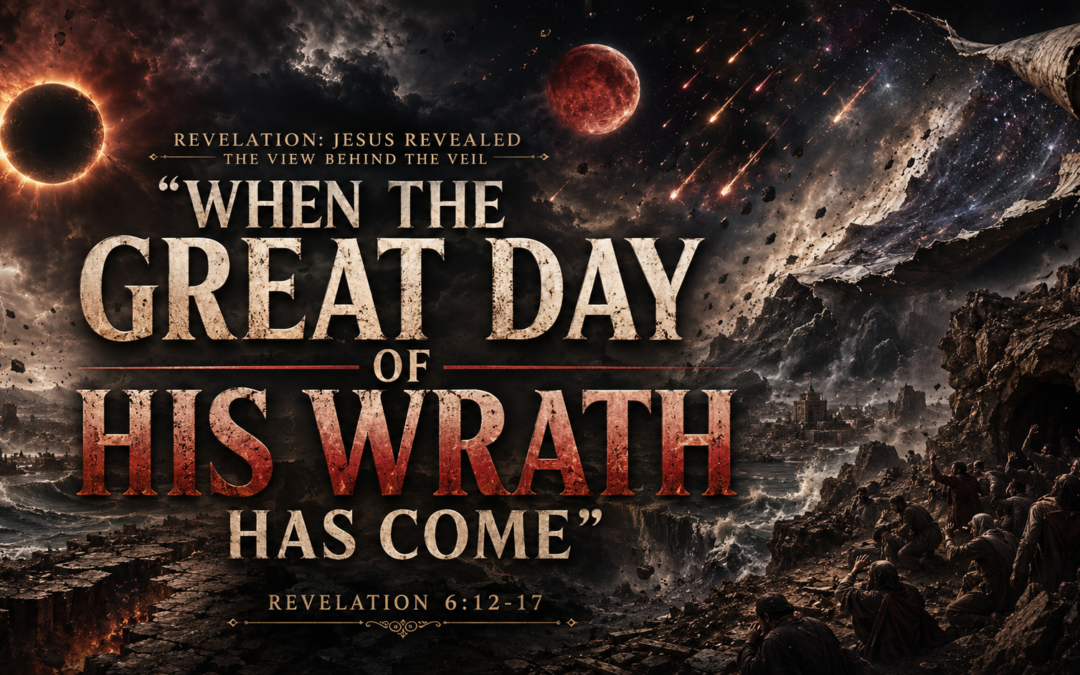
What happens when the created order begins to undo itself? In this powerful study of the sixth seal in Revelation, we witness a dramatic, cosmic “de-creation.” From shattering earthquakes and a darkened sky to falling stars and mountains moved from their foundations, the universe itself trembles at the holiness of God.
Sermon Audio
Sermon Video
Sermon Notes:
Revelation 6:12 I looked when He opened the sixth seal, and behold, there was
a great earthquake; and the sun became black as sackcloth of hair, and the moon
became like blood.
Revelation 6:13 And the stars of heaven fell to the earth, as a fig tree drops its late
figs when it is shaken by a mighty wind.
Revelation 6:14 Then the sky receded as a scroll when it is rolled up, and every
mountain and island was moved out of its place.
Revelation 6:15 And the kings of the earth, the great men, the rich men, the
commanders, the mighty men, every slave and every free man, hid themselves
in the caves and in the rocks of the mountains,
Revelation 6:16 and said to the mountains and rocks, “Fall on us and hide us from
the face of Him who sits on the throne and from the wrath of the Lamb!
Revelation 6:17 For the great day of His wrath has come, and who is able to stand?”
This is section is like a de-creation or the undoing, reversing, of the created order
1. Earth
2. Sun
3. Moon
4. Stars
5. Firmament
6. Land
7. Man
I. THE SHAKING OF THE EARTH.
Revelation 6:12 I looked when He opened the sixth seal, and behold, there was
a great earthquake; …”
Haggai 2:6 “For thus says the Lord of hosts: ‘Once more (it is a little while) I will shake
heaven and earth, the sea and dry land;
Haggai 2:7 and I will shake all nations,
II. THE DARKENING OF THE SKY.
Revelation 6:12 “… and the sun became black as sackcloth of hair, and the moon
became like blood.
Exodus 10:21 Then the Lord said to Moses, “Stretch out your hand toward heaven,
that there may be darkness over the land of Egypt, darkness which may even be felt.”
Exodus 10: 22 So Moses stretched out his hand toward heaven, and there was thick
darkness in all the land of Egypt three days.
Exodus 10:23 They did not see one another; nor did anyone rise from his place for
three days.
Matthew 27:45 Now from the sixth hour until the ninth hour there was darkness over
all the land.
Joel 2:10 The earth quakes before them, the heavens tremble; the sun and moon
grow dark, and the stars diminish their brightness.
III. THE FALLING OF THE STARS.
Revelation 6:13 And the stars of heaven fell to the earth, as a fig tree drops its late
figs when it is shaken by a mighty wind.
IV. THE ROLLING BACK OF THE HEAVENS.
Revelation 6:14 Then the sky receded as a scroll when it is rolled up, …”
The sky rolling up like a scroll
https://gospeldoctrine.com/sites/default/files/bookImages/OT/rolled%20up%20like%20a%20scroll.jpg
Isaiah 34:4 All the host of heaven shall be dissolved, and the heavens shall be
rolled up like a scroll; All their host shall fall down as the leaf falls from the vine,
and as fruit falling from a fig tree.
Amazing Grace lost verse
The earth shall soon dissolve like snow,
The sun forbear to shine;
But God, who called me here below,
Will be for ever mine.
V. THE MOVING OF THE MOUNTAINS AND ISLANDS.
Revelation 6:14 “… and every mountain and island was moved out of its place.
Matthew 24:29 “Immediately after the tribulation of those days the sun will be
darkened, and the moon will not give its light; the stars will fall from heaven, and the
powers of the heavens will be shaken.
Matthew 24:22 And unless those days were shortened, no flesh would be saved;
VI. THE HIDING OF THE WICKED.
Revelation 6:15 And the kings of the earth, the great men, the rich men, the
commanders, ‘the mighty men, every slave and every free man, hid themselves in
the caves and in the rocks of the mountains,
Revelation 6:16 and said to the mountains and rocks, “Fall on us and hide us from the
face of Him who sits on the throne and from the wrath of the Lamb!
2 Peter 3:9 The Lord is … longsuffering toward us, not willing that any should perish
but that all should come to repentance.
VII. THE COMING OF HIS WRATH.
Revelation 6:17 For the great day of His wrath has come, and who is able to stand?”
Joel 2:11 “… For the day of the Lord is great and very terrible; Who can endure it?
John 3:36 He who believes in the Son has everlasting life; and he who does not
believe the Son shall not see life, but the wrath of God abides on him.
About This Sermon: The Great Day of His Wrath Has Come
In this expository sermon from Victory Baptist Church in Carthage, we study the sixth seal of Revelation 6:12-17 – the moment when the great day of His wrath has come. The passage describes a dramatic, cosmic “de-creation” in which the created order begins to unravel before the holiness of God. As the sixth seal is opened, a great earthquake shakes the earth, the sun turns black as sackcloth, the moon becomes like blood, the stars fall from heaven, the sky rolls back like a scroll, and every mountain and island is moved out of its place.
The message walks through seven movements of judgment, showing how the great day of His wrath touches the earth, sun, moon, stars, firmament, land, and ultimately mankind. Each point is grounded in Scripture, connecting Revelation 6 to parallel passages in Haggai, Exodus, Joel, Isaiah, Matthew, and 2 Peter. The sermon closes with the searching question of Revelation 6:17 – “who is able to stand?” – and the hope of John 3:36 for all who believe in the Son.
Sermon Outline: The Sixth Seal of Revelation 6
I. The Shaking of the Earth – Revelation 6:12; Haggai 2:6-7
II. The Darkening of the Sky – Revelation 6:12; Exodus 10:21-23; Matthew 27:45; Joel 2:10
III. The Falling of the Stars – Revelation 6:13
IV. The Rolling Back of the Heavens – Revelation 6:14; Isaiah 34:4
V. The Moving of the Mountains and Islands – Revelation 6:14; Matthew 24:29, 24:22
VI. The Hiding of the Wicked – Revelation 6:15-16; 2 Peter 3:9
VII. The Coming of His Wrath – Revelation 6:17; Joel 2:11; John 3:36
Key Scriptures Referenced
Revelation 6:12-17, Haggai 2:6-7, Exodus 10:21-23, Matthew 27:45, Joel 2:10-11, Isaiah 34:4, Matthew 24:22-29, 2 Peter 3:9, and John 3:36.
Frequently Asked Questions
What does “the great day of His wrath has come” mean in Revelation 6:17?
It marks the climax of the sixth seal, when the cosmic signs of judgment make plain that the day of God’s wrath has arrived, prompting the question, “who is able to stand?”
What is the sixth seal in Revelation?
The sixth seal (Revelation 6:12-17) unleashes a series of cosmic upheavals – a great earthquake, a darkened sun and moon, falling stars, a receding sky, and mountains moved from their place – portraying the undoing of the created order before God’s holiness.
Listen to the sermon audio or watch the video above, and follow along with the full sermon notes from Victory Baptist Church, Carthage, Missouri.
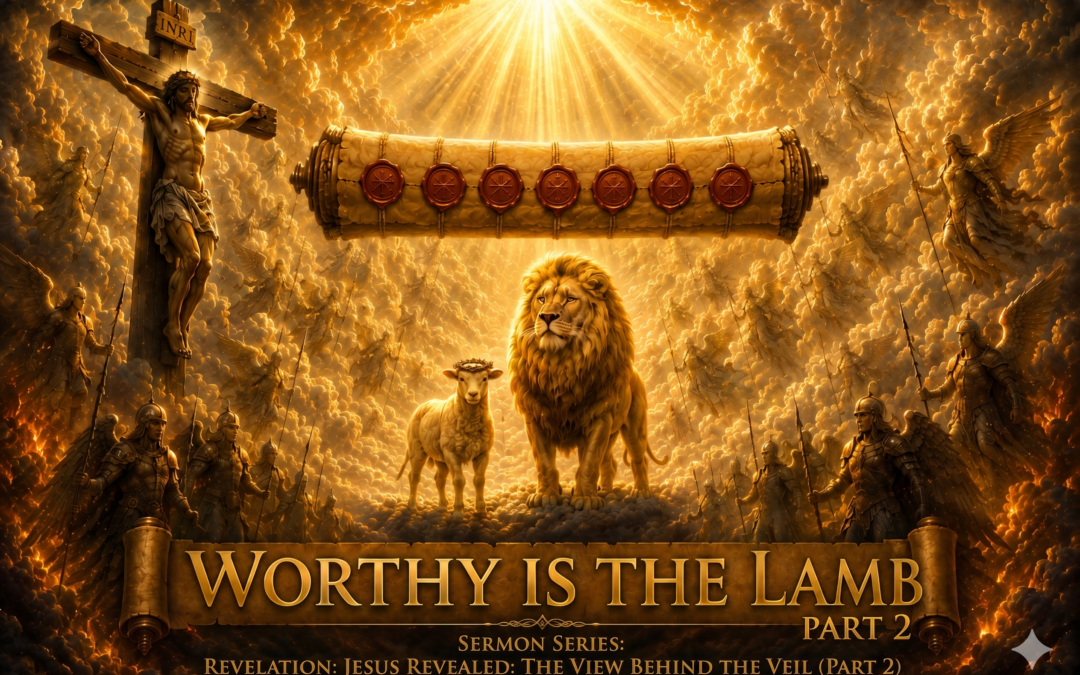
Join us as we continue our verse-by-verse study of the Book of Revelation. In this message, we dive deep into Revelation 5:7-14, witnessing the breathtaking scene in the heavenly throne room where the Lamb of God approaches the throne to take the scroll. Discover why Jesus Christ alone is uniquely qualified and completely worthy to unlock history and receive all our praise.
Audio Only
Video
Sermon Notes:
Revelation 5:7 Then He came and took the scroll out of the right hand of Him who
sat on the throne.
Revelation 5:8 Now when He had taken the scroll, the four living creatures and
the twenty-four elders fell down before the Lamb, each having a harp, and golden
bowls full of incense, which are the prayers of the saints.
Revelation 5:9 And they sang a new song, saying: “You are worthy to take the scroll,
and to open its seals; For You were slain, and have redeemed us to God by Your
blood out of every tribe and tongue and people and nation,
Revelation 5:10 And have made us kings and priests to our God; And we shall reign
on the earth.”
Revelation 5:11 Then I looked, and I heard the voice of many angels around the
throne, the living creatures, and the elders; and the number of them was ten
thousand times ten thousand, and thousands of thousands,
Revelation 5:12 saying with a loud voice: “Worthy is the Lamb who was slain to
receive power and riches and wisdom, and strength and honor and glory and blessing!”
Revelation 5:13 And every creature which is in heaven and on the earth and under
the earth and such as are in the sea, and all that are in them, I heard saying:
Blessing and honor and glory and power be to Him who sits on the throne, and to
the Lamb, forever and ever!”
Revelation 5:14 Then the four living creatures said, “Amen!” And the twenty-four
elders fell down and worshiped Him who lives forever and ever.
Dr. Donald Grey Barnhouse, writing on Revelation, said this:
“There are four things out of place in the universe. The church is out of place; she
ought to be in heaven. Israel is out of place; she should be in the land that has been
sworn to her, and possess every part of it. The devil is out of place; he ought to be
in the lake of fire, but he’s still roaming free. And Christ is out of place; He should
be through with intercession and seated on His throne, reigning, instead of upon
His Father’s throne interceding.”
I. THE SPECIAL SEARCH FOR THE WORTHY ONE.
II. THE SPECIFIC SELECTION OF THE WORTHY ONE.
III. THE SLAIN SACRIFICE KNOWN AS THE WORTHY ONE.
IV. THE SPONTANEOUS SERVICE TO THE WORTHY ONE.
Revelation 5:7 Then He came and took the scroll out of the right hand of Him who
sat on the throne.
Revelation 5:8 Now when He had taken the scroll, the four living creatures and
the twenty-four elders fell down before the Lamb, each having a harp, and golden
bowls full of incense, which are the prayers of the saints.
Psalm 33:2 Praise the Lord with the harp; Make melody to Him with an instrument
of ten strings.
Psalm 144:9 I will sing a new song to You, O God; On a harp of ten strings I will sing
praises to You,
Revelation 5:8 “… the twenty-four elders fell down before the Lamb, each having
a harp, and golden bowls full of incense, which are the prayers of the saints.
Luke 1:9 according to the custom of the priesthood, his lot fell to burn incense
when he went into the temple of the Lord.
Luke 1:10 And the whole multitude of the people was praying outside at the hour
of incense.
In the Old Testament, God had a temple for His people.
In the New Testament God has a people for His temple
1 Corinthians 6:19 Or do you not know that your body is the temple of the Holy Spirit
who is in you, whom you have from God, and you are not your own?
1 Thessalonains 5:17 Pray without ceasing,
V. THE SAINTS SONG FOR THE WORTHY ONE.
Revelation 5:9 And they sang a new song, saying: “You are worthy to take the scroll,
and to open its seals; For You were slain, and have redeemed us to God by Your
blood out of every tribe and tongue and people and nation,
Psalm 33:3 Sing to Him a new song; Play skillfully with a shout of joy
Psalm 40:3 He has put a new song in my mouth–Praise to our God
Isaiah 42:10 Sing to the Lord a new song, and His praise from the ends of the earth,
Colossians 3:16 Let the word of Christ dwell in you richly in all wisdom, teaching and
admonishing one another in psalms and hymns and spiritual songs, singing with
grace in your hearts to the Lord.
Revelation 4:8 “…they do not rest day or night, saying: “Holy, holy, holy, Lord God
Almighty Who was and is and is to come!”
Psalm 98:4 Shout joyfully to the Lord, all the earth; Break forth in song, rejoice and
sing praises
Psalm 47:1 Oh, clap your hands, all you peoples! Shout to God with the voice of triumph!
1. IT IS A WORSHIP SONG
Revelation 5:9 And they sang a new song, saying: “You are worthy …”
Plato said, “Every heart sings a song incomplete until another heart whispers back.”
Is he worthy? Is he worthy? Of all blessing and honor and glory.
Is he worthy of this? HE IS!
Revelation 5:12 …”Worthy is the Lamb who was slain to receive power and riches
and wisdom, and strength and honor and glory and blessing!”
Who is worthy to open the scroll of history and eternity? In this message, we dive into Revelation 5 to witness the “Special Search” for the one worthy to loose the seven seals. While John wept when no one was found in heaven or earth, his tears were turned to joy at the revelation of the Lion of the tribe of Judah—the Root of David who has prevailed.
Audio
Video
Notes
Revelation 5:1 And I saw in the right hand of Him who sat on the throne a scroll
written inside and on the back, sealed with seven seals.
Revelation 5:2 Then I saw a strong angel proclaiming with a loud voice, “Who is worthy
to open the scroll and to loose its seals?”
Revelation 5:3 And no one in heaven or on the earth or under the earth was able
to open the scroll, or to look at it.
Revelation 5:4 So I wept much, because no one was found worthy to open and
read the scroll, or to look at it.
Revelation 5:5 But one of the elders said to me, “Do not weep. Behold, the Lion
of the tribe of Judah, the Root of David, has prevailed to open the scroll and to
loose its seven seals.”
Revelation 5:6 And I looked, and behold, in the midst of the throne and of the
four living creatures, and in the midst of the elders, stood a Lamb as though
it had been slain, having seven horns and seven eyes, which are the seven Spirits
of God sent out into all the earth.
Hebrews 13:8 Jesus Christ is the same yesterday, today, and forever.
So worship in eternity in heaven is the same yesterday, today and forever.”
Revelation 5:1 And I saw in the right hand of Him who sat on the throne a scroll
written inside and on the back, sealed with seven seals.
Those great theologians the Eagles in their song “The Last Resort” sang:
And you can see them there on Sunday morning
Stand up and sing about what it’s like up there
They call it paradise, I don’t know why
You call someplace paradise, kiss it goodbye
1. THE SPECIAL SEARCH FOR THE WORTHY ONE.
Revelation 5:2 Then I saw a strong angel proclaiming with a loud voice, “Who is worthy
to open the scroll and to loose its seals?”
Revelation 5:3 And no one in heaven or on the earth or under the earth was able
to open the scroll, or to look at it.
The person doing the saving can’t have the same problem as the one who needs
to be saved.
Revelation 5:4 So I wept much, because no one was found worthy to open and
read the scroll, or to look at it.
W. A. Criswell once wrote: “These tears of John represent the tears of all God’s
people through all the centuries.”
2. THE SPECIFIC SELECTION OF THE WORTHY ONE.
Revelation 5:5 But one of the elders said to me, “Do not weep. Behold, the Lion
of the tribe of Judah, the Root of David, has prevailed to open the scroll and to
loose its seven seals.”
Matthew 1:1 The book of the genealogy of Jesus Christ, the Son of David,…
Jesus not only comes from David, but David comes from Him.
Matthew 22:45 If David then calls Him ‘Lord,’ how is He his Son?
Revelation 22:16 “I, Jesus, have sent My angel to testify to you these things in the
churches. I am the Root and the Offspring of David, the Bright and Morning Star.”
Revelation 5:5 “… the Lion of the tribe of Judah, the Root of David, has prevailed to
open the scroll and to loose its seven seals.”
Revelation 5:5 (NLT) “… Look, the Lion of the tribe of Judah, the heir to David’s throne,
has won the victory. He is worthy to open the scroll and its seven seals.
3. THE SLAIN SACRIFICE KNOWN AS THE WORTHY ONE
Revelation 5:6 And I looked, and behold, in the midst of the throne and of the
four living creatures, and in the midst of the elders, stood a Lamb as though
it had been slain, ,,,
Exodus 12:3 (EASY) Tell all the Israelite people to do this on the tenth day of this
month: Each man must choose a lamb to kill as a sacrifice for his family.
That will be one lamb for each home.
1 Corinthians 5:7 “… For indeed Christ, our Passover, was sacrificed for us.
The bridge of the song “Here I Am to Worship,” written by Tim Hughes
“I’ll never know how much it cost to see my sin upon that cross”
Revelation 5:6 And I looked, and behold, in the midst of the throne and of the
four living creatures, and in the midst of the elders, stood a Lamb as though
it had been slain, having seven horns and seven eyes, which are the seven
Spirits of God sent out into all the earth.
Revelation 5:12 …”Worthy is the Lamb who was slain to receive power and riches
and wisdom, and strength and honor and glory and blessing!”
Songwriter: Eugene Monroe Bartlett Sr. | Written: 1939 | Genre: Southern Gospel / Worship Hymn | Hall of Fame: Gospel Music Hall of Fame, 1973
The Origin Story: Written from a Sickbed, Destined for Eternity
Some of the most triumphant songs in Christian history were written in the darkest of circumstances. Victory in Jesus is perhaps the defining example. Written by Eugene Monroe Bartlett Sr. in 1939, this beloved hymn emerged not from a season of health and abundance but from a sickbed—after a devastating stroke robbed one of gospel music’s most energetic pioneers of his ability to travel, teach, and perform.
For nearly four decades, Bartlett had criss-crossed the American South, founding singing schools, building a gospel music publishing empire, and composing hundreds of songs. Then, at 53 or 54 years old, a stroke paralyzed him and left him bedridden for the final two years of his life. The man who had built the Hartford Music Company, trained generations of musicians, and composed over 800 gospel songs could no longer do any of it. Yet instead of bitterness, Bartlett turned to his Bible. And from that daily reading and meditation on Scripture—particularly 1 Corinthians 15:57—emerged what would become one of the most sung hymns in Christian worship history.
The song first appeared in 1939 in Gospel Choruses, a paperback songbook published by James D. Vaughan in Lawrenceburg, Tennessee—the same Vaughan Music Company that had been central to the rise of Southern Gospel quartet singing for decades. Bartlett passed away on January 25, 1941, just two years after writing it. He never lived to see it become an anthem of the global church.
Songwriter Biography: Eugene Monroe Bartlett Sr. (1883–1941)
Early Life and Musical Education
Eugene Monroe Bartlett Sr. was born on Christmas Eve, 1883 (some sources record 1885), in Waynesville, Missouri. His family relocated to Sebastian County, Arkansas, while he was still a boy, and it was in the Ozarks and Arkansas River Valley that he came of age musically. He received formal music training and graduated from the Hall-Moody Institute in Martin, Tennessee—an institution known for producing gospel music educators and practitioners throughout the South.
Bartlett was a gifted multi-instrumentalist, singer, and song leader with a natural aptitude for teaching others to read shaped-note music. He quickly became one of the most sought-after instructors in the American South, traveling extensively to hold singing schools and conventions where he trained hundreds of amateur musicians in the fundamentals of harmony and sight reading.
Hartford Music Company and Institute
In 1918, Bartlett founded the Hartford Music Company in Hartford, Arkansas—one of the earliest and most influential Southern Gospel publishing houses in American music history. The company published hymnals, songbooks, and gospel song collections, selling more than 15,000 copies of its titles in its early years. The Hartford company became a launching pad for numerous Southern Gospel composers and helped define the sound and style of quartet gospel music in the early twentieth century.
In 1921, Bartlett expanded his vision by founding the Hartford Music Institute, a school dedicated to shape-note singing that provided formal musical education and created career pathways for aspiring gospel musicians across the region. Bartlett served as president of the Hartford Music Company from its founding until 1935, overseeing its growth into a multi-state operation with branch offices in several cities. Among his notable publishing achievements was the introduction of McClung’s “Just a Rose Will Do”—a beloved gospel standard in its own right.
Prolific Composer and Unlikely Legacy
In his lifetime, Bartlett composed over 800 gospel songs—an extraordinary output. His catalog included beloved titles such as Everybody Will Be Happy Over There, Just a Little While, He Will Remember Me, You Can’t Keep a Good Man Down, and Camping Toward Canaan’s Land. He also composed the country music song Take an Old Cold Tater (and Wait), later recorded by Little Jimmy Dickens. Yet ironically, nearly all of his 800+ compositions have faded into obscurity, while Victory in Jesus—his very last song—has outlived them all. In 1973, Bartlett was posthumously inducted into the Gospel Music Hall of Fame in Nashville, Tennessee, a recognition of his transformative role in the genre’s formation.
Scripture Foundation: The Theology of Victory
Victory in Jesus is not merely an emotional celebration—it is a theologically precise hymn built on specific biblical foundations. Every verse traces a different dimension of salvation, and each is anchored in the New Testament’s proclamation of Christ’s redemptive work.
Key Scriptures
1 Corinthians 15:57 — “But thanks be to God, who gives us the victory through our Lord Jesus Christ.” This is the primary theme verse of the entire hymn. The “victory” belongs to God and is given through Christ—not earned by human effort. This distinction is central to the song’s message.
1 Peter 1:18–19 — “Knowing that you were not redeemed with corruptible things… but with the precious blood of Christ.” The chorus line “He sought me and bought me with His redeeming blood” draws directly from this passage of Christ as Redeemer who purchases sinners at great personal cost.
John 3:16 — “For God so loved the world that He gave His only begotten Son…” The chorus phrase “He loved me ere I knew Him” echoes the prevenient grace of John 3:16—God’s love preceding any human response.
Matthew 9:35; John 9:6–7 — Verse 2 references Christ making “the lame to walk again and caused the blind to see,” drawing directly from the healing miracles of the Gospels as evidence of Christ’s divine authority and compassion.
John 14:2–3 — “In My Father’s house are many mansions… I go to prepare a place for you.” Verse 3’s “I heard about a mansion He has built for me in glory” is a direct echo of Christ’s promise in the Upper Room Discourse.
Revelation 21:21; 22:1–5 — “Streets of gold beyond the crystal sea” draws from Revelation’s vision of the New Jerusalem and the river of life flowing from the throne of God.
Ephesians 2:4–5; Titus 3:5 — The phrase “beneath the cleansing flood” draws on the New Testament’s language of regeneration and the washing of the Holy Spirit—salvation as a cleansing act of divine grace.
The theological arc of the song is classically evangelical and Wesleyan-Arminian in tone: God initiates, Christ redeems, the Spirit cleanses, and the believer responds. The victory is entirely Christ’s, bestowed freely on the sinner who repents and trusts—a message perfectly suited to Bartlett’s own experience of helplessness on his sickbed.
Verse-by-Verse Lyrical Analysis
Verse 1: “I Heard an Old, Old Story”
I heard an old, old story, how a Savior came from glory, / How He gave His life on Calvary to save a wretch like me; / I heard about His groaning, of His precious blood’s atoning, / Then I repented of my sins and won the victory.
Verse 1 is a personal salvation testimony compressed into four lines. It begins with hearing—”I heard an old, old story”—which captures the biblical truth that “faith comes by hearing” (Romans 10:17). The “old, old story” refers to the gospel itself, echoing the beloved hymn Tell Me the Old, Old Story by A. Catherine Hankey (1866), intentionally invoking a sense of continuity with generations of Christian witness. “How a Savior came from glory” neatly captures the Incarnation (Philippians 2:7), and “gave His life on Calvary to save a wretch like me” echoes John Newton’s Amazing Grace in its unflinching self-description. The phrase “precious blood’s atoning” anchors the atonement in the substitutionary sacrifice of Christ—His blood as the price of redemption. “I repented of my sins and won the victory” completes the conversion narrative: hearing, conviction, repentance, and the resulting victory. This verse, in eight lines, tells the whole story of salvation.
Verse 2: “I Heard About His Healing”
I heard about His healing, of His cleansing pow’r revealing, / How He made the lame to walk again and caused the blind to see; / And then I cried, “Dear Jesus, come and heal my broken spirit,” / And somehow Jesus came and bro’t to me the victory.
Verse 2 moves from the historical gospel to its personal application. Having heard about Christ’s miraculous healing ministry—specifically the lame walking and the blind seeing (Matthew 11:5; John 9:25)—the songwriter now makes his own cry: “Come and heal my broken spirit.” This is the pivotal moment of personal application: the miracles of the Gospels are not merely historical curiosities but precedents for present-day transformation. The phrase “somehow Jesus came” is a remarkable admission of mystery—Bartlett does not claim to fully understand the mechanism of conversion; he simply testifies that Christ came. There is pastoral wisdom in this humility. The word “somehow” has resonated with millions of believers who experienced genuine spiritual transformation without being able to fully articulate its mechanics. This verse is especially poignant given Bartlett’s circumstances: a man whose body had failed him, now crying out for healing of spirit rather than flesh.
Verse 3: “I Heard About a Mansion”
I heard about a mansion He has built for me in glory, / And I heard about the streets of gold beyond the crystal sea; / About the angels singing, and the old redemption story, / And some sweet day I’ll sing up there the song of victory.
Verse 3 completes the salvation journey by turning the believer’s gaze heavenward. The “mansion in glory” draws from John 14:2–3 (Christ’s promise to prepare a place), while “streets of gold beyond the crystal sea” are taken directly from Revelation 21:21 and 22:1. The phrase “angels singing” evokes both the nativity chorus of Luke 2 and the heavenly worship of Revelation 5. “The old redemption story” functions as a bookend with verse 1’s “old, old story”—the same gospel that is heard on earth will be sung in heaven. The final line—”some sweet day I’ll sing up there the song of victory”—transforms the hymn from testimony to anticipation. Bartlett, confined to his bed and approaching death, was looking forward to the day he would join that choir. The present-tense victory of salvation becomes an eternal song.
The Chorus: “O Victory in Jesus”
O victory in Jesus, my Savior, forever. / He sought me and bought me with His redeeming blood; / He loved me ere I knew Him, and all my love is due Him, / He plunged me to victory, beneath the cleansing flood.
The chorus is a masterpiece of evangelical theology in hymn form. “He sought me and bought me” captures the dual movement of prevenient grace (the seeking) and substitutionary atonement (the buying)—drawing from Luke 15’s parables of the lost sheep and lost coin, and from 1 Peter 1:18–19. “He loved me ere I knew Him” is one of the most theologically profound lines in all of gospel hymnody: it directly addresses the primacy of God’s love before any human response—a key Wesleyan emphasis rooted in John 3:16 and 1 John 4:19 (“We love Him because He first loved us”). “All my love is due Him” follows logically: because love is first received, it is then owed in return. “He plunged me to victory, beneath the cleansing flood” may allude to both baptism and the Spirit’s sanctifying work—the “cleansing flood” echoing Ezekiel 36:25 (“I will sprinkle clean water on you”) and Titus 3:5 (“the washing of regeneration”). The chorus is not a vague celebration but a doctrinally precise summary of the gospel: divine initiative, atoning death, prevenient love, and cleansing grace.
Historical Timeline
Year
Event
December 24, 1883
Eugene Monroe Bartlett Sr. born in Waynesville, Missouri (some sources record 1885)
~1900s
Graduates Hall-Moody Institute, Martin, Tennessee; begins career teaching singing schools across the South
1918
Founds Hartford Music Company in Hartford, Arkansas—one of the South’s earliest gospel music publishers
1921
Founds the Hartford Music Institute, a shape-note singing school
1918–1935
Serves as president of Hartford Music Company; grows it to a multi-state operation
1939
Suffers a debilitating stroke; left bedridden and unable to travel or teach
1939
Writes Victory in Jesus while bedridden; first published in Gospel Choruses by James D. Vaughan, Lawrenceburg, Tennessee
January 25, 1941
E.M. Bartlett passes away, age 57 (or 55); never witnesses the hymn’s rise to worldwide fame
1950s–1960s
Song adopted into Baptist, Methodist, and Church of God hymnals across America; becomes a congregational standard
1973
E.M. Bartlett posthumously inducted into the Gospel Music Hall of Fame, Nashville, Tennessee
2014
Michael W. Smith records the hymn on his album Hymns, introducing it to a new CCM audience
2021
Carrie Underwood records Victory in Jesus on her album My Savior (UMG Recordings), reaching millions of new listeners
Present
Widely regarded as one of the most beloved hymns in all of Protestant Christianity; sung in virtually every evangelical denomination worldwide
Notable Recordings and Covers
Year
Artist
Album / Label
Significance
1939
Various Quartet Groups
Gospel Choruses (Vaughan Music)
First publication; adopted by Southern Gospel quartets almost immediately
1950s–1960s
George Beverly Shea
Various RCA/Word Records releases
Shea’s rich baritone carried the hymn to Billy Graham Crusade audiences worldwide
1960s–1970s
Various Baptist Hymnal editions
Lifeway / Baptist Sunday School Board
Inclusion in the Baptist Hymnal cemented its status as a denominational standard
1970s
The Statler Brothers
Various
Country gospel crossover that broadened the song’s reach beyond Southern Gospel
1970s–1980s
The Florida Boys
Various
Long-running Southern Gospel quartet kept the song in regular rotation on TV programs
1980s–1990s
Various Church of God / Pentecostal Quartets
Various
Adopted as a near-universal worship standard in Holiness-Pentecostal traditions
2014
Michael W. Smith
Hymns (Reunion Records)
Major CCM artist re-introduced the hymn to contemporary Christian audiences
2018
The Band Steele
Single release
Contemporary gospel arrangement featuring Bo Steele; official music video went viral
2021
Carrie Underwood
My Savior (UMG Recordings)
Grammy-winning country superstar’s rendition reached mainstream audiences; album debuted at #1 on Billboard Christian Albums chart
2021
Carrie Underwood (Live)
My Savior: Live from the Ryman
Sold-out live recording at the legendary Ryman Auditorium; performance became widely shared online
Ongoing
Dailey & Vincent, Gaither Vocal Band, various bluegrass artists
Various
Continuously recorded in bluegrass, country gospel, and traditional church music settings
Frequently Asked Questions
1. Who wrote “Victory in Jesus” and what inspired it?
Victory in Jesus was written by Eugene Monroe Bartlett Sr. in 1939. It was inspired by his personal study of 1 Corinthians 15:57—”Thanks be to God, who gives us the victory through our Lord Jesus Christ”—during a period when he was bedridden following a debilitating stroke. Unable to travel or teach as he had done for decades, Bartlett channeled his faith and Scripture meditation into what would become his final and most enduring composition. The circumstances of its writing give the hymn an extraordinary authenticity: a man who had lost nearly everything was writing about victory he still believed in with his whole heart.
2. What does the chorus mean by “He sought me and bought me”?
This phrase captures two essential movements of salvation theology. “He sought me” refers to prevenient grace—the theological conviction that God takes the initiative in pursuing sinners before they seek Him (Luke 15:3–7; 1 John 4:19). “He bought me” refers to the atonement—Christ’s death on the cross as the price paid for redemption (1 Corinthians 6:20; 1 Peter 1:18–19). Taken together, the phrase asserts that salvation is entirely God’s doing from beginning to end: He sought the lost sinner first, and then paid the ultimate price to redeem that sinner. The believer contributes nothing to the transaction except the sin that required it.
3. What is “the cleansing flood” in the chorus referring to?
The phrase “He plunged me to victory, beneath the cleansing flood” carries rich multi-layered imagery. It primarily refers to the spiritual cleansing of regeneration—what the Bible describes as being washed clean by the blood of Christ (Revelation 1:5) and by the Holy Spirit (Titus 3:5; Ezekiel 36:25–26). Many also hear an allusion to Christian baptism, which symbolizes dying to sin and rising to new life (Romans 6:3–4). In the Holiness-Wesleyan tradition that shaped much of Southern Gospel, “the cleansing flood” additionally evokes the sanctifying work of the Holy Spirit—being plunged into a deeper experience of grace that cleanses not just the guilt of sin but its power. The word “plunged” is vivid and deliberate: it speaks of total immersion, not a superficial sprinkling, in the victory Christ provides.
4. Why is “Victory in Jesus” sometimes called the “Baptist theme song”?
The affectionate nickname “Baptist theme song” emerged from the hymn’s near-universal adoption in Baptist churches across America from the 1950s onward, when it was included in successive editions of the Baptist Hymnal published by the Southern Baptist Convention’s Sunday School Board (now Lifeway). Generations of Baptist churchgoers grew up singing it at revivals, Vacation Bible Schools, Sunday services, and altar calls. Its straightforward evangelical theology—emphasizing personal salvation through Christ’s atoning blood, the priority of grace, and the hope of heaven—aligns perfectly with Baptist doctrinal distinctives. However, the song is by no means exclusively Baptist; it is sung with equal enthusiasm in Methodist, Church of God, Assembly of God, non-denominational, and countless other Protestant traditions worldwide.
5. How can “Victory in Jesus” be effectively used in worship today?
Victory in Jesus is one of the most versatile hymns in the evangelical repertoire. In a traditional worship context, its upbeat, march-like rhythm makes it an energetic congregational opener or a powerful closing hymn. In a contemporary setting, it has been adapted with electric guitar, drums, and keys while retaining the original melody and lyrics—The Band Steele’s 2018 arrangement is an excellent modern template. It works exceptionally well as an altar-call invitation hymn, since each verse traces the full arc of conversion and the chorus reinforces the assurance of salvation. For sermon series, it pairs naturally with messages on 1 Corinthians 15 (resurrection and victory), Romans 8 (no condemnation), or John 14 (heaven and the Father’s house). For pastoral care contexts—hospital visits, funerals, or grief support—verse 3 in particular (“some sweet day I’ll sing up there the song of victory”) provides profound comfort. In all settings, the hymn’s core message remains inexhaustible: the victory belongs to Christ, and He freely gives it to those who trust in Him.
Have a worship song you’d like to see featured? Leave a comment below or contact us at vbccarthage.org. This post is part of our ongoing Worship Song Deep Dive series.
Next to John 3:16, Revelation 3:20 is perhaps the most famous evangelistic passage in the New Testament. It has been described as the simplest explanation of the plan of salvation in the Word of God. In this sermon, we explore the profound invitation of Jesus Christ to every individual.
Revelation 1:4 John, to the seven churches which are in Asia: Grace to you and peace
from Him who is and who was and who is to come, and from the seven Spirits who
are before His throne,
Revelation 1:5 and from Jesus Christ, the faithful witness, the firstborn from the dead
and the ruler over the kings of the earth. To Him who loved us and washed us from
our sins in His own blood,
Revelation 1:10 I was in the Spirit on the Lord’s Day …
Revelation 1:18 I am He who lives, and was dead, and behold, I am alive forevermore.
Amen. And I have the keys of Hades and of Death.
Revelation 2:8 “And to the angel of the church in Smyrna write, ‘These things says
the First and the Last, who was dead, and came to life:
Revelation 3:20 Behold, I stand at the door and knock. If anyone hears My voice
and opens the door, I will come in to him and dine with him, and he with Me.
Revelation 3:21 To him who overcomes I will grant to sit with Me on My throne,
as I also overcame and sat down with My Father on His throne.
Revelation 3:22 “He who has an ear, let him hear what the Spirit says to the churches.”
Next to John 3:16, — Revelation 3:20 is perhaps the most famous evangelistic
passage of Scripture in the New Testament
This verse of Scripture has been described as “the simplest explanation of the plan
of salvation contained within the Word of God.”
1. WHOSE STANDING AT THE DOOR?
Revelation 3:20 Behold, I stand at the door …
Revelation 3:21 To him who overcomes I will grant to sit with Me on My throne,
as I also overcame and sat down with My Father on His throne.
2. WHAT DOES THE DOOR REPRESENT?
Revelation 3:20 Behold, I stand at the door and knock ….
Proverbs 4:23 Keep your heart with all diligence, for out of it spring the issues of life.
Proverbs 4:23 (CJB) Above everything else, guard your heart; for it is the source of
life’s consequences.
Proverbs 4:23 (GNT) Be careful how you think; your life is shaped by your thoughts.
There is an old hymn that includes these lines:
Somebody’s knocking at your door
Sounds like Jesus
Oh sinner why don’t you answer
Somebody’s knocking at your door.”
John 1:12 But as many as received Him, to them He gave the right to become
children of God, to those who believe in His name:
3. WHO CAN LET HIM COME IN?
Revelation 3:20 “… If anyone … ”
Unbelief is never neutral
Matthew 12:30 “He who is not with Me is against Me …”
Matthew 13:58 Now He did not do many mighty works there because of their unbelief.
Mark 6:5 Now He could do no mighty work there, except that He laid His hands on a
few sick people and healed them.
Mark 6:6 And He marveled because of their unbelief. Then He went about the villages
in a circuit, teaching.
Mark 8:18 Having eyes, do you not see? And having ears, do you not hear? And do
you not remember?
Someone said, “We repeated the words without thinking about what they meant.”
4. HOW DOES HE SEEK ENTRANCE INTO OUR DOOR?
Revelation 2:20 “… If anyone hears My voice and opens the door…”
Romans 10:17 So then faith comes by hearing, and hearing by the word of God.
Rita Coolidge said, “Too often the opportunity knocks, but by the time you disengage
the chain, push back the bolt, unhooked the two locks and shut off the burglar
alarms, it is too late.”
5. WHAT WILL HAPPEN IF I OPEN THE DOOR?
Revelation 3:20 “… I will come in to him,…”
The Christian life is defined as, “I in Christ and Christ in me.”
Galatians 2:20 I am crucified with Christ: nevertheless I live; yet not I, but Christ
but Christ liveth in me: and the life which I now live in the flesh I live
by the faith of the Son of God, who loved me, and gave himself for me.
Revelation 2:20 “… I will come in to him and dine with him, and he with Me.”
With the Lord’s supper we dine with Him in remembrance of His sacrifice for us.
6. WILL WE HAVE TO OVERCOME OPPOSITION?
Revelation 3:21 To him who overcomes I will grant to sit with Me on My throne,
as I also overcame and sat down with My Father on His throne.
7. WHY DON’T YOU LET HIM COME IN?
Revelation 3:22 “He who has an ear, let him hear what the Spirit says to the
churches.'”
The “Hymn” “The Savior is Waiting” includes these lines:
The Savior is waiting to enter your heart
Why don’t you let Him come in
There’s nothing in this world to keep you apart
What is your answer to Him
Time after time He has waited before
And now He is waiting again
To see if you’re willing to open the door
Oh how He wants to come in
John 10:9 I am the door: by me if any man enter in, he shall be saved, …