On a bright Sunday morning here in Carthage, Missouri, the sanctuary at Victory Baptist Church fills with the warm sounds of familiar praise. As the pianist begins the introduction, voices across the pews lift in unison: “Come, Thou Fount of every blessing, tune my heart to sing Thy grace.” Whether you have worshipped with us for decades at our location on County Lane 117 or are visiting from elsewhere in Jasper County, this hymn touches something deep in the soul. It speaks of mercy that never runs dry and a Savior who pursues even the wandering heart.
But behind these beloved words lies a remarkable story—one of youthful rebellion, dramatic conversion, profound theological insight, and a lifelong struggle with the very human tendency to wander from the God we love. Today we explore the story of “Come Thou Fount of Every Blessing,” written by Robert Robinson in 1758, and why its message continues to minister so powerfully to believers in Southwest Missouri churches and around the world.
A Restless Heart in 18th-Century England
Robert Robinson was born on September 27, 1735, in the small town of Swaffham, Norfolk, England. Tragedy struck early when his father died while Robert was still a boy. His mother, determined to give him a trade, apprenticed the fourteen-year-old to a barber in the bustling city of London. What she hoped would provide structure instead exposed him to the rough streets and wild company of the capital.
Robinson quickly became the leader of a gang of troublemakers. Drinking, pranks, and mockery of religion filled his days. One afternoon, he and his friends visited a gypsy fortune-teller, partly for amusement and partly to harass her. The woman studied the young man’s face and declared that he would one day live to see his children and his grandchildren. The prophecy unsettled him more than he would admit. For the first time, perhaps, he began to wonder what his future might hold if he continued down his reckless path.
Young Robert Robinson, whose wild youth in England would lead to one of the church’s most cherished hymns.
Convicted by the Preaching of George Whitefield
At seventeen, Robinson’s life took an unexpected turn. He and his companions decided to attend an open-air meeting led by the fiery evangelist George Whitefield—not to seek God, but to mock and disrupt the “poor deluded Methodists.” Whitefield, one of the greatest preachers of the Great Awakening, stood and proclaimed the words of Matthew 3:7 with piercing power: “O generation of vipers, who hath warned you to flee from the wrath to come?”
The message struck Robert Robinson like a thunderbolt. Though he tried to shake it off, the conviction would not leave. For nearly three years he wrestled with his sin and the claims of Christ. On December 10, 1755, at the age of twenty, he finally surrendered. Robinson later described the moment he found “full and free forgiveness through the precious blood of Jesus Christ.” His wild heart was captured by grace.
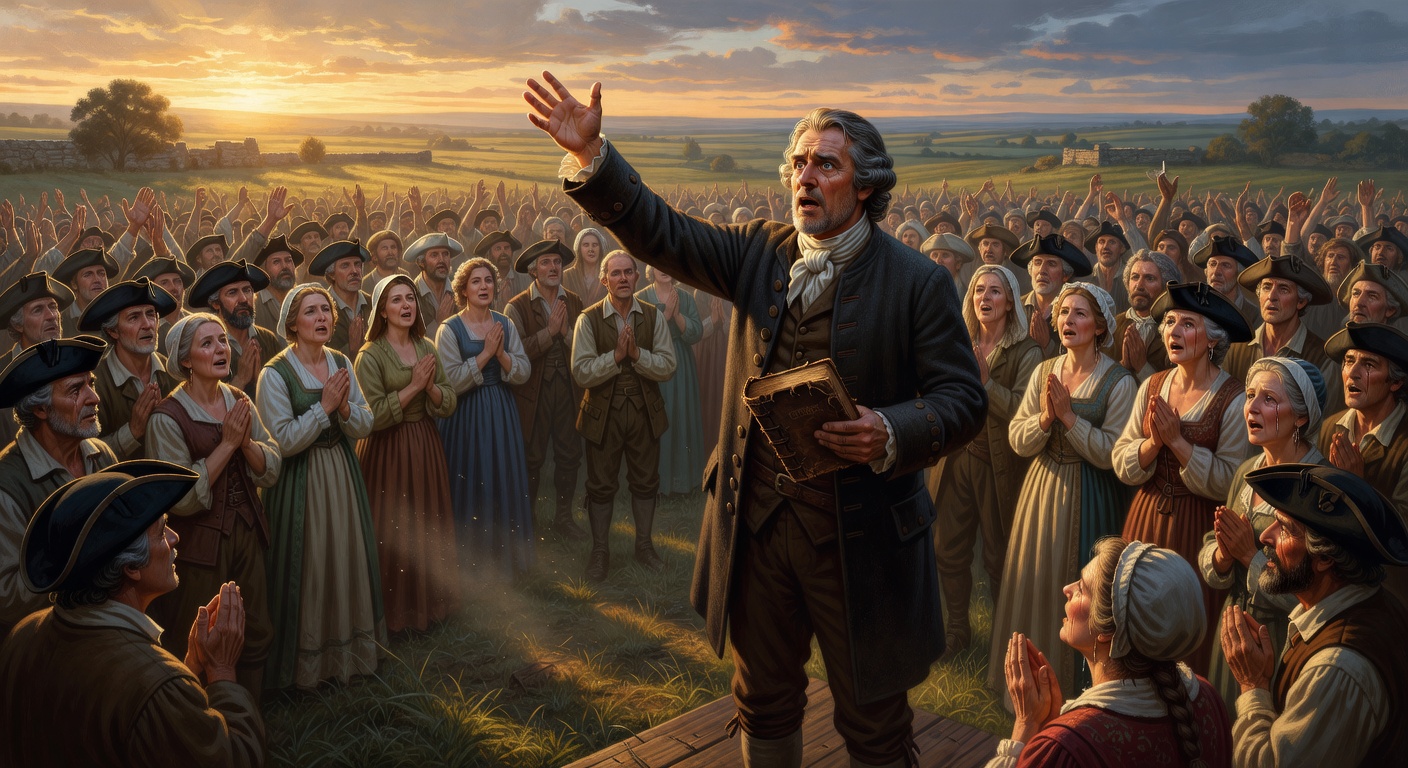
George Whitefield’s powerful open-air preaching that pierced the heart of young Robert Robinson and changed his life forever.
Robinson soon began preaching himself. After a season with the Methodists, he embraced Baptist convictions and pastored for many years at the St. Andrew’s Street Baptist Church in Cambridge. He became a respected scholar, writing a significant history of the Baptists. Yet the hymn he wrote in his early twenties would outlive all his other works and touch millions of hearts.
The Hymn Is Born: A Testimony of Redeeming Love
In 1758, at just twenty-two years old, Robert Robinson wrote “Come, Thou Fount of Every Blessing.” Some accounts suggest he composed it to accompany a sermon on Pentecost Sunday, the third anniversary of his conversion. First published the following year, the hymn is both a personal spiritual autobiography and a profound theological reflection on the nature of grace.
Its three stanzas move from praise of God’s abundant blessings, to remembrance of Christ’s saving work, to a heartfelt plea for grace to keep the wandering heart fixed upon the Lord. Every line is rich with Scripture and personal experience.
The Full Lyrics
Come, Thou Fount of every blessing, Tune my heart to sing Thy grace; Streams of mercy, never ceasing, Call for songs of loudest praise. Teach me some melodious sonnet, Sung by flaming tongues above; Praise the mount! I’m fixed upon it, Mount of Thy redeeming love.
Here I raise my Ebenezer; Hither by Thy help I’m come; And I hope, by Thy good pleasure, Safely to arrive at home. Jesus sought me when a stranger, Wand’ring from the fold of God; He, to rescue me from danger, Interposed His precious blood.
O to grace how great a debtor Daily I’m constrained to be! Let that grace now, like a fetter, Bind my wand’ring heart to Thee. Prone to wander, Lord, I feel it, Prone to leave the God I love; Here’s my heart, O take and seal it, Seal it for Thy courts above.
Streams of Mercy Never Ceasing: Verse-by-Verse Reflection
The opening lines establish the central theme: God Himself is the “Fount of every blessing.” All good gifts flow from Him alone. Robinson prays, “Tune my heart to sing Thy grace,” acknowledging that even the desire to praise must come from the Lord. The image of “streams of mercy, never ceasing” draws on the language of Scripture—think of the river of life in Revelation or the constant provision of manna in the wilderness. Mercy does not trickle; it flows in a mighty, unending stream.
Streams of mercy, never ceasing — the beautiful river scene that captures the endless grace celebrated in the hymn.
“Praise the mount! I’m fixed upon it, Mount of Thy redeeming love” points us to Calvary. The cross is the mountain upon which our hope is fixed. There, at the place of redeeming love, the fount was opened wide.
Here I Raise My Ebenezer
The second stanza contains one of the most distinctive phrases in all hymnody: “Here I raise my Ebenezer.” The word comes directly from 1 Samuel 7:12. After the Israelites repented and cried out to the Lord, Samuel prayed and God delivered them from the Philistines with thunder from heaven. In gratitude, Samuel set up a large stone and named it Ebenezer—“stone of help”—declaring, “Hitherto hath the Lord helped us.”
Robinson takes this Old Testament memorial and makes it personal. “Hither by Thy help I’m come.” Up to this point in my life, every step has been sustained by divine help. The line is both a testimony and a prayer of hope: “And I hope, by Thy good pleasure, safely to arrive at home.”
Here I raise my Ebenezer: a powerful symbol of God’s faithfulness — “Hither by Thy help I’m come.”
The stanza then turns to the gospel itself: “Jesus sought me when a stranger, Wand’ring from the fold of God; He, to rescue me from danger, Interposed His precious blood.” What a beautiful description of substitutionary atonement! Christ stood between the sinner and the wrath we deserved. He interposed—placed Himself in the gap—through the shedding of His own blood. This is the heart of Baptist preaching and the message we proclaim every week at Victory Baptist Church in Carthage, Missouri.
Prone to Wander, Lord, I Feel It
The final stanza is perhaps the most honest and beloved. “O to grace how great a debtor daily I’m constrained to be!” Grace creates a beautiful debt we can never repay, yet we are joyfully bound to the One who gave it. Robinson pleads, “Let that grace now, like a fetter, bind my wand’ring heart to Thee.” A fetter is a chain or shackle—here used positively. We want to be bound to Christ so tightly that we cannot stray far.
“Prone to wander, Lord, I feel it, prone to leave the God I love” is a confession every honest believer recognizes. Our hearts are deceitful and desperately wicked (Jeremiah 17:9). Even after conversion, the old nature pulls us away. The only hope is the sealing work of the Holy Spirit: “Here’s my heart, O take and seal it, seal it for Thy courts above.” This echoes Ephesians 1:13-14, where believers are sealed with the promised Holy Spirit as a guarantee of our inheritance.
The Stagecoach Encounter: When the Hymn Writer Heard His Own Song
Like many of us, Robert Robinson did not live in unbroken victory. Later in life he experienced seasons of spiritual coldness and doubt. Some accounts suggest he moved in circles that pulled him toward unorthodox views, though he continued to affirm core truths about Christ. The very words he had written as a young man—“prone to wander”—proved painfully true in his own experience.
One of the most moving (and often retold) stories associated with the hymn occurred during a stagecoach journey. A young woman passenger began softly singing or reading the words of “Come Thou Fount of Every Blessing.” She turned to the distinguished gentleman beside her and asked his opinion of the beautiful hymn.
With tears streaming down his face, Robinson replied, “Madam, I am the poor unhappy man who wrote that hymn many years ago, and I would give a thousand worlds, if I had them, to enjoy the feelings I had then.”
The legendary stagecoach moment: the hymn writer hears his own song and is moved to reflect on God’s pursuing grace.
The young woman is said to have responded with gentle encouragement, reminding him that the streams of mercy were still flowing and that it was not too late to return fully to the Lord. Whether every detail of the anecdote is historically verified or has grown in the telling, it perfectly embodies the message of the hymn itself. Even the author of these words needed the very grace he celebrated. God’s pursuing love does not give up on His children.
A Hymn That Still Sings in Carthage, Missouri
More than 265 years after it was written, “Come Thou Fount of Every Blessing” remains one of the most sung hymns in evangelical and Baptist churches across America—including right here in Southwest Missouri. At Victory Baptist Church in Carthage, we return to it often because it tells the whole gospel story with honesty and beauty.
In Jasper County, where life can be busy with work, family, school activities, and the ordinary pressures of living, the hymn’s confession rings true. We know what it is to feel “prone to wander.” We also know the joy of raising our own Ebenezers—looking back over answered prayers, preserved marriages, children brought to faith, and the faithful ministry of our local church.
The hymn’s popularity in our region is no accident. Its robust theology of grace aligns perfectly with the verse-by-verse, expository preaching we value. It reminds us that salvation is all of grace from beginning to end. Jesus sought us when we were strangers. He interposed His precious blood. And now the Holy Spirit seals us and keeps us.
Lessons for Believers in Jasper County and Beyond
What can we take away from Robert Robinson’s story and the hymn he gave the church?
God is the source. Every blessing—physical, spiritual, eternal—flows from the fount of His goodness. We contribute nothing but our need.
Our hearts are prone to wander. The most mature saint still feels the pull. We must daily cry out for grace to bind us to Christ.
Raise your Ebenezer. Keep memorials of God’s faithfulness. Write them down. Share them with your family. At Victory Baptist Carthage we often testify of God’s “hitherto” help in prayer meetings and around the table.
Christ interposed for you. The rescue came at infinite cost. Never grow casual about the precious blood.
The seal is sure. The Holy Spirit guarantees our arrival home. What a comfort when the road is long!
Whether you are a teenager navigating peer pressure in Carthage schools, a parent praying for a prodigal, a senior saint reflecting on decades of God’s care, or someone far from the Lord reading this on a screen in Jasper County—this hymn is for you.
Will You Raise Your Ebenezer Today?
The story of “Come Thou Fount of Every Blessing” is ultimately not about Robert Robinson. It is about the God who pursues rebels, opens fountains of mercy, interposes His own Son, and seals wandering hearts for glory. It is about the grace that is greater than all our sin and stronger than all our wanderings.
Here in Carthage, Missouri, at Victory Baptist Church, we want every person in our community to know this grace. If you do not yet know the Savior who sought you when you were a stranger, we invite you to come to the fount today. The streams are still flowing.
And for those of us who have tasted that grace, may we sing with renewed passion:
“Here’s my heart, O take and seal it, Seal it for Thy courts above.”
Will you join us this Lord’s Day? Whether you have attended for years or have never stepped inside our doors on County Lane 117, you are welcome. Come and lift your voice with brothers and sisters who, like Robert Robinson, have every reason to praise the Fount of every blessing.
Together, let us raise our Ebenezers and declare to the next generation: Hither by Thy help we’ve come—and by that same grace, we will arrive safely home.
Victory Baptist Church 9871 County Lane 117 Carthage, Missouri 64836 Sunday School 9:30 AM | Morning Worship 10:30 AM | Wednesday 6:30 PM We would love to worship the Lord with you.
Come, Thou Fount of every blessing—tune our hearts afresh to sing Thy grace.
Songwriter: Robert Emmett (R.E.) Winsett | Written: 1942 | Genre: Southern Gospel / Worship Hymn | Award: GMA Dove Award – Song of the Year, 1969
Jesus Is Coming Soon song history: This article traces R.E. Winsett’s 1942 Southern Gospel hymn from its World War II setting to its Scripture-rich message about the Second Coming of Christ, its historic Dove Award recognition, and its lasting place in church worship.
The Origin Story: Born in the Shadow of World War II
There are songs that transcend their moment of writing—songs that feel like they were composed for every generation at once. Jesus Is Coming Soon is one of those songs. Written in 1942 by Robert Emmett Winsett, this timeless Southern Gospel anthem emerged from one of the darkest chapters in modern history.
When Winsett penned the opening line—“Troublesome times are here, filling men’s hearts with fear”—the United States had just been jolted into World War II following the attack on Pearl Harbor in December 1941. The Great Depression had already spent a decade hollowing out American communities. Freedom, as the song declares, was genuinely “at stake.” Winsett wasn’t writing metaphor; he was writing headlines.
In the midst of global upheaval, Winsett turned not to despair but to prophecy—anchoring his words in the New Testament’s great hope of Christ’s return. The song was published in 1942, yet it barely caused a stir at first. Winsett would never see it become the beloved standard it is today. He passed away on June 26, 1952, at age 76, unaware that his modest gospel tune was destined to top the charts, win the gospel world’s highest honor, and be sung in sanctuaries across generations and continents.
Songwriter Biography: Robert Emmett Winsett (1876–1952)
Early Life and Musical Formation
Robert Emmett Winsett was born on January 15, 1876, on a farm in Bledsoe County, Tennessee—a rural stretch of Appalachian foothills near the town of Pikeville. From the very beginning, music was woven into his DNA. By the age of seven, young Robert had already experienced a religious awakening and written his first song—a remarkable gift that hinted at a lifetime of sacred creativity.
Winsett was proficient on nine musical instruments and possessed a rare natural gift for harmony. He formalized his musical education at the Bowman Normal School of Music, graduating in January 1899. The training gave structure to his natural gifts, and within a few years he was ready to share them with the world.
Publisher, Evangelist, and Churchman
Around 1903, Winsett founded the R.E. Winsett Song Book Publishing Company in Dayton, Tennessee—one of the earliest gospel music publishing houses in the American South. His first solo compilation, Union Revival Songs, appeared in 1906. Over the next five decades, Winsett authored and compiled dozens of gospel songbooks, with his final publication—Best of All (1951)—selling over one million copies. Across all his titles, total sales exceeded ten million copies.
But Winsett was more than a publisher. He served as a Church of God preacher, evangelist, and pastor. He was also part of the originating committee of the Assemblies of God—one of the founding voices of the American Pentecostal movement—and played a role in establishing a town in Oklahoma during the land-rush era of American expansion. He was, in the truest sense, a builder: of music, of community, and of faith.
Legacy and Honors
In his lifetime, Winsett composed approximately 1,000 gospel songs—a staggering output by any measure. After his death, the gospel world gradually recognized the magnitude of his contribution. In 1969—seventeen years after he died—his song Jesus Is Coming Soon won the very first GMA Dove Award for Song of the Year, beating out the entire Southern Gospel catalog of the era. In 1973, he was inducted into the Gospel Music Hall of Fame, and in 2002 into the Southern Gospel Music Hall of Fame.
Scripture Foundation: What the Bible Says About Christ’s Return
Jesus Is Coming Soon is not simply a catchy chorus—it is a carefully constructed theological proclamation rooted in the New Testament’s teaching on eschatology (the doctrine of last things). Every verse and the chorus itself draw from specific scriptural threads.
Primary Texts
1 Thessalonians 4:16–17 — “For the Lord Himself will descend from heaven with a shout, with the voice of an archangel, and with the trumpet of God. And the dead in Christ will rise first. Then we who are alive and remain shall be caught up together with them in the clouds to meet the Lord in the air.” This passage is the direct inspiration for the chorus: “trumpets will sound… all of the dead shall rise… righteous meet in the skies.”
Matthew 24:42–44 — “Watch therefore, for you do not know what hour your Lord is coming… Therefore you also be ready, for the Son of Man is coming at an hour you do not expect.” The urgency of Christ’s unexpected return drives the entire song’s call to “Christians, awake!”
Revelation 22:12, 20 — “And behold, I am coming quickly, and My reward is with Me… Even so, come, Lord Jesus!” The title phrase “Jesus is coming soon” echoes Christ’s own words in the Revelation.
Matthew 24:12 — “Because lawlessness will abound, the love of many will grow cold.” Verse 2 draws directly on this imagery: “Love of so many cold… evils abound.”
Romans 2:5–16 — Paul’s teaching on the Day of Judgment undergirds the warning tone of the chorus: “Many will meet their doom.”
2 Peter 3:10 — “But the day of the Lord will come as a thief in the night.” The theme of sudden arrival connects to the song’s “morning or night or noon.”
The song’s theology is thoroughly evangelical and pre-millennial in its orientation—it treats the second coming as imminent, visible, and accompanied by a literal trumpet call and bodily resurrection. For congregations that hold to a futurist reading of Matthew 24 and Revelation, this song serves as a powerful affirmation of the blessed hope.
Verse-by-Verse Lyrical Analysis
Verse 1: “Troublesome Times Are Here”
Troublesome times are here, filling men’s hearts with fear, / Freedom we all hold dear, now is at stake; / Humbling your heart to God, saves from chast’ning rod, / Seek the way pilgrims trod, Christians awake!
Winsett opens in pure pastoral urgency. Written in 1942, “troublesome times” was not a vague spiritual metaphor—it was a live newspaper report. The world was at war; freedom was literally at stake as fascism and imperialism swept across Europe and Asia. Yet Winsett’s response is not despair or nationalism—it is humility before God. The phrase “chast’ning rod” alludes to Hebrews 12:6: “For the Lord disciplines the one He loves.” The call to “seek the way pilgrims trod” echoes the imagery of Hebrews 11’s Hall of Faith—the saints who walked by faith through their own troublesome times. The final two words, “Christians, awake!” function as an alarm bell: the song begins not with comfort but with a summons to spiritual alertness.
Verse 2: “Love of So Many Cold”
Love of so many cold, losing their home of gold, / This in God’s Word is told, evils abound; / When these signs come to pass, nearing the end at last, / It will come very fast; trumpets will sound.
Verse 2 is the most theologically dense and, for some interpreters, the most contested verse of the song. Winsett draws from Matthew 24:12 (“the love of many will grow cold”) and Luke 21:28 (“when these things begin to happen, look up”). The phrase “losing their home of gold” may allude to the parable of the Prodigal Son—the squandering of spiritual inheritance—or to the broader theme of Revelation’s imagery of heavenly treasure forfeited through unfaithfulness. The urgency intensifies: “it will come very fast.” This verse functions as a prophetic warning—a signal that those who miss or dismiss the signs will be caught unprepared. Notably, many contemporary worship recordings omit this verse, focusing instead on verses 1 and 3 for their more broadly applicable themes.
Verse 3: “Troubles Will Soon Be O’er”
Troubles will soon be o’er; happy forevermore, / When we meet on that shore, free from all care; / Rising up in the sky, telling this world goodbye; / Homeward we then will fly, glory to share.
If verse 1 is alarm and verse 2 is warning, verse 3 is pure doxology. The tone shifts dramatically from minor-key anxiety to major-key triumph. “Troubles will soon be o’er” mirrors 1 Corinthians 15:54—”Death is swallowed up in victory.” The image of meeting “on that shore” draws on the ancient hymnody of heaven as a promised land across the water—Canaan imagery applied to eternal life. “Rising up in the sky” is the rapture or resurrection in plain language, echoing 1 Thessalonians 4:17. “Telling this world goodbye” is one of the most memorable lines in Southern Gospel literature—a moment of joyful finality. And “glory to share” reminds believers that this homecoming is not private but communal: the entire redeemed company arrives together. This verse is the theological heart of the song’s hope.
The Chorus: “Jesus Is Coming Soon”
Jesus is coming soon, morning or night or noon; / Many will meet their doom, trumpets will sound; / All of the dead shall rise, righteous meet in the skies, / Going where no one dies, heavenward bound.
The chorus is a masterclass in compressed theology. In eight lines and fewer than 50 words, Winsett captures the full arc of eschatological teaching: the imminence of Christ’s return (“morning or night or noon”—alluding to Matthew 24:42 and the unexpected hour), the judgment (“many will meet their doom”), the resurrection (“all of the dead shall rise”—1 Thessalonians 4:16), the gathering of the redeemed (“righteous meet in the skies”—1 Thessalonians 4:17), and the eternal state (“going where no one dies”—Revelation 21:4). The final phrase “heavenward bound” became so iconic that the Singing News used it as a metaphor for the entire genre. The repetition of this chorus after each verse functions as a doxological refrain—a repeated proclamation of the church’s ultimate hope above every troublesome circumstance.
Historical Timeline
Year
Event
January 15, 1876
Robert Emmett Winsett born on a farm in Bledsoe County, Tennessee
~1883 (age 7)
Winsett experiences religious awakening and writes his first song
January 1899
Graduates from Bowman Normal School of Music
~1903
Founds R.E. Winsett Song Book Publishing Company in Dayton, Tennessee
1906
Publishes Union Revival Songs, his first solo songbook compilation
1914
Serves on originating committee of the Assemblies of God
1942
Jesus Is Coming Soon written and published; WWII context shapes its lyrics
1951
Publishes Best of All, his final songbook; sells over 1 million copies
June 26, 1952
R.E. Winsett passes away in Dayton, Tennessee, age 76
1967
The Sheltons record the first professional version on Halo Records (Heart Felt Gospel)
1968
The Inspirations record the song; debut it on Gospel Singing Jubilee TV program
1969
The Oak Ridge Boys record Jesus Is Coming Soon on album It’s Happening!
April 1969
Song wins Song of the Year at the 1st GMA Dove Awards—the first Dove Award ever given
January 1970
Song reaches #1 on inaugural Singing News airplay chart, held by multiple groups simultaneously
1973
R.E. Winsett posthumously inducted into the Gospel Music Hall of Fame
2002
R.E. Winsett inducted into the Southern Gospel Music Hall of Fame
Present
Song remains a staple in Southern Gospel, bluegrass gospel, and traditional church worship worldwide
Notable Recordings and Covers
Year
Artist / Group
Album / Label
Significance
1967
The Sheltons
Heart Felt Gospel (Halo Records)
First professional recording; discovered the song through a piano teacher; directly inspired the Inspirations
1968
Roger McDuff
—
Early recording that helped spread the song’s popularity
1968
The Inspirations
Jesus Is Coming Soon (Mark V Studios)
Pivotal recording; TV debut on Gospel Singing Jubilee launched the song into widespread popularity
1969
The Oak Ridge Boys
It’s Happening! (HeartWarming)
Album won Dove Award Album of the Year; their version became the most widely known recording
1969
Blue Ridge Quartet
—
One of several groups recording in the same year, reflecting the song’s viral spread
1969
The Prophets
—
Contributed to the multi-artist #1 charting on Singing News
1970
The Florida Boys
—
Featured prominently in the song’s multi-month Singing News #1 run
1971
J.D. Sumner & The Stamps Quartet
—
Brought the song to broader audiences through their vast touring reach
1971
The Easter Brothers
—
Bluegrass gospel interpretation
~1970s
Ralph Stanley
—
Bluegrass legend brought the song into Appalachian gospel tradition
~1970s
The Primitive Quartet
—
Traditional quartet arrangement in mountain gospel style
2009
Dailey & Vincent
—
Contemporary bluegrass-gospel duo reintroduced the song to new audiences
Frequently Asked Questions
1. Who wrote “Jesus Is Coming Soon” and when?
Jesus Is Coming Soon was written and composed by Robert Emmett (R.E.) Winsett in 1942. Winsett was a prolific Tennessee-born gospel songwriter, publisher, and Church of God minister who authored approximately 1,000 gospel songs in his lifetime. He wrote the tune—officially titled “Troublesome Times”—against the backdrop of World War II and published it through his own R.E. Winsett Song Book Publishing Company in Dayton, Tennessee.
2. What award did “Jesus Is Coming Soon” win?
The song won Song of the Year at the very first GMA Dove Awards ceremony in 1969—making it the inaugural recipient of what became gospel music’s most prestigious honor. The Dove Awards are hosted annually by the Gospel Music Association, and “Jesus Is Coming Soon” holds the distinction of being the first song ever to receive the Song of the Year award. Notably, the same awards night also saw the Oak Ridge Boys’ album It’s Happening!—which featured the song—win Album of the Year, and Bill Gaither win Songwriter of the Year.
3. What Scripture is “Jesus Is Coming Soon” based on?
The song draws primarily from 1 Thessalonians 4:16–17, which describes the Lord descending from heaven with the trumpet of God, the dead in Christ rising first, and believers being caught up to meet Him in the air. Additional scriptural threads include Matthew 24:42–44 (the call to watchfulness and readiness), Revelation 22:12 and 20 (Christ’s own declaration “I am coming soon”), Matthew 24:12 (love growing cold, referenced in verse 2), and 2 Peter 3:10 (the Day of the Lord coming unexpectedly). The song essentially compresses the New Testament’s eschatological hope into three verses and a chorus.
4. Why is the second verse sometimes left out of recordings?
Verse 2—with lines like “love of so many cold,” “evils abound,” and “when these signs come to pass”—draws from Matthew 24:12 and Luke 21:28, passages that some theologians interpret as referring to the destruction of Jerusalem in A.D. 70 rather than the end times. For congregations and groups that hold to a preterist or amillennial reading of these passages, the verse’s application to the Second Coming is theologically disputed. As a result, many recordings and hymnals opt to use only verses 1 and 3, which carry the more universally applicable themes of spiritual urgency and eschatological hope without the sign-watching framework of verse 2.
5. How can this song be used in worship today?
Jesus Is Coming Soon is a powerful worship tool for any context focused on Advent, eschatology, evangelism, or simple congregational encouragement. Its fast, singable tune makes it accessible to all ages, while its theological depth rewards deeper study. In a worship service, it pairs naturally with sermon series on 1 Thessalonians 4–5, the Olivet Discourse (Matthew 24–25), or Revelation. It can also serve as an altar-call song, given its urgency to “Christians, awake!” and its warning that “many will meet their doom.” For churches with piano or organ traditions, the original four-part harmony arrangement is especially effective. Modern worship bands can also reimagine it with contemporary instrumentation while preserving the integrity of the original lyrics and message.
Have a worship song you’d like to see featured? Leave a comment below or contact us at vbccarthage.org. This post is part of our ongoing Worship Song Deep Dive series.
Few hymns in the history of Christian worship have moved as many hearts or prompted as many decisions of faith as Just As I Am. Written in 1835 by Charlotte Elliott, this beloved hymn has stood the test of time, appearing in hymnals across denominational lines and echoing through revival tents, church sanctuaries, and personal quiet times for nearly two centuries.
The Story Behind the Hymn
Charlotte Elliott was an English poet and hymnist who wrote Just As I Am during a period of deep personal struggle. Suffering from poor health and feeling spiritually restless, she wrestled with whether she was worthy enough to come to God. It was the encouragement of Swiss evangelist César Malan that led her to the life-changing realization: she could come to Christ exactly as she was — not after cleaning up her life, not after earning worthiness, but just as she was.
That moment of surrender became the seed of one of the most powerful invitational hymns ever penned. Elliott wrote the words as a reminder — first to herself, then to the world — that God’s grace meets us where we are.
The Lyrics and Their Meaning
Each verse of the hymn builds on the theme of coming to God with nothing held back. The opening verse arrives without excuse, relying solely on Christ’s atoning sacrifice. Subsequent verses address coming with doubt and fear, a burdened soul, blindness and poverty of spirit, and finally — full yielding and surrender.
The repeated refrain, O Lamb of God, I come!, is both a cry and a confidence — the voice of a soul that has stopped striving and started trusting.
Its Role in Christian History
Perhaps no figure is more associated with Just As I Am than the late evangelist Billy Graham. For decades, this hymn was sung at the close of every Billy Graham Crusade as thousands of people responded to the gospel invitation. The hymn became synonymous with the moment of decision — that sacred space between conviction and commitment.
Countless testimonies have been shared by people who found faith while this hymn played in the background. It has accompanied altar calls in small rural churches and stadium-sized evangelistic events alike. Its message transcends culture, background, and era.
Why This Hymn Still Matters Today
In an age of performance and self-improvement, Just As I Am is a radical countercultural statement. It reminds us that God does not require us to fix ourselves before coming to Him. The gospel is not a reward for the righteous — it is a rescue for the broken.
At Victory Baptist Church in Carthage, we treasure hymns like this one because they carry deep theological truth in memorable, singable form. They connect us to generations of believers who came before us and anchor us in the unchanging Word of God.
Whether you are hearing this hymn for the first time or the hundredth, the invitation remains the same: Come. Just as you are. God’s grace is greater than your failures, His mercy wider than your doubts, and His love deeper than your shame.
Sing It, Pray It, Live It
Take time this week to sing or read through Just As I Am slowly and prayerfully. Let each verse be a prayer. Let the refrain be your response. If you have never placed your faith in Jesus Christ, this hymn is an open door — a personal invitation from a God who loves you unconditionally.
And if you are a longtime believer who has grown weary or distant, let these words call you back to the simplicity of the cross: just as I am, Thy love unknown has broken every barrier down — now to be Thine, yea Thine alone, O Lamb of God, I come.
We would love to worship alongside you. Join us at Victory Baptist Church in Carthage for our Sunday services and experience the joy of congregational hymn singing together.
Songwriter: Eugene Monroe Bartlett Sr. | Written: 1939 | Genre: Southern Gospel / Worship Hymn | Hall of Fame: Gospel Music Hall of Fame, 1973
The Origin Story: Written from a Sickbed, Destined for Eternity
Some of the most triumphant songs in Christian history were written in the darkest of circumstances. Victory in Jesus is perhaps the defining example. Written by Eugene Monroe Bartlett Sr. in 1939, this beloved hymn emerged not from a season of health and abundance but from a sickbed—after a devastating stroke robbed one of gospel music’s most energetic pioneers of his ability to travel, teach, and perform.
For nearly four decades, Bartlett had criss-crossed the American South, founding singing schools, building a gospel music publishing empire, and composing hundreds of songs. Then, at 53 or 54 years old, a stroke paralyzed him and left him bedridden for the final two years of his life. The man who had built the Hartford Music Company, trained generations of musicians, and composed over 800 gospel songs could no longer do any of it. Yet instead of bitterness, Bartlett turned to his Bible. And from that daily reading and meditation on Scripture—particularly 1 Corinthians 15:57—emerged what would become one of the most sung hymns in Christian worship history.
The song first appeared in 1939 in Gospel Choruses, a paperback songbook published by James D. Vaughan in Lawrenceburg, Tennessee—the same Vaughan Music Company that had been central to the rise of Southern Gospel quartet singing for decades. Bartlett passed away on January 25, 1941, just two years after writing it. He never lived to see it become an anthem of the global church.
Songwriter Biography: Eugene Monroe Bartlett Sr. (1883–1941)
Early Life and Musical Education
Eugene Monroe Bartlett Sr. was born on Christmas Eve, 1883 (some sources record 1885), in Waynesville, Missouri. His family relocated to Sebastian County, Arkansas, while he was still a boy, and it was in the Ozarks and Arkansas River Valley that he came of age musically. He received formal music training and graduated from the Hall-Moody Institute in Martin, Tennessee—an institution known for producing gospel music educators and practitioners throughout the South.
Bartlett was a gifted multi-instrumentalist, singer, and song leader with a natural aptitude for teaching others to read shaped-note music. He quickly became one of the most sought-after instructors in the American South, traveling extensively to hold singing schools and conventions where he trained hundreds of amateur musicians in the fundamentals of harmony and sight reading.
Hartford Music Company and Institute
In 1918, Bartlett founded the Hartford Music Company in Hartford, Arkansas—one of the earliest and most influential Southern Gospel publishing houses in American music history. The company published hymnals, songbooks, and gospel song collections, selling more than 15,000 copies of its titles in its early years. The Hartford company became a launching pad for numerous Southern Gospel composers and helped define the sound and style of quartet gospel music in the early twentieth century.
In 1921, Bartlett expanded his vision by founding the Hartford Music Institute, a school dedicated to shape-note singing that provided formal musical education and created career pathways for aspiring gospel musicians across the region. Bartlett served as president of the Hartford Music Company from its founding until 1935, overseeing its growth into a multi-state operation with branch offices in several cities. Among his notable publishing achievements was the introduction of McClung’s “Just a Rose Will Do”—a beloved gospel standard in its own right.
Prolific Composer and Unlikely Legacy
In his lifetime, Bartlett composed over 800 gospel songs—an extraordinary output. His catalog included beloved titles such as Everybody Will Be Happy Over There, Just a Little While, He Will Remember Me, You Can’t Keep a Good Man Down, and Camping Toward Canaan’s Land. He also composed the country music song Take an Old Cold Tater (and Wait), later recorded by Little Jimmy Dickens. Yet ironically, nearly all of his 800+ compositions have faded into obscurity, while Victory in Jesus—his very last song—has outlived them all. In 1973, Bartlett was posthumously inducted into the Gospel Music Hall of Fame in Nashville, Tennessee, a recognition of his transformative role in the genre’s formation.
Scripture Foundation: The Theology of Victory
Victory in Jesus is not merely an emotional celebration—it is a theologically precise hymn built on specific biblical foundations. Every verse traces a different dimension of salvation, and each is anchored in the New Testament’s proclamation of Christ’s redemptive work.
Key Scriptures
1 Corinthians 15:57 — “But thanks be to God, who gives us the victory through our Lord Jesus Christ.” This is the primary theme verse of the entire hymn. The “victory” belongs to God and is given through Christ—not earned by human effort. This distinction is central to the song’s message.
1 Peter 1:18–19 — “Knowing that you were not redeemed with corruptible things… but with the precious blood of Christ.” The chorus line “He sought me and bought me with His redeeming blood” draws directly from this passage of Christ as Redeemer who purchases sinners at great personal cost.
John 3:16 — “For God so loved the world that He gave His only begotten Son…” The chorus phrase “He loved me ere I knew Him” echoes the prevenient grace of John 3:16—God’s love preceding any human response.
Matthew 9:35; John 9:6–7 — Verse 2 references Christ making “the lame to walk again and caused the blind to see,” drawing directly from the healing miracles of the Gospels as evidence of Christ’s divine authority and compassion.
John 14:2–3 — “In My Father’s house are many mansions… I go to prepare a place for you.” Verse 3’s “I heard about a mansion He has built for me in glory” is a direct echo of Christ’s promise in the Upper Room Discourse.
Revelation 21:21; 22:1–5 — “Streets of gold beyond the crystal sea” draws from Revelation’s vision of the New Jerusalem and the river of life flowing from the throne of God.
Ephesians 2:4–5; Titus 3:5 — The phrase “beneath the cleansing flood” draws on the New Testament’s language of regeneration and the washing of the Holy Spirit—salvation as a cleansing act of divine grace.
The theological arc of the song is classically evangelical and Wesleyan-Arminian in tone: God initiates, Christ redeems, the Spirit cleanses, and the believer responds. The victory is entirely Christ’s, bestowed freely on the sinner who repents and trusts—a message perfectly suited to Bartlett’s own experience of helplessness on his sickbed.
Verse-by-Verse Lyrical Analysis
Verse 1: “I Heard an Old, Old Story”
I heard an old, old story, how a Savior came from glory, / How He gave His life on Calvary to save a wretch like me; / I heard about His groaning, of His precious blood’s atoning, / Then I repented of my sins and won the victory.
Verse 1 is a personal salvation testimony compressed into four lines. It begins with hearing—”I heard an old, old story”—which captures the biblical truth that “faith comes by hearing” (Romans 10:17). The “old, old story” refers to the gospel itself, echoing the beloved hymn Tell Me the Old, Old Story by A. Catherine Hankey (1866), intentionally invoking a sense of continuity with generations of Christian witness. “How a Savior came from glory” neatly captures the Incarnation (Philippians 2:7), and “gave His life on Calvary to save a wretch like me” echoes John Newton’s Amazing Grace in its unflinching self-description. The phrase “precious blood’s atoning” anchors the atonement in the substitutionary sacrifice of Christ—His blood as the price of redemption. “I repented of my sins and won the victory” completes the conversion narrative: hearing, conviction, repentance, and the resulting victory. This verse, in eight lines, tells the whole story of salvation.
Verse 2: “I Heard About His Healing”
I heard about His healing, of His cleansing pow’r revealing, / How He made the lame to walk again and caused the blind to see; / And then I cried, “Dear Jesus, come and heal my broken spirit,” / And somehow Jesus came and bro’t to me the victory.
Verse 2 moves from the historical gospel to its personal application. Having heard about Christ’s miraculous healing ministry—specifically the lame walking and the blind seeing (Matthew 11:5; John 9:25)—the songwriter now makes his own cry: “Come and heal my broken spirit.” This is the pivotal moment of personal application: the miracles of the Gospels are not merely historical curiosities but precedents for present-day transformation. The phrase “somehow Jesus came” is a remarkable admission of mystery—Bartlett does not claim to fully understand the mechanism of conversion; he simply testifies that Christ came. There is pastoral wisdom in this humility. The word “somehow” has resonated with millions of believers who experienced genuine spiritual transformation without being able to fully articulate its mechanics. This verse is especially poignant given Bartlett’s circumstances: a man whose body had failed him, now crying out for healing of spirit rather than flesh.
Verse 3: “I Heard About a Mansion”
I heard about a mansion He has built for me in glory, / And I heard about the streets of gold beyond the crystal sea; / About the angels singing, and the old redemption story, / And some sweet day I’ll sing up there the song of victory.
Verse 3 completes the salvation journey by turning the believer’s gaze heavenward. The “mansion in glory” draws from John 14:2–3 (Christ’s promise to prepare a place), while “streets of gold beyond the crystal sea” are taken directly from Revelation 21:21 and 22:1. The phrase “angels singing” evokes both the nativity chorus of Luke 2 and the heavenly worship of Revelation 5. “The old redemption story” functions as a bookend with verse 1’s “old, old story”—the same gospel that is heard on earth will be sung in heaven. The final line—”some sweet day I’ll sing up there the song of victory”—transforms the hymn from testimony to anticipation. Bartlett, confined to his bed and approaching death, was looking forward to the day he would join that choir. The present-tense victory of salvation becomes an eternal song.
The Chorus: “O Victory in Jesus”
O victory in Jesus, my Savior, forever. / He sought me and bought me with His redeeming blood; / He loved me ere I knew Him, and all my love is due Him, / He plunged me to victory, beneath the cleansing flood.
The chorus is a masterpiece of evangelical theology in hymn form. “He sought me and bought me” captures the dual movement of prevenient grace (the seeking) and substitutionary atonement (the buying)—drawing from Luke 15’s parables of the lost sheep and lost coin, and from 1 Peter 1:18–19. “He loved me ere I knew Him” is one of the most theologically profound lines in all of gospel hymnody: it directly addresses the primacy of God’s love before any human response—a key Wesleyan emphasis rooted in John 3:16 and 1 John 4:19 (“We love Him because He first loved us”). “All my love is due Him” follows logically: because love is first received, it is then owed in return. “He plunged me to victory, beneath the cleansing flood” may allude to both baptism and the Spirit’s sanctifying work—the “cleansing flood” echoing Ezekiel 36:25 (“I will sprinkle clean water on you”) and Titus 3:5 (“the washing of regeneration”). The chorus is not a vague celebration but a doctrinally precise summary of the gospel: divine initiative, atoning death, prevenient love, and cleansing grace.
Historical Timeline
Year
Event
December 24, 1883
Eugene Monroe Bartlett Sr. born in Waynesville, Missouri (some sources record 1885)
~1900s
Graduates Hall-Moody Institute, Martin, Tennessee; begins career teaching singing schools across the South
1918
Founds Hartford Music Company in Hartford, Arkansas—one of the South’s earliest gospel music publishers
1921
Founds the Hartford Music Institute, a shape-note singing school
1918–1935
Serves as president of Hartford Music Company; grows it to a multi-state operation
1939
Suffers a debilitating stroke; left bedridden and unable to travel or teach
1939
Writes Victory in Jesus while bedridden; first published in Gospel Choruses by James D. Vaughan, Lawrenceburg, Tennessee
January 25, 1941
E.M. Bartlett passes away, age 57 (or 55); never witnesses the hymn’s rise to worldwide fame
1950s–1960s
Song adopted into Baptist, Methodist, and Church of God hymnals across America; becomes a congregational standard
1973
E.M. Bartlett posthumously inducted into the Gospel Music Hall of Fame, Nashville, Tennessee
2014
Michael W. Smith records the hymn on his album Hymns, introducing it to a new CCM audience
2021
Carrie Underwood records Victory in Jesus on her album My Savior (UMG Recordings), reaching millions of new listeners
Present
Widely regarded as one of the most beloved hymns in all of Protestant Christianity; sung in virtually every evangelical denomination worldwide
Notable Recordings and Covers
Year
Artist
Album / Label
Significance
1939
Various Quartet Groups
Gospel Choruses (Vaughan Music)
First publication; adopted by Southern Gospel quartets almost immediately
1950s–1960s
George Beverly Shea
Various RCA/Word Records releases
Shea’s rich baritone carried the hymn to Billy Graham Crusade audiences worldwide
1960s–1970s
Various Baptist Hymnal editions
Lifeway / Baptist Sunday School Board
Inclusion in the Baptist Hymnal cemented its status as a denominational standard
1970s
The Statler Brothers
Various
Country gospel crossover that broadened the song’s reach beyond Southern Gospel
1970s–1980s
The Florida Boys
Various
Long-running Southern Gospel quartet kept the song in regular rotation on TV programs
1980s–1990s
Various Church of God / Pentecostal Quartets
Various
Adopted as a near-universal worship standard in Holiness-Pentecostal traditions
2014
Michael W. Smith
Hymns (Reunion Records)
Major CCM artist re-introduced the hymn to contemporary Christian audiences
2018
The Band Steele
Single release
Contemporary gospel arrangement featuring Bo Steele; official music video went viral
2021
Carrie Underwood
My Savior (UMG Recordings)
Grammy-winning country superstar’s rendition reached mainstream audiences; album debuted at #1 on Billboard Christian Albums chart
2021
Carrie Underwood (Live)
My Savior: Live from the Ryman
Sold-out live recording at the legendary Ryman Auditorium; performance became widely shared online
Ongoing
Dailey & Vincent, Gaither Vocal Band, various bluegrass artists
Various
Continuously recorded in bluegrass, country gospel, and traditional church music settings
Frequently Asked Questions
1. Who wrote “Victory in Jesus” and what inspired it?
Victory in Jesus was written by Eugene Monroe Bartlett Sr. in 1939. It was inspired by his personal study of 1 Corinthians 15:57—”Thanks be to God, who gives us the victory through our Lord Jesus Christ”—during a period when he was bedridden following a debilitating stroke. Unable to travel or teach as he had done for decades, Bartlett channeled his faith and Scripture meditation into what would become his final and most enduring composition. The circumstances of its writing give the hymn an extraordinary authenticity: a man who had lost nearly everything was writing about victory he still believed in with his whole heart.
2. What does the chorus mean by “He sought me and bought me”?
This phrase captures two essential movements of salvation theology. “He sought me” refers to prevenient grace—the theological conviction that God takes the initiative in pursuing sinners before they seek Him (Luke 15:3–7; 1 John 4:19). “He bought me” refers to the atonement—Christ’s death on the cross as the price paid for redemption (1 Corinthians 6:20; 1 Peter 1:18–19). Taken together, the phrase asserts that salvation is entirely God’s doing from beginning to end: He sought the lost sinner first, and then paid the ultimate price to redeem that sinner. The believer contributes nothing to the transaction except the sin that required it.
3. What is “the cleansing flood” in the chorus referring to?
The phrase “He plunged me to victory, beneath the cleansing flood” carries rich multi-layered imagery. It primarily refers to the spiritual cleansing of regeneration—what the Bible describes as being washed clean by the blood of Christ (Revelation 1:5) and by the Holy Spirit (Titus 3:5; Ezekiel 36:25–26). Many also hear an allusion to Christian baptism, which symbolizes dying to sin and rising to new life (Romans 6:3–4). In the Holiness-Wesleyan tradition that shaped much of Southern Gospel, “the cleansing flood” additionally evokes the sanctifying work of the Holy Spirit—being plunged into a deeper experience of grace that cleanses not just the guilt of sin but its power. The word “plunged” is vivid and deliberate: it speaks of total immersion, not a superficial sprinkling, in the victory Christ provides.
4. Why is “Victory in Jesus” sometimes called the “Baptist theme song”?
The affectionate nickname “Baptist theme song” emerged from the hymn’s near-universal adoption in Baptist churches across America from the 1950s onward, when it was included in successive editions of the Baptist Hymnal published by the Southern Baptist Convention’s Sunday School Board (now Lifeway). Generations of Baptist churchgoers grew up singing it at revivals, Vacation Bible Schools, Sunday services, and altar calls. Its straightforward evangelical theology—emphasizing personal salvation through Christ’s atoning blood, the priority of grace, and the hope of heaven—aligns perfectly with Baptist doctrinal distinctives. However, the song is by no means exclusively Baptist; it is sung with equal enthusiasm in Methodist, Church of God, Assembly of God, non-denominational, and countless other Protestant traditions worldwide.
5. How can “Victory in Jesus” be effectively used in worship today?
Victory in Jesus is one of the most versatile hymns in the evangelical repertoire. In a traditional worship context, its upbeat, march-like rhythm makes it an energetic congregational opener or a powerful closing hymn. In a contemporary setting, it has been adapted with electric guitar, drums, and keys while retaining the original melody and lyrics—The Band Steele’s 2018 arrangement is an excellent modern template. It works exceptionally well as an altar-call invitation hymn, since each verse traces the full arc of conversion and the chorus reinforces the assurance of salvation. For sermon series, it pairs naturally with messages on 1 Corinthians 15 (resurrection and victory), Romans 8 (no condemnation), or John 14 (heaven and the Father’s house). For pastoral care contexts—hospital visits, funerals, or grief support—verse 3 in particular (“some sweet day I’ll sing up there the song of victory”) provides profound comfort. In all settings, the hymn’s core message remains inexhaustible: the victory belongs to Christ, and He freely gives it to those who trust in Him.
Have a worship song you’d like to see featured? Leave a comment below or contact us at vbccarthage.org. This post is part of our ongoing Worship Song Deep Dive series.
Few hymns in modern Christian worship carry the depth of theology, poetic beauty, and enduring relevance like “Before the Throne of God Above.” Though many believers today associate the song with contemporary worship, its origins trace back more than 160 years. The journey of this hymn—from a 19th-century poem to a globally beloved worship song—is a fascinating story of rediscovery, revival, and rich biblical truth.
This article explores the origins, historical development, theological depth, and modern resurgence of this powerful hymn.
Listen To The Article:
The Author: Charitie Lees Smith (Bancroft)
The text of “Before the Throne of God Above” was written in 1863 by Charitie Lees Smith, an Irish-born poet and the daughter of an Anglican clergyman.
Born in 1841, Smith grew up in a home deeply rooted in Scripture and theology. Her father’s role as a minister influenced her early exposure to biblical teaching, and she demonstrated a gift for writing poetry from a young age.
Originally, the poem was titled “Within the Veil with Jesus” or sometimes “The Advocate.” This title reflects the central theme of the hymn: Christ as our advocate before God.
The Original Publication (1863)
The hymn first appeared in a collection titled The Praise of Jesus in 1863.
At that time, it was not even set to music—it was simply a poem consisting of six stanzas. This is important because it reminds us that the power of the hymn lies first in its text, not its melody.
The poem was later included in other hymn collections, including:
Praises of Jesus (1865, United States)
Our Own Hymn-Book (1866), compiled by Charles Spurgeon
Spurgeon titled it “Jesus Pleads for Me,” emphasizing its central doctrinal message: the intercession of Christ.
A Hymn Nearly Forgotten
Despite its strong theology, the hymn did not achieve widespread popularity in its early years. In fact, it largely faded into obscurity for nearly a century.
While it appeared in some hymnals in the late 1800s, it never gained the traction of other well-known hymns of the time. One reason may be that it lacked a widely accepted musical setting. Various tunes were used, but none captured the heart of the text in a way that resonated broadly with congregations.
For decades, “Before the Throne of God Above” remained a hidden treasure—rich in truth but largely unknown.
The 20th-Century Revival
Everything changed in 1997.
A modern composer named Vikki Cook, associated with Sovereign Grace Music, encountered the hymn text during a church service.
Though the existing musical setting did not connect well with the congregation, Cook was deeply moved by the words. She began meditating on the text during her personal devotional time and eventually composed a brand-new melody.
This new arrangement transformed the hymn.
Cook’s version was first recorded in 1997 and later published in hymnals by 1999.
This moment marked the beginning of the hymn’s modern resurgence.
A Leader in the “Retuned Hymn Movement”
The new version of “Before the Throne of God Above” became a key example of what is often called the “retuned hymn movement.”
This movement seeks to:
Recover older hymn texts rich in theology
Pair them with modern, accessible melodies
Reintroduce them to contemporary congregations
Cook’s melody gave the hymn a fresh emotional tone—one of confidence, assurance, and joy—rather than the more somber tone of earlier tunes.
Today, many worshipers assume the song is entirely modern, unaware that its lyrics date back to the 1800s.
The Theology of the Hymn
One of the reasons this hymn has endured—and flourished—is its deep biblical foundation.
The lyrics draw heavily from Scripture, especially passages like:
Hebrews 4:14–16
Hebrews 7:25
Romans 8:33–34
The central theme is clear: Jesus Christ is our High Priest and Advocate before God.
Key Doctrinal Themes
1. Christ as Our Advocate
The hymn opens with the powerful line:
“I have a strong and perfect plea…”
This reflects the biblical truth that Christ intercedes for believers before the Father.
2. Assurance of Salvation
Lines like:
“No tongue can bid me thence depart”
emphasize the security of the believer in Christ.
3. Justification Through Christ
The hymn declares:
“For God the just is satisfied
To look on Him and pardon me.”
This beautifully captures the doctrine of substitutionary atonement.
4. Union with Christ
The final stanza proclaims:
“One with Himself, I cannot die…”
This expresses the believer’s unity with Christ and eternal hope.
Why the Hymn Still Resonates Today
Despite being written in 1863, “Before the Throne of God Above” feels incredibly relevant in modern worship.
1. It Addresses Doubt and Guilt
In a world where many struggle with guilt and insecurity, the hymn speaks directly to the believer’s assurance in Christ.
2. It Is Rich in Scripture
Unlike many modern songs that focus on emotional expression, this hymn is saturated with biblical truth.
3. It Bridges Old and New
Thanks to Vikki Cook’s melody, the hymn successfully connects:
Historical theology
Modern worship style
4. It Centers on Christ
The song is entirely Christ-focused—His work, His intercession, and His righteousness.
From Obscurity to Global Worship
Today, “Before the Throne of God Above” is sung in churches around the world and has appeared in numerous hymnals and worship albums.
Artists and groups such as Sovereign Grace Music and others have helped popularize the hymn among new generations.
What was once a nearly forgotten poem is now a cornerstone of modern Christian worship.
Search
Service Times
Victory Baptist Church
9871 CL-117
Carthage, MO 64836
417-358-5065
Service Times
Sunday
Sunday School Provided For All Ages – 9:30-10:15 Morning Worship – 10:30 – 12:00
Children’s Church – 10:45 – 12:00
Wednesday Evening
Bible Study – 6:30 – 7:30
Youth Group – 6:30 – 7:30
Children’s Class – 6:30-7:30