Compositor: Eugene Monroe Bartlett Sr. | Año: 1939 | Traducción al español: Honorato T. Reza | Género: Himno Gospel / Adoración
La Historia de Origen: Escrito desde un Lecho de Enfermedad, Destinado a la Eternidad
Algunos de los himnos más triunfantes en la historia cristiana nacieron en las circunstancias más oscuras. Victoria en Jesús es quizás el ejemplo definitivo. Escrito por Eugene Monroe Bartlett Sr. en 1939, este amado himno no surgió de una temporada de salud y abundancia, sino de un lecho de enfermedad, después de que un devastador derrame cerebral le robara a uno de los pioneros más enérgicos de la música gospel su capacidad para viajar, enseñar y cantar.
Durante casi cuatro décadas, Bartlett había recorrido el sur de los Estados Unidos fundando escuelas de canto, construyendo una empresa editorial de música gospel y componiendo cientos de canciones. Luego, a los 53 o 54 años de edad, un derrame cerebral lo paralizó y lo dejó postrado en cama durante los últimos dos años de su vida. El hombre que había fundado la Hartford Music Company, formado a generaciones de músicos y compuesto más de 800 canciones gospel ya no podía hacer ninguna de esas cosas. Sin embargo, en lugar de amargarse, Bartlett se volvió a su Biblia. Y de esa lectura diaria y meditación en las Escrituras —particularmente en 1 Corintios 15:57— surgió lo que se convertiría en uno de los himnos más cantados en la historia de la adoración cristiana.
El himno apareció por primera vez en 1939 en Gospel Choruses, un cancionero publicado por James D. Vaughan en Lawrenceburg, Tennessee. Bartlett falleció el 25 de enero de 1941, apenas dos años después de escribirlo, sin haber visto cómo se convertiría en un himno de la iglesia global. La traducción al español más conocida es la del pastor y compositor mexicano Honorato T. Reza (1912–2000), cuya versión —conocida como Victoria en Cristo— se ha cantado en congregaciones evangélicas de habla hispana por generaciones.
Biografía del Compositor: Eugene Monroe Bartlett Sr. (1883–1941)
Primeros Años y Formación Musical
Eugene Monroe Bartlett Sr. nació el 24 de diciembre de 1883 en Waynesville, Missouri. Su familia se mudó al condado de Sebastian, Arkansas, cuando él todavía era niño, y fue en los Ozarks y el Valle del Río Arkansas donde creció musicalmente. Recibió formación musical formal y se graduó del Instituto Hall-Moody en Martin, Tennessee, una institución conocida por formar educadores y practicantes de música gospel en todo el sur de los Estados Unidos.
Bartlett era un talentoso multi-instrumentista, cantante y director de coro con una aptitud natural para enseñar a otros a leer música de nota en forma (shaped-note). Rápidamente se convirtió en uno de los instructores más solicitados del sur americano, viajando extensamente para dictar escuelas de canto y convenciones donde formó a cientos de músicos aficionados en los fundamentos de la armonía y la lectura a primera vista.
La Hartford Music Company y el Instituto Hartford
En 1918, Bartlett fundó la Hartford Music Company en Hartford, Arkansas, una de las primeras y más influyentes casas editoriales de gospel sureño en la historia de la música estadounidense. La empresa publicó himnarios, cancioneros y colecciones de canciones gospel, vendiendo más de 15,000 copias de sus títulos en sus primeros años. En 1921, Bartlett amplió su visión fundando el Instituto Hartford, una escuela dedicada al canto de shaped-note que formaba a músicos gospel y creaba caminos profesionales para los aspirantes a músicos de la región.
Bartlett sirvió como presidente de la Hartford Music Company desde su fundación hasta 1935, supervisando su crecimiento hasta convertirse en una operación multi-estatal. En su vida, compuso más de 800 canciones gospel. Sin embargo, de manera irónica, casi todas sus composiciones han caído en el olvido, mientras que Victoria en Jesús —su última canción— las ha sobrevivido a todas. En 1973, Bartlett fue incluido póstumamente en el Salón de la Fama de la Música Gospel en Nashville, Tennessee.
El Traductor: Honorato T. Reza (1912–2000)
La versión en español del himno que hoy se canta en las iglesias de habla hispana del mundo fue traducida por Honorato T. Reza, pastor, teólogo y prolífico traductor de himnos mexicano. Nacido en México en 1912, Reza dedicó su vida al servicio de la iglesia metodista y a poner al alcance de los creyentes hispanohablantes las grandes obras de la himnología cristiana. Tradujo centenares de himnos al español y colaboró con editoriales como Abingdon Press y Casa Unida de Publicaciones, dejando un legado musical incalculable para la iglesia latinoamericana. Falleció en el año 2000, habiendo servido a la iglesia durante más de seis décadas.
Fundamento Bíblico: La Teología de la Victoria
Victoria en Jesús no es simplemente una celebración emocional; es un himno teológicamente preciso construido sobre fundamentos bíblicos específicos. Cada verso traza una dimensión diferente de la salvación, y cada uno está anclado en la proclamación del Nuevo Testamento sobre la obra redentora de Cristo.
Textos Bíblicos Clave
1 Corintios 15:57 — “Gracias a Dios, que nos da la victoria por medio de nuestro Señor Jesucristo.” Este es el versículo central de todo el himno. La “victoria” pertenece a Dios y se otorga a través de Cristo, no se gana por esfuerzo humano.
1 Pedro 1:18–19 — “Sabiendo que fuisteis rescatados… no con cosas corruptibles… sino con la sangre preciosa de Cristo.” La frase del coro “me buscó y me compró con su divino amor” refleja directamente este pasaje de Cristo como Redentor que compra a los pecadores a un gran costo personal.
Juan 3:16 — “Porque de tal manera amó Dios al mundo…” La frase del coro “antes de conocerle ya me amó” refleja la gracia preveniente de Juan 3:16, el amor de Dios que precede a cualquier respuesta humana.
Mateo 9:35; Juan 9:6–7 — El verso 2 hace referencia a Cristo sanando a los enfermos, haciendo caminar a los cojos y dando la vista a los ciegos, tomado directamente de los milagros curativos de los Evangelios.
Juan 14:2–3 — “En la casa de mi Padre muchas moradas hay… voy a prepararos lugar.” El verso 3 sobre las “mansiones de victoria” que preparó “su santa mano” es un eco directo de la promesa de Cristo en el Discurso del Aposento Alto.
Apocalipsis 21:21; 22:1–5 — Las “calles de oro” y el “río de agua de vida” provienen de la visión de Juan de la Nueva Jerusalén en el Apocalipsis.
Tito 3:5; Ezequiel 36:25 — La imagen de ser “sumergido en la victoria bajo la inundación purificadora” evoca el lenguaje neotestamentario de la regeneración y el lavamiento del Espíritu Santo.
El arco teológico del himno es clásicamente evangélico y de tono wesleyano-arminiano: Dios inicia, Cristo redime, el Espíritu purifica y el creyente responde. La victoria pertenece completamente a Cristo, otorgada gratuitamente al pecador que se arrepiente y confía, un mensaje perfectamente adecuado para la propia experiencia de impotencia de Bartlett en su lecho de enfermedad.
Análisis Letra por Letra
Verso 1: “Oí Bendita Historia”
Oí bendita historia / de Jesús quien de su gloria / al Calvario decidió venir / para salvarme a mí. / Su sangre derramada / se aplicó feliz a mi alma, / me dio victoria sin igual / cuando me arrepentí.
El primer verso es un testimonio personal de salvación comprimido en cuatro líneas. Comienza con escuchar —”oí bendita historia”— lo cual captura la verdad bíblica de que “la fe viene por el oír” (Romanos 10:17). La “bendita historia” se refiere al evangelio mismo. “Jesús quien de su gloria al Calvario decidió venir” capta perfectamente la Encarnación y el sacrificio voluntario de Cristo (Filipenses 2:7–8). La frase “su sangre derramada se aplicó feliz a mi alma” ancla la expiación en el sacrificio sustitutorio de Cristo, su sangre como el precio de la redención. “Cuando me arrepentí” completa la narrativa de conversión: escuchar, convicción, arrepentimiento y la victoria resultante. En ocho líneas, este verso cuenta toda la historia de la salvación.
Verso 2: “Oí que en Amor Tierno”
Oí que en amor tierno / Él sanó a los enfermos; / a los cojos los mandó correr, / al ciego lo hizo ver. / Entonces suplicante / le pedí al Cristo amante, / le diera a mi alma sanidad / y fe para vencer.
El segundo verso pasa del evangelio histórico a su aplicación personal. Habiendo escuchado sobre el ministerio de sanación milagrosa de Cristo —específicamente los cojos que caminan y los ciegos que ven (Mateo 11:5; Juan 9:25)— el compositor ahora hace su propio clamor: “Le diera a mi alma sanidad y fe para vencer.” Esta es el momento pivotal de aplicación personal: los milagros de los Evangelios no son meras curiosidades históricas sino precedentes para la transformación presente. La petición de “sanidad del alma” y “fe para vencer” es especialmente conmovedora dado el contexto: un hombre cuyo cuerpo le había fallado, que clamaba por sanidad del espíritu. Este verso resuena profundamente con cualquier creyente que haya enfrentado una situación de impotencia y haya tenido que clamar a Cristo con humildad.
Verso 3: “Oí Allá en la Gloria”
Oí allá en la gloria / hay mansiones de victoria, / que su santa mano preparó / para los que Él salvó. / Espero unir mi canto / al del grupo sacrosanto / que victorioso rendirá / tributo al Redentor.
El tercer verso completa el viaje de salvación volviendo la mirada del creyente hacia el cielo. Las “mansiones de victoria” se toman de Juan 14:2–3 (la promesa de Cristo de preparar un lugar), y “que su santa mano preparó para los que Él salvó” enfatiza que la salvación es completamente obra de Dios. “Espero unir mi canto al del grupo sacrosanto” transforma el himno de testimonio en anticipación. Bartlett, confinado a su cama y acercándose a la muerte, miraba hacia adelante al día en que se uniría a ese coro. La victoria presente de la salvación se convierte en una canción eterna. Este verso es especialmente poderoso en contextos de consolación funeraria, comunidades en sufrimiento y celebraciones pascuales, donde la esperanza de la gloria venidera cobra mayor relevancia.
El Coro: “Ya Tengo la Victoria”
Ya tengo la victoria / pues Cristo me salva, / buscóme y cómprome / con su divino amor. / Me imparte de su gloria, / su paz inunda mi alma, / victoria me concedió / cuando por mí murió.
El coro es una obra maestra de teología evangélica en forma de himno. “Buscóme y cómprome” captura el doble movimiento de la gracia preveniente (la búsqueda) y la expiación sustitutoria (la compra), extrayendo de las parábolas de Lucas 15 y de 1 Pedro 1:18–19. “Su paz inunda mi alma” refleja Juan 14:27 y Filipenses 4:7, la paz de Dios que sobrepasa todo entendimiento. “Victoria me concedió cuando por mí murió” resume de manera perfecta la teología de la cruz: la victoria no es conquistada por el creyente sino concedida por Cristo mediante su muerte. El tiempo verbal “ya tengo” —presente— es significativo: la victoria no es solamente futura (celestial) sino una realidad presente que el creyente puede experimentar ahora. Este coro es uno de los más doctrinalmente precisos en toda la himnología gospel.
Línea de Tiempo Histórica
Año
Evento
24 dic. 1883
Eugene Monroe Bartlett Sr. nace en Waynesville, Missouri
~1900s
Se gradúa del Instituto Hall-Moody, Tennessee; inicia carrera enseñando canto por todo el sur de EE.UU.
1912
Nace Honorato T. Reza en México, quien más tarde traducirá el himno al español
1918
Bartlett funda la Hartford Music Company en Hartford, Arkansas
1921
Funda el Instituto Hartford de Música, escuela de canto de shaped-note
1939
Sufre un derrame cerebral; queda postrado en cama e incapaz de viajar o enseñar
1939
Escribe Victoria en Jesús mientras está postrado; publicado por primera vez en Gospel Choruses por James D. Vaughan
25 ene. 1941
E.M. Bartlett fallece a los 57 años; nunca presenció el ascenso mundial del himno
1950s–1960s
El himno es adoptado en himnarios bautistas, metodistas e iglesias de Dios en todo el mundo de habla inglesa
~1960s–1970s
Honorato T. Reza traduce el himno al español (Victoria en Cristo); adopción masiva en iglesias latinoamericanas
1973
E.M. Bartlett incluido póstumamente en el Salón de la Fama de la Música Gospel, Nashville
2000
Fallece Honorato T. Reza, traductor del himno al español, tras más de seis décadas de servicio a la iglesia
2014
Michael W. Smith graba el himno en su álbum Hymns, introduciéndolo a nuevas audiencias CCM
2021
Carrie Underwood graba Victory in Jesus en su álbum My Savior, alcanzando a millones de nuevos oyentes
Hoy
Considerado uno de los himnos más amados del protestantismo mundial; cantado en prácticamente cada denominación evangélica en español e inglés
Grabaciones y Versiones Notables
Año
Artista
Álbum / Sello
Importancia
1939
Varios grupos de cuarteto
Gospel Choruses (Vaughan Music)
Primera publicación; adoptado casi de inmediato por cuartetos de gospel sureño
1950s–1960s
George Beverly Shea
Varios lanzamientos de RCA/Word Records
El poderoso barítono de Shea llevó el himno a audiencias de las Cruzadas de Billy Graham en todo el mundo
1960s–1970s
Diversas ediciones del Himnario Bautista
Lifeway / Baptist Sunday School Board
Su inclusión en el Himnario Bautista consolidó su estatus como estándar denominacional en inglés
~1970s
Iglesias evangélicas latinoamericanas
Himnarios metodistas, bautistas y de Dios en español
La traducción de Reza se estableció como estándar en toda América Latina y España
1970s–1980s
The Florida Boys
Varios
Cuarteto de gospel sureño de larga trayectoria que mantuvo la canción en rotación regular en programas de televisión
2014
Michael W. Smith
Hymns (Reunion Records)
Importante artista del CCM que reintrodujo el himno a audiencias de música cristiana contemporánea
2018
The Band Steele
Sencillo
Arreglo gospel contemporáneo; el video musical oficial se volvió viral en redes sociales
2021
Carrie Underwood
My Savior (UMG Recordings)
La superestrella country ganadora de un Grammy llevó el himno a audiencias masivas; el álbum debutó en #1 en la lista de Álbumes Cristianos de Billboard
2021
Carrie Underwood (En vivo)
My Savior: Live from the Ryman
Grabación en vivo en el legendario Ryman Auditorium; la actuación fue ampliamente compartida en línea
Continuo
Gaither Vocal Band, Dailey & Vincent, artistas de bluegrass latinoamericanos
Varios
Grabado continuamente en contextos de bluegrass, gospel country y música de iglesia tradicional en inglés y español
Preguntas Frecuentes
1. ¿Quién escribió “Victoria en Jesús” y qué lo inspiró?
Victoria en Jesús fue escrita por Eugene Monroe Bartlett Sr. en 1939. La inspiró su estudio personal de 1 Corintios 15:57 —”Gracias a Dios, que nos da la victoria por medio de nuestro Señor Jesucristo”— durante un período en que estaba postrado en cama tras un derrame cerebral. Incapaz de viajar o enseñar como había hecho durante décadas, Bartlett canalizó su fe y meditación en las Escrituras en lo que se convertiría en su composición final y más duradera. La letra fue traducida al español por el pastor y teólogo mexicano Honorato T. Reza (1912–2000), cuya versión es la más ampliamente utilizada en las congregaciones hispanohablantes del mundo.
2. ¿Qué significa la frase “buscóme y cómprome” en el coro?
Esta frase captura dos movimientos esenciales de la teología de la salvación. “Me buscó” se refiere a la gracia preveniente, la convicción teológica de que Dios toma la iniciativa al buscar a los pecadores antes de que ellos lo busquen a Él (Lucas 15:3–7; 1 Juan 4:19). “Me compró” se refiere a la expiación: la muerte de Cristo en la cruz como el precio pagado por la redención (1 Corintios 6:20; 1 Pedro 1:18–19). Tomada en conjunto, la frase afirma que la salvación es completamente obra de Dios de principio a fin: Él buscó primero al pecador perdido y luego pagó el precio máximo para redimirlo. El creyente no contribuye nada a la transacción excepto el pecado que la hizo necesaria.
3. ¿Cuál es el significado teológico del “Cristo me salva” en el coro en español?
La traducción de Reza utiliza el presente indicativo: “Cristo me salva.” Esto es teológicamente significativo porque afirma que la salvación no es solamente un evento pasado (cuando me convertí) ni únicamente una promesa futura (cuando llegue al cielo), sino una realidad presente y continua. Cristo sigue siendo Salvador hoy. Esta comprensión es coherente con la enseñanza del Nuevo Testamento: en Romanos 8:34, Cristo “intercede por nosotros” en el presente; en Hebreos 7:25, “siempre vive para interceder por ellos.” La salvación en la teología bíblica tiene una dimensión pasada (justificación), presente (santificación) y futura (glorificación), y el coro en español captura esa realidad presente con gran precisión.
4. ¿Por qué este himno es tan importante para la iglesia latinoamericana?
Victoria en Cristo ha sido durante décadas uno de los himnos más reconocidos y amados en las congregaciones evangélicas de habla hispana de todo el mundo. Su importancia radica en varios factores: (1) Su teología sencilla pero profunda lo hace accesible para creyentes de todos los niveles de madurez espiritual; (2) Su melodía viva y memorable facilita que sea cantado por congregaciones de todos los tamaños y con cualquier nivel de experiencia musical; (3) Su narrativa de conversión personal resuena profundamente en la tradición evangelística latinoamericana, que enfatiza el testimonio personal y la experiencia transformadora del evangelio; (4) Fue incorporado en himnarios metodistas, bautistas, pentecostales y de Dios en América Latina desde los años 1960s, garantizando su transmisión a generaciones sucesivas. Para millones de creyentes hispanohablantes, este himno es tan familiar como el Padre Nuestro.
5. ¿Cómo puede usarse “Victoria en Jesús” eficazmente en la adoración congregacional?
Victoria en Jesús es uno de los himnos más versátiles del repertorio evangélico en español. En un contexto de adoración tradicional, su ritmo animado y marcial lo convierte en un poderoso himno de apertura o en un cierre triunfante del servicio. En un contexto contemporáneo, ha sido adaptado con guitarra eléctrica, batería y teclados mientras conserva la melodía y la letra originales. Funciona excepcionalmente bien como himno de invitación al altar, ya que cada verso traza el arco completo de la conversión y el coro refuerza la seguridad de la salvación. Para series de sermones, se combina de manera natural con mensajes sobre 1 Corintios 15 (resurrección y victoria), Romanos 8 (ninguna condenación) o Juan 14 (el cielo y la casa del Padre). En contextos de cuidado pastoral como visitas hospitalarias, funerales o acompañamiento en el duelo, el verso 3 —”espero unir mi canto al del grupo sacrosanto”— ofrece un consuelo profundo y una esperanza inquebrantable.
¿Hay algún himno o canto de adoración que te gustaría ver en nuestra próxima publicación? Déjanos un comentario abajo o visítanos en vbccarthage.org. Esta publicación es parte de nuestra serie Himno a Fondo.
Songwriter: Eugene Monroe Bartlett Sr. | Written: 1939 | Genre: Southern Gospel / Worship Hymn | Hall of Fame: Gospel Music Hall of Fame, 1973
The Origin Story: Written from a Sickbed, Destined for Eternity
Some of the most triumphant songs in Christian history were written in the darkest of circumstances. Victory in Jesus is perhaps the defining example. Written by Eugene Monroe Bartlett Sr. in 1939, this beloved hymn emerged not from a season of health and abundance but from a sickbed—after a devastating stroke robbed one of gospel music’s most energetic pioneers of his ability to travel, teach, and perform.
For nearly four decades, Bartlett had criss-crossed the American South, founding singing schools, building a gospel music publishing empire, and composing hundreds of songs. Then, at 53 or 54 years old, a stroke paralyzed him and left him bedridden for the final two years of his life. The man who had built the Hartford Music Company, trained generations of musicians, and composed over 800 gospel songs could no longer do any of it. Yet instead of bitterness, Bartlett turned to his Bible. And from that daily reading and meditation on Scripture—particularly 1 Corinthians 15:57—emerged what would become one of the most sung hymns in Christian worship history.
The song first appeared in 1939 in Gospel Choruses, a paperback songbook published by James D. Vaughan in Lawrenceburg, Tennessee—the same Vaughan Music Company that had been central to the rise of Southern Gospel quartet singing for decades. Bartlett passed away on January 25, 1941, just two years after writing it. He never lived to see it become an anthem of the global church.
Songwriter Biography: Eugene Monroe Bartlett Sr. (1883–1941)
Early Life and Musical Education
Eugene Monroe Bartlett Sr. was born on Christmas Eve, 1883 (some sources record 1885), in Waynesville, Missouri. His family relocated to Sebastian County, Arkansas, while he was still a boy, and it was in the Ozarks and Arkansas River Valley that he came of age musically. He received formal music training and graduated from the Hall-Moody Institute in Martin, Tennessee—an institution known for producing gospel music educators and practitioners throughout the South.
Bartlett was a gifted multi-instrumentalist, singer, and song leader with a natural aptitude for teaching others to read shaped-note music. He quickly became one of the most sought-after instructors in the American South, traveling extensively to hold singing schools and conventions where he trained hundreds of amateur musicians in the fundamentals of harmony and sight reading.
Hartford Music Company and Institute
In 1918, Bartlett founded the Hartford Music Company in Hartford, Arkansas—one of the earliest and most influential Southern Gospel publishing houses in American music history. The company published hymnals, songbooks, and gospel song collections, selling more than 15,000 copies of its titles in its early years. The Hartford company became a launching pad for numerous Southern Gospel composers and helped define the sound and style of quartet gospel music in the early twentieth century.
In 1921, Bartlett expanded his vision by founding the Hartford Music Institute, a school dedicated to shape-note singing that provided formal musical education and created career pathways for aspiring gospel musicians across the region. Bartlett served as president of the Hartford Music Company from its founding until 1935, overseeing its growth into a multi-state operation with branch offices in several cities. Among his notable publishing achievements was the introduction of McClung’s “Just a Rose Will Do”—a beloved gospel standard in its own right.
Prolific Composer and Unlikely Legacy
In his lifetime, Bartlett composed over 800 gospel songs—an extraordinary output. His catalog included beloved titles such as Everybody Will Be Happy Over There, Just a Little While, He Will Remember Me, You Can’t Keep a Good Man Down, and Camping Toward Canaan’s Land. He also composed the country music song Take an Old Cold Tater (and Wait), later recorded by Little Jimmy Dickens. Yet ironically, nearly all of his 800+ compositions have faded into obscurity, while Victory in Jesus—his very last song—has outlived them all. In 1973, Bartlett was posthumously inducted into the Gospel Music Hall of Fame in Nashville, Tennessee, a recognition of his transformative role in the genre’s formation.
Scripture Foundation: The Theology of Victory
Victory in Jesus is not merely an emotional celebration—it is a theologically precise hymn built on specific biblical foundations. Every verse traces a different dimension of salvation, and each is anchored in the New Testament’s proclamation of Christ’s redemptive work.
Key Scriptures
1 Corinthians 15:57 — “But thanks be to God, who gives us the victory through our Lord Jesus Christ.” This is the primary theme verse of the entire hymn. The “victory” belongs to God and is given through Christ—not earned by human effort. This distinction is central to the song’s message.
1 Peter 1:18–19 — “Knowing that you were not redeemed with corruptible things… but with the precious blood of Christ.” The chorus line “He sought me and bought me with His redeeming blood” draws directly from this passage of Christ as Redeemer who purchases sinners at great personal cost.
John 3:16 — “For God so loved the world that He gave His only begotten Son…” The chorus phrase “He loved me ere I knew Him” echoes the prevenient grace of John 3:16—God’s love preceding any human response.
Matthew 9:35; John 9:6–7 — Verse 2 references Christ making “the lame to walk again and caused the blind to see,” drawing directly from the healing miracles of the Gospels as evidence of Christ’s divine authority and compassion.
John 14:2–3 — “In My Father’s house are many mansions… I go to prepare a place for you.” Verse 3’s “I heard about a mansion He has built for me in glory” is a direct echo of Christ’s promise in the Upper Room Discourse.
Revelation 21:21; 22:1–5 — “Streets of gold beyond the crystal sea” draws from Revelation’s vision of the New Jerusalem and the river of life flowing from the throne of God.
Ephesians 2:4–5; Titus 3:5 — The phrase “beneath the cleansing flood” draws on the New Testament’s language of regeneration and the washing of the Holy Spirit—salvation as a cleansing act of divine grace.
The theological arc of the song is classically evangelical and Wesleyan-Arminian in tone: God initiates, Christ redeems, the Spirit cleanses, and the believer responds. The victory is entirely Christ’s, bestowed freely on the sinner who repents and trusts—a message perfectly suited to Bartlett’s own experience of helplessness on his sickbed.
Verse-by-Verse Lyrical Analysis
Verse 1: “I Heard an Old, Old Story”
I heard an old, old story, how a Savior came from glory, / How He gave His life on Calvary to save a wretch like me; / I heard about His groaning, of His precious blood’s atoning, / Then I repented of my sins and won the victory.
Verse 1 is a personal salvation testimony compressed into four lines. It begins with hearing—”I heard an old, old story”—which captures the biblical truth that “faith comes by hearing” (Romans 10:17). The “old, old story” refers to the gospel itself, echoing the beloved hymn Tell Me the Old, Old Story by A. Catherine Hankey (1866), intentionally invoking a sense of continuity with generations of Christian witness. “How a Savior came from glory” neatly captures the Incarnation (Philippians 2:7), and “gave His life on Calvary to save a wretch like me” echoes John Newton’s Amazing Grace in its unflinching self-description. The phrase “precious blood’s atoning” anchors the atonement in the substitutionary sacrifice of Christ—His blood as the price of redemption. “I repented of my sins and won the victory” completes the conversion narrative: hearing, conviction, repentance, and the resulting victory. This verse, in eight lines, tells the whole story of salvation.
Verse 2: “I Heard About His Healing”
I heard about His healing, of His cleansing pow’r revealing, / How He made the lame to walk again and caused the blind to see; / And then I cried, “Dear Jesus, come and heal my broken spirit,” / And somehow Jesus came and bro’t to me the victory.
Verse 2 moves from the historical gospel to its personal application. Having heard about Christ’s miraculous healing ministry—specifically the lame walking and the blind seeing (Matthew 11:5; John 9:25)—the songwriter now makes his own cry: “Come and heal my broken spirit.” This is the pivotal moment of personal application: the miracles of the Gospels are not merely historical curiosities but precedents for present-day transformation. The phrase “somehow Jesus came” is a remarkable admission of mystery—Bartlett does not claim to fully understand the mechanism of conversion; he simply testifies that Christ came. There is pastoral wisdom in this humility. The word “somehow” has resonated with millions of believers who experienced genuine spiritual transformation without being able to fully articulate its mechanics. This verse is especially poignant given Bartlett’s circumstances: a man whose body had failed him, now crying out for healing of spirit rather than flesh.
Verse 3: “I Heard About a Mansion”
I heard about a mansion He has built for me in glory, / And I heard about the streets of gold beyond the crystal sea; / About the angels singing, and the old redemption story, / And some sweet day I’ll sing up there the song of victory.
Verse 3 completes the salvation journey by turning the believer’s gaze heavenward. The “mansion in glory” draws from John 14:2–3 (Christ’s promise to prepare a place), while “streets of gold beyond the crystal sea” are taken directly from Revelation 21:21 and 22:1. The phrase “angels singing” evokes both the nativity chorus of Luke 2 and the heavenly worship of Revelation 5. “The old redemption story” functions as a bookend with verse 1’s “old, old story”—the same gospel that is heard on earth will be sung in heaven. The final line—”some sweet day I’ll sing up there the song of victory”—transforms the hymn from testimony to anticipation. Bartlett, confined to his bed and approaching death, was looking forward to the day he would join that choir. The present-tense victory of salvation becomes an eternal song.
The Chorus: “O Victory in Jesus”
O victory in Jesus, my Savior, forever. / He sought me and bought me with His redeeming blood; / He loved me ere I knew Him, and all my love is due Him, / He plunged me to victory, beneath the cleansing flood.
The chorus is a masterpiece of evangelical theology in hymn form. “He sought me and bought me” captures the dual movement of prevenient grace (the seeking) and substitutionary atonement (the buying)—drawing from Luke 15’s parables of the lost sheep and lost coin, and from 1 Peter 1:18–19. “He loved me ere I knew Him” is one of the most theologically profound lines in all of gospel hymnody: it directly addresses the primacy of God’s love before any human response—a key Wesleyan emphasis rooted in John 3:16 and 1 John 4:19 (“We love Him because He first loved us”). “All my love is due Him” follows logically: because love is first received, it is then owed in return. “He plunged me to victory, beneath the cleansing flood” may allude to both baptism and the Spirit’s sanctifying work—the “cleansing flood” echoing Ezekiel 36:25 (“I will sprinkle clean water on you”) and Titus 3:5 (“the washing of regeneration”). The chorus is not a vague celebration but a doctrinally precise summary of the gospel: divine initiative, atoning death, prevenient love, and cleansing grace.
Historical Timeline
Year
Event
December 24, 1883
Eugene Monroe Bartlett Sr. born in Waynesville, Missouri (some sources record 1885)
~1900s
Graduates Hall-Moody Institute, Martin, Tennessee; begins career teaching singing schools across the South
1918
Founds Hartford Music Company in Hartford, Arkansas—one of the South’s earliest gospel music publishers
1921
Founds the Hartford Music Institute, a shape-note singing school
1918–1935
Serves as president of Hartford Music Company; grows it to a multi-state operation
1939
Suffers a debilitating stroke; left bedridden and unable to travel or teach
1939
Writes Victory in Jesus while bedridden; first published in Gospel Choruses by James D. Vaughan, Lawrenceburg, Tennessee
January 25, 1941
E.M. Bartlett passes away, age 57 (or 55); never witnesses the hymn’s rise to worldwide fame
1950s–1960s
Song adopted into Baptist, Methodist, and Church of God hymnals across America; becomes a congregational standard
1973
E.M. Bartlett posthumously inducted into the Gospel Music Hall of Fame, Nashville, Tennessee
2014
Michael W. Smith records the hymn on his album Hymns, introducing it to a new CCM audience
2021
Carrie Underwood records Victory in Jesus on her album My Savior (UMG Recordings), reaching millions of new listeners
Present
Widely regarded as one of the most beloved hymns in all of Protestant Christianity; sung in virtually every evangelical denomination worldwide
Notable Recordings and Covers
Year
Artist
Album / Label
Significance
1939
Various Quartet Groups
Gospel Choruses (Vaughan Music)
First publication; adopted by Southern Gospel quartets almost immediately
1950s–1960s
George Beverly Shea
Various RCA/Word Records releases
Shea’s rich baritone carried the hymn to Billy Graham Crusade audiences worldwide
1960s–1970s
Various Baptist Hymnal editions
Lifeway / Baptist Sunday School Board
Inclusion in the Baptist Hymnal cemented its status as a denominational standard
1970s
The Statler Brothers
Various
Country gospel crossover that broadened the song’s reach beyond Southern Gospel
1970s–1980s
The Florida Boys
Various
Long-running Southern Gospel quartet kept the song in regular rotation on TV programs
1980s–1990s
Various Church of God / Pentecostal Quartets
Various
Adopted as a near-universal worship standard in Holiness-Pentecostal traditions
2014
Michael W. Smith
Hymns (Reunion Records)
Major CCM artist re-introduced the hymn to contemporary Christian audiences
2018
The Band Steele
Single release
Contemporary gospel arrangement featuring Bo Steele; official music video went viral
2021
Carrie Underwood
My Savior (UMG Recordings)
Grammy-winning country superstar’s rendition reached mainstream audiences; album debuted at #1 on Billboard Christian Albums chart
2021
Carrie Underwood (Live)
My Savior: Live from the Ryman
Sold-out live recording at the legendary Ryman Auditorium; performance became widely shared online
Ongoing
Dailey & Vincent, Gaither Vocal Band, various bluegrass artists
Various
Continuously recorded in bluegrass, country gospel, and traditional church music settings
Frequently Asked Questions
1. Who wrote “Victory in Jesus” and what inspired it?
Victory in Jesus was written by Eugene Monroe Bartlett Sr. in 1939. It was inspired by his personal study of 1 Corinthians 15:57—”Thanks be to God, who gives us the victory through our Lord Jesus Christ”—during a period when he was bedridden following a debilitating stroke. Unable to travel or teach as he had done for decades, Bartlett channeled his faith and Scripture meditation into what would become his final and most enduring composition. The circumstances of its writing give the hymn an extraordinary authenticity: a man who had lost nearly everything was writing about victory he still believed in with his whole heart.
2. What does the chorus mean by “He sought me and bought me”?
This phrase captures two essential movements of salvation theology. “He sought me” refers to prevenient grace—the theological conviction that God takes the initiative in pursuing sinners before they seek Him (Luke 15:3–7; 1 John 4:19). “He bought me” refers to the atonement—Christ’s death on the cross as the price paid for redemption (1 Corinthians 6:20; 1 Peter 1:18–19). Taken together, the phrase asserts that salvation is entirely God’s doing from beginning to end: He sought the lost sinner first, and then paid the ultimate price to redeem that sinner. The believer contributes nothing to the transaction except the sin that required it.
3. What is “the cleansing flood” in the chorus referring to?
The phrase “He plunged me to victory, beneath the cleansing flood” carries rich multi-layered imagery. It primarily refers to the spiritual cleansing of regeneration—what the Bible describes as being washed clean by the blood of Christ (Revelation 1:5) and by the Holy Spirit (Titus 3:5; Ezekiel 36:25–26). Many also hear an allusion to Christian baptism, which symbolizes dying to sin and rising to new life (Romans 6:3–4). In the Holiness-Wesleyan tradition that shaped much of Southern Gospel, “the cleansing flood” additionally evokes the sanctifying work of the Holy Spirit—being plunged into a deeper experience of grace that cleanses not just the guilt of sin but its power. The word “plunged” is vivid and deliberate: it speaks of total immersion, not a superficial sprinkling, in the victory Christ provides.
4. Why is “Victory in Jesus” sometimes called the “Baptist theme song”?
The affectionate nickname “Baptist theme song” emerged from the hymn’s near-universal adoption in Baptist churches across America from the 1950s onward, when it was included in successive editions of the Baptist Hymnal published by the Southern Baptist Convention’s Sunday School Board (now Lifeway). Generations of Baptist churchgoers grew up singing it at revivals, Vacation Bible Schools, Sunday services, and altar calls. Its straightforward evangelical theology—emphasizing personal salvation through Christ’s atoning blood, the priority of grace, and the hope of heaven—aligns perfectly with Baptist doctrinal distinctives. However, the song is by no means exclusively Baptist; it is sung with equal enthusiasm in Methodist, Church of God, Assembly of God, non-denominational, and countless other Protestant traditions worldwide.
5. How can “Victory in Jesus” be effectively used in worship today?
Victory in Jesus is one of the most versatile hymns in the evangelical repertoire. In a traditional worship context, its upbeat, march-like rhythm makes it an energetic congregational opener or a powerful closing hymn. In a contemporary setting, it has been adapted with electric guitar, drums, and keys while retaining the original melody and lyrics—The Band Steele’s 2018 arrangement is an excellent modern template. It works exceptionally well as an altar-call invitation hymn, since each verse traces the full arc of conversion and the chorus reinforces the assurance of salvation. For sermon series, it pairs naturally with messages on 1 Corinthians 15 (resurrection and victory), Romans 8 (no condemnation), or John 14 (heaven and the Father’s house). For pastoral care contexts—hospital visits, funerals, or grief support—verse 3 in particular (“some sweet day I’ll sing up there the song of victory”) provides profound comfort. In all settings, the hymn’s core message remains inexhaustible: the victory belongs to Christ, and He freely gives it to those who trust in Him.
Have a worship song you’d like to see featured? Leave a comment below or contact us at vbccarthage.org. This post is part of our ongoing Worship Song Deep Dive series.
How a drowsy drive on an American highway gave the world the greatest worship anthem of the modern era
The Man Who Yelled Into the Wind
It was sometime in 1987, and a tired young man named Richard Wayne Mullins was driving alone across the American heartland toward a youth conference. Sleep threatened to pull him under as the flat landscape rolled by. What happened next is the stuff of Christian music legend.
According to his brother David, Rich rolled down the car window and started yelling. Not out of frustration — but in imitation. He was channeling the old fire-and-brimstone country preachers he had grown up listening to, the ones who could shake a congregation loose from its pews with vivid, Old Testament imagery. Into the rushing wind, he thundered about a God whose footsteps shook the earth and whose fists held lightning. He preached to empty fields and open sky. And somewhere in that sleepy, gloriously unhinged sermon-in-motion, a chorus took shape:
“Our God is an awesome God — He reigns from heaven above, with wisdom, power, and love — our God is an awesome God.”
By the time he arrived at that Christ in Youth conference in Joplin, Missouri, the song existed in rough form. He taught it to the audience that night. The kids went wild. Rich thought nothing of it.
He was wrong.
Rich Mullins: The Ragamuffin Behind the Song
To understand why “Awesome God” resonated with millions, you have to know the man who wrote it — because everything about the song flows directly from the contradictions, struggles, and convictions of his life.
A Boy From Indiana
Richard Wayne Mullins was born on October 21, 1955, in Richmond, Indiana. His mother, Neva, was a birthright Quaker — gentle, spiritual, nurturing. His father, John, was a tree farmer — tough, emotionally reserved, and not easy to please. Rich grew up straddling those two worlds: the quiet interior life of Quaker faith and the hard exterior world of rural Indiana labor.
He was musical from almost before he could walk. His great-grandmother would hold him on her lap at the piano, and he would press his fingers on the keys, learning hymns in four-part harmony before he could speak clearly. At four years old, riding a tractor across the farm, he reportedly composed his first song. Music was not a choice for Rich Mullins — it was the air he breathed.
But he was also awkward, sensitive, not good at sports, and deeply uncertain of his own worth. He would later describe the years from his junior year of high school through age 30 as a period of near-constant torment: “I didn’t like myself, and I didn’t like anybody who was around me.” His faith, paradoxically, felt hollow during much of this time — not because he stopped believing in God, but because he couldn’t believe God could love him.
The Road to Music
After graduating high school in 1974, Rich pursued music education, eventually landing at Cincinnati Bible College and later Friends University in Wichita, Kansas. His early songwriting caught the attention of Amy Grant’s team, and Grant recorded his song “Sing Your Praises to the Lord” — giving him his first real foothold in the Contemporary Christian Music (CCM) industry.
His debut album, Behold the Man, arrived in 1981, followed by Rich Mullins (1986) and Pictures in the Sky (1987). These early records showed a songwriter with unusual depth and theological seriousness — but they were commercially modest. Rich entered the studio in spring 1988 with the conviction that it might be his final album. “I figured, ‘Boy, this is gonna be my last album, so I’m not gonna be clever here. I’m just gonna say what I have to say.'”
The album he made was Winds of Heaven, Stuff of Earth — and it contained a little song born on a highway somewhere between Tennessee and Missouri.
The Origin of “Awesome God”: Setting the Record Straight
There is some fascinating ambiguity about exactly where the song was written. Most accounts agree Rich was driving alone, fighting off sleep, and began yelling out the window in imitation of old-time country preachers. Some sources specifically place it as a drive toward a concert in Colorado; others say it was en route to a Christ in Youth conference in Joplin, Missouri, with the song first performed at Southwest Baptist University in Bolivar, MO in August 1988. Still other accounts point to a high school camp in Michigan.
What is consistent across all accounts: the song was composed in motion, essentially improvised during a drive, and then immediately shared with a live audience who responded with immediate enthusiasm. Rich himself was ambivalent about the precise origin — he told different stories at different times and appeared genuinely unconcerned with the details.
What is not ambiguous is what happened next. When “Awesome God” debuted on the AC Charts on August 15, 1988, it climbed steadily and hit #1 on October 3, 1988, spending a total of 18 weeks on the chart. Reunion Records later threw Rich a celebration party in Nashville for the achievement.
Lyrical Analysis: What “Awesome God” Actually Says
One of the great injustices done to “Awesome God” over the decades is that most people only know the chorus. This is a tragedy, because the complete song — three verses plus the famous refrain — is a remarkably dense theological statement compressed into vivid, concrete images.
The Title and the Word “Awesome”
The title is drawn directly from Scripture. The phrase “awesome God” appears in Nehemiah 1:5, Nehemiah 9:32, Psalm 47, and Daniel 9:4. The Hebrew concept behind these passages is yirah — a complex word that carries connotations of fear, reverence, awe, and wonder all at once.
By 1988, the word “awesome” had already begun its slide into casual slang — a synonym for “cool” or “great.” Rich Mullins was reaching deliberately backward, reclaiming the word’s original weight. To call God “awesome” in Mullins’s sense is not a compliment — it is a statement of ontological reality. It means: this Being exceeds your categories. You cannot domesticate Him. He is beyond you.
Verse 1 — The God of Power
When He rolls up His sleeves He ain’t just putting on the ritz (Our God is an awesome God) There’s thunder in His footsteps and lightning in His fists (Our God is an awesome God) And the Lord wasn’t joking when He kicked ’em out of Eden It wasn’t for no reason that He shed His blood His return is very close and so you better be believing that Our God is an awesome God
This verse draws from an enormous swath of Old Testament imagery. The picture of God “rolling up His sleeves” is a vernacular translation of the ancient Hebrew concept of the “arm of the Lord” — God’s powerful intervention in history (Isaiah 52:10). “Thunder in His footsteps and lightning in His fists” references passages including Exodus 19:16, Psalm 18:13, Psalm 29:3-7, Job 37:3-5, and Revelation 4:5. The verse then pivots rapidly through three theological pillars: the Fall (Eden), the Atonement (the cross), and the Second Coming. In four lines, Mullins covers the entire sweep of redemptive history.
Verse 2 — The God of Creation and Judgment
And when the sky was starless in the void of the night (Our God is an awesome God) He spoke into the darkness and created the light (Our God is an awesome God) Judgment and wrath He poured out on Sodom Mercy and grace He gave us at the cross I hope that we have not too quickly forgotten that Our God is an awesome God
This verse begins with Genesis 1:1-3 — the darkness before creation, God speaking light into existence. It then pairs the destruction of Sodom (Genesis 18-19) with the mercy of the cross — the most theologically loaded juxtaposition in the entire song. The implication is unmistakable: the same God who obliterated Sodom for its wickedness is the God who absorbed that same judgment Himself at Calvary. Wrath and mercy are not opposites in this theology — they are held together at the cross. The structure mirrors Psalm 136, where a single refrain (“His love endures forever”) repeats while the verses build the cumulative case for it.
The Chorus — A Declaration, Not a Description
Our God is an awesome God He reigns from heaven above With wisdom, power, and love Our God is an awesome God
“He reigns from heaven above” echoes Psalm 97:1 and Exodus 15:18. “Wisdom, power, and love” is a triad drawn from 2 Timothy 1:7 combined with Proverbs 8 and the Psalms. The repetition of “Our God is an awesome God” throughout the song functions liturgically — like a doxology or antiphon. By the end, the listener has not just heard a statement; they have participated in a confession.
The Verse-Chorus Divorce
One of the most-noted observations about the song’s modern use is what one theologian called “the great divorce between verse and chorus.” As “Awesome God” became a congregational staple, many worship leaders stripped it to its chorus alone — discarding the verses that provide the reason for the declaration. Sung alone, the chorus becomes cheerleading. Sung with the verses, it becomes a creed. The full song argues its case; the chorus alone simply asserts it.
Timeline: The Life of a Song
Year
Event
1987
Rich Mullins writes “Awesome God” during a late-night drive, improvising it as a preacher-styled rant to stay awake
Spring 1988
Rich enters the studio to record Winds of Heaven, Stuff of Earth for Reunion Records
August 2, 1988
Winds of Heaven, Stuff of Earth is released; “Awesome God” is the lead single
August 15, 1988
“Awesome God” debuts on the Christian AC Charts
October 3, 1988
“Awesome God” hits #1 on the AC Charts; spends 18 total weeks on chart
September 1988
Rich launches a 16-week national “Awesome God Tour”
December 1988
Reunion Records throws a celebration party for Rich in Nashville
1989
Maranatha! Praise Band records the chorus — beginning the song’s congregational worship life
1993
Rich forms The Ragamuffin Band, named after Brennan Manning’s book
1994
Michael W. Smith records a live version; featured on WOW Worship compilations
September 19, 1997
Rich Mullins dies in a traffic accident near Lostant, Illinois, at age 41
1998
Awesome God: A Tribute to Rich Mullins is released
1998
The Jesus Record, Rich’s posthumous album, is released
1998
Rich is named GMA Dove Award Artist of the Year — posthumously
2004
CCM Magazine names “Awesome God” the #1 greatest song in Christian music history
2021
Netflix film A Week Away features “Awesome God” in a campfire medley
2023
Point of Grace releases a new recording with a live a cappella outro
April 11, 2025
Phil Wickham releases “What An Awesome God” in six versions
2025
Phil Wickham’s version spends 23 weeks at #1 on Christian radio charts
The Humble Artist Who Gave It All Away
The commercial success of “Awesome God” created an uncomfortable tension for its author. Rich Mullins was profoundly suspicious of wealth, celebrity, and the CCM industry’s growing entanglement with consumer culture.
After the song’s success, he made a decision that shocked the music world: he set up a board of directors to manage his finances and had his royalty checks sent directly to his lawyer rather than himself. The board distributed the funds according to a plan Rich helped design. He accepted only the average median salary for an American laborer — the rest went to charities, including Compassion International (he eventually sponsored three children through the organization).
His reasoning was theological: “Jesus said whatever you do to the least of these my brothers you’ve done it to me. If I want to identify fully with Jesus Christ, the best way I can do that is to identify with the poor.”
In 1995, after graduating from Friends University with a degree in music education, he moved to Tse Bonito on the Navajo Nation reservation in New Mexico, where he lived in a small sheet-metal trailer and taught music to Navajo children. “God never told me to go to New Mexico,” he said with characteristic deflation. “It’s no different than someone saying, ‘I’m going to flip burgers in Pittsburgh.'”
The Ragamuffin Gospel and the Theology Behind the Song
Any serious engagement with “Awesome God” must grapple with the theological framework that shaped it — and no influence was more formative than Brennan Manning, the former Catholic priest and author of The Ragamuffin Gospel (1990).
Manning wrote his book “for the bedraggled, beat-up, and burnt-out” — for people who could not get their spiritual lives together and suspected God had given up on them. His central argument was that God’s grace is more scandalous, more unconditional, and more available than the moralistic religious culture of American Christianity was willing to admit.
Mullins, who wrestled throughout his life with depression, alcoholism, and a profound sense of unworthiness, heard Manning’s message and was transformed. He said Manning’s teaching “broke the power of mere ‘moralistic religiosity'” in his life. In 1993, he named his backing musicians The Ragamuffin Band as an explicit tribute to Manning’s work and theology.
The paradox of “Awesome God” is that it was written by a man who simultaneously believed God was terrifyingly holy and that this same terrifying God loved broken people with reckless abandon. The song holds both truths — the holiness and the mercy — in the same lyrical space. That tension is not an accident; it is the entire point.
The Death That Shocked a Generation
On the evening of September 19, 1997, Rich Mullins and his friend and bandmate Mitch McVicker were driving from Chicago to a benefit concert in Wichita, Kansas. Near Lostant, Illinois, on Interstate 39, Mullins’s Jeep went out of control and rolled, ejecting both men. A tractor-trailer, unable to stop in time, swerved to avoid the Jeep and struck Mullins. He died instantly. He was 41 years old.
McVicker survived, though he suffered serious head and internal injuries and spent weeks in a Peoria hospital before beginning rehabilitation. Rich had been just weeks away from entering the studio to record a collection of ten new songs about Jesus — songs his friends and colleagues described as the best writing of his career. Those recordings were assembled posthumously into The Jesus Record, released in 1998 — one of the most poignant artifacts in Christian music history. At the 1998 GMA Dove Awards, he was named Artist of the Year. At the 1999 awards, he won Songwriter of the Year.
Rich Mullins never made a cent from his signature song. By his own design, it had all gone elsewhere. And yet the song outlived him by decades and shows no signs of stopping.
Legacy and Modern Covers: The Song That Will Not Die
In 2004, CCM Magazine named “Awesome God” the #1 greatest song in Christian music history — a distinction that still stands more than two decades later. The song migrated out of CCM radio and into the pews of churches around the world, becoming a staple of youth camps, vacation Bible schools, revival meetings, and Sunday morning worship services across virtually every Protestant denomination.
When Point of Grace recorded a new version in 2023 — more than 25 years after his death — they added a live outro: the entire audience at their Ocean City, New Jersey concert singing the chorus a cappella, without being given the lyrics. “The entire room instinctively knew the words,” said group member Leigh Cappillino. “That’s just another example of how ‘Awesome God’ continues to stand the test of time.”
Notable Covers
Artist
Version / Context
Year
Maranatha! Praise Band
First congregational worship recording (chorus only)
1989
Michael W. Smith
Live version; performed live 36+ documented times in concert
1994–present
Helen Baylor
Full gospel cover
1990s
Rebecca St. James
Featured on WOW Worship compilations
2000s
Third Day
Various live performances and recordings
2000s
Hillsong United
Featured in worship sets worldwide
2000s
Cast of A Week Away (Netflix)
Campfire medley with “God Only Knows”
2021
Point of Grace
Studio version with live a cappella outro
2023
Phil Wickham
“What An Awesome God” — six-version extended single with new verses
2025
Phil Wickham and the New Generation
Of all the modern interpretations of “Awesome God,” Phil Wickham’s 2025 release “What An Awesome God” represents the most significant artistic intervention since the original. Released on April 11, 2025 — a year that would have marked Rich Mullins’s 70th birthday — the song preserves the iconic chorus while adding entirely new verses penned by Wickham and co-writer Jonathan Smith.
Wickham’s new verses draw on Psalm 33:6 and Genesis 2:7, maintaining the same scriptural density as Mullins’s original verses while updating the production for modern congregational worship. The song was released in six distinct versions — studio, organic, live, voice memo, choir, and instrumental — to serve different worship contexts. “What An Awesome God” went on to spend 23 weeks at #1 on Christian radio charts in 2025.
Wickham described the experience: “It’s hard to even describe what it means to me to share a small part of the legacy of this song. It has quickly become one of my favorite songs to sing with the church.”
Why This Song Endures
Scholars, pastors, and musicians have offered many explanations for “Awesome God”‘s extraordinary staying power. Nathan Myrick, writing for United Methodist Discipleship Ministries, argues that it became “one of the signature songs of the burgeoning contemporary worship music movement” because it combined a singable, theologically confident chorus with a driving, emotionally accessible melody. Michael Blanton, the head of Reunion Records, attributes the song’s longevity to Mullins’s refusal to write for the church market — he was always writing for the ordinary, spiritually hungry person on the street.
But perhaps the deepest explanation lies in what the song refuses to do. It refuses to make God safe. It refuses to make worship comfortable. It insists on a God who judges as well as saves, who poured out wrath on Sodom and then absorbed that same wrath at the cross. In an era of therapeutic Christianity — a God who serves as life coach and cosmic affirmation engine — Rich Mullins drove down the highway and yelled about a different kind of God: awesome in the ancient sense, terrifying and beautiful and wholly other.
That version of God turns out to be the one people actually want to worship.
Rich Mullins (October 21, 1955 – September 19, 1997) is remembered at Friends University in Wichita, Kansas, in a dedicated archive known as “Rich’s Room” in the Edmund Stanley Library. His music continues to be performed by artists worldwide, and “Awesome God” remains, nearly four decades after its creation, the #1 ranked song in Contemporary Christian Music history.
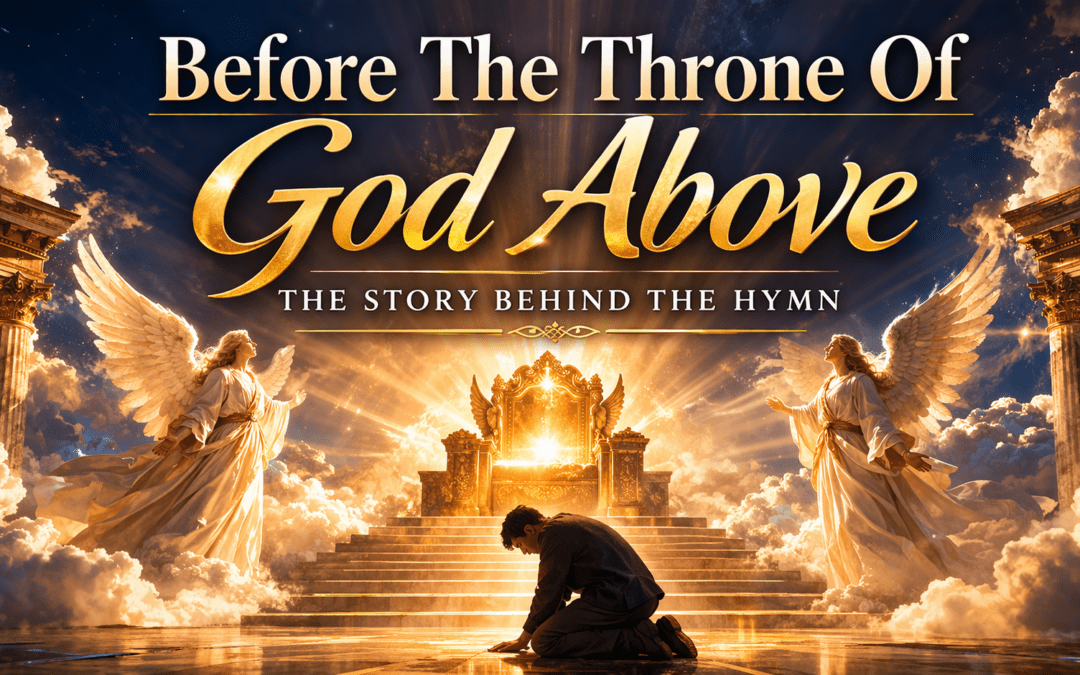
Few hymns in modern Christian worship carry the depth of theology, poetic beauty, and enduring relevance like “Before the Throne of God Above.” Though many believers today associate the song with contemporary worship, its origins trace back more than 160 years. The journey of this hymn—from a 19th-century poem to a globally beloved worship song—is a fascinating story of rediscovery, revival, and rich biblical truth.
This article explores the origins, historical development, theological depth, and modern resurgence of this powerful hymn.
Listen To The Article:
The Author: Charitie Lees Smith (Bancroft)
The text of “Before the Throne of God Above” was written in 1863 by Charitie Lees Smith, an Irish-born poet and the daughter of an Anglican clergyman.
Born in 1841, Smith grew up in a home deeply rooted in Scripture and theology. Her father’s role as a minister influenced her early exposure to biblical teaching, and she demonstrated a gift for writing poetry from a young age.
Originally, the poem was titled “Within the Veil with Jesus” or sometimes “The Advocate.” This title reflects the central theme of the hymn: Christ as our advocate before God.
The Original Publication (1863)
The hymn first appeared in a collection titled The Praise of Jesus in 1863.
At that time, it was not even set to music—it was simply a poem consisting of six stanzas. This is important because it reminds us that the power of the hymn lies first in its text, not its melody.
The poem was later included in other hymn collections, including:
Praises of Jesus (1865, United States)
Our Own Hymn-Book (1866), compiled by Charles Spurgeon
Spurgeon titled it “Jesus Pleads for Me,” emphasizing its central doctrinal message: the intercession of Christ.
A Hymn Nearly Forgotten
Despite its strong theology, the hymn did not achieve widespread popularity in its early years. In fact, it largely faded into obscurity for nearly a century.
While it appeared in some hymnals in the late 1800s, it never gained the traction of other well-known hymns of the time. One reason may be that it lacked a widely accepted musical setting. Various tunes were used, but none captured the heart of the text in a way that resonated broadly with congregations.
For decades, “Before the Throne of God Above” remained a hidden treasure—rich in truth but largely unknown.
The 20th-Century Revival
Everything changed in 1997.
A modern composer named Vikki Cook, associated with Sovereign Grace Music, encountered the hymn text during a church service.
Though the existing musical setting did not connect well with the congregation, Cook was deeply moved by the words. She began meditating on the text during her personal devotional time and eventually composed a brand-new melody.
This new arrangement transformed the hymn.
Cook’s version was first recorded in 1997 and later published in hymnals by 1999.
This moment marked the beginning of the hymn’s modern resurgence.
A Leader in the “Retuned Hymn Movement”
The new version of “Before the Throne of God Above” became a key example of what is often called the “retuned hymn movement.”
This movement seeks to:
Recover older hymn texts rich in theology
Pair them with modern, accessible melodies
Reintroduce them to contemporary congregations
Cook’s melody gave the hymn a fresh emotional tone—one of confidence, assurance, and joy—rather than the more somber tone of earlier tunes.
Today, many worshipers assume the song is entirely modern, unaware that its lyrics date back to the 1800s.
The Theology of the Hymn
One of the reasons this hymn has endured—and flourished—is its deep biblical foundation.
The lyrics draw heavily from Scripture, especially passages like:
Hebrews 4:14–16
Hebrews 7:25
Romans 8:33–34
The central theme is clear: Jesus Christ is our High Priest and Advocate before God.
Key Doctrinal Themes
1. Christ as Our Advocate
The hymn opens with the powerful line:
“I have a strong and perfect plea…”
This reflects the biblical truth that Christ intercedes for believers before the Father.
2. Assurance of Salvation
Lines like:
“No tongue can bid me thence depart”
emphasize the security of the believer in Christ.
3. Justification Through Christ
The hymn declares:
“For God the just is satisfied
To look on Him and pardon me.”
This beautifully captures the doctrine of substitutionary atonement.
4. Union with Christ
The final stanza proclaims:
“One with Himself, I cannot die…”
This expresses the believer’s unity with Christ and eternal hope.
Why the Hymn Still Resonates Today
Despite being written in 1863, “Before the Throne of God Above” feels incredibly relevant in modern worship.
1. It Addresses Doubt and Guilt
In a world where many struggle with guilt and insecurity, the hymn speaks directly to the believer’s assurance in Christ.
2. It Is Rich in Scripture
Unlike many modern songs that focus on emotional expression, this hymn is saturated with biblical truth.
3. It Bridges Old and New
Thanks to Vikki Cook’s melody, the hymn successfully connects:
Historical theology
Modern worship style
4. It Centers on Christ
The song is entirely Christ-focused—His work, His intercession, and His righteousness.
From Obscurity to Global Worship
Today, “Before the Throne of God Above” is sung in churches around the world and has appeared in numerous hymnals and worship albums.
Artists and groups such as Sovereign Grace Music and others have helped popularize the hymn among new generations.
What was once a nearly forgotten poem is now a cornerstone of modern Christian worship.
Sacred music history is filled with hymns that have touched the hearts and souls of believers for generations. These hymns are more than just melodic expressions of faith; they carry stories of inspiration, reflection, and triumph. In this article, we will delve into the rich tapestry of sacred music history and explore the stories behind 10 inspiring hymns. From Martin Luther’s stirring “A Mighty Fortress Is Our God” to Joseph M. Scriven’s heartfelt “What A Friend,” each hymn has a unique story to tell. Join us on this musical journey as we unravel the threads of history and discover the timeless messages within these beloved hymns.
The Significance of Hymns in Worship
Hymns play a crucial role in worship, acting as a powerful means of expressing faith, praise, and devotion. Through their rich lyrics and melodious tunes, hymns create a sacred atmosphere, inviting worshippers to connect with the divine.
One of the significant aspects of hymns is their ability to convey deep theological truths in a poetic and accessible manner. The timeless messages woven within the verses provide a framework for believers to reflect on their faith, contemplate spiritual truths, and find comfort in the presence of God. As hymns are sung congregationally, they foster a sense of unity and collective worship, allowing individuals to join their voices together in praise.
“Hymns are like prayers set to music, allowing us to express our deepest emotions and desires to God,” says Reverend John Davidson, a worship leader with over 20 years of experience.
“They serve as a means of communication between the worshipper and the divine, offering a way to express gratitude, seek solace, or surrender in worship.”
Hymns also have a historical significance, carrying with them the stories and legacies of the composers who penned them. Each hymn weaves together personal experiences, biblical truths, and cultural influences, creating a tapestry of worship that spans across generations. As such, hymns not only connect us to the present moment of worship but also link us to the wider Christian tradition and the faithful who have gone before us.
The Impact of Hymns in Worship Practices
Within the context of worship practices, hymns serve several crucial purposes. First and foremost, they provide a vehicle for congregational participation, allowing worshippers to actively engage in the act of worship. When a congregation sings hymns together, it becomes a collective declaration of faith and a shared expression of devotion.
Hymns also create a sense of familiarity and continuity, particularly within established worship traditions. Many hymns have withstood the test of time and have become beloved treasures that have been passed down from one generation to another. As a result, they evoke feelings of nostalgia, evoke memories, and create a deep connection between the present and the past.
Furthermore, hymns can help to reinforce and teach theological concepts. The lyrics often contain deep theological truths and biblical references that can deepen understanding and faith. Through the repetition of key phrases and themes, hymns serve as a form of spiritual formation, shaping individuals’ beliefs and perspectives.
Overall, hymns hold a special place in the hearts and worship practices of believers, providing a means to express adoration, find solace, and deepen one’s relationship with God. Whether through traditional hymns or contemporary worship songs inspired by hymnody, these musical expressions continue to play a vital role in the worship experiences of believers worldwide.
Martin Luther’s Impact: “A Mighty Fortress Is Our God”
Martin Luther, a key figure in the Reformation, left a lasting impact on sacred music with his timeless hymn, “A Mighty Fortress Is Our God.” This hymn, written in the early 16th century, became a rallying cry for Protestant Christians during a time of religious upheaval and theological change. Its powerful lyrics and majestic melody continue to inspire and resonate with believers around the world.
The Story Behind the Hymn
“A Mighty Fortress Is Our God” was born out of the tumultuous environment of the Protestant Reformation, as Martin Luther sought to communicate his theological beliefs and provide comfort to his fellow believers. Inspired by Psalm 46, Luther crafted lyrics that declared God’s steadfastness and protection in the face of adversity. The hymn’s bold expression of faith and confidence in God’s sovereignty struck a chord with many, becoming a cornerstone of Protestant hymnody.”
Luther’s impact on sacred music extended beyond the composition of “A Mighty Fortress Is Our God.” He also played a vital role in establishing congregational singing in the vernacular language, as opposed to the traditional Latin used in Catholic worship. By advocating for the use of German hymns, Luther enabled the congregation to actively participate in worship, fostering a deep sense of community and shared faith.
The Enduring Influence
Centuries later, “A Mighty Fortress Is Our God” continues to be sung and cherished by Christians worldwide. Its message of trust in God’s strength and protection resonates in times of uncertainty and struggle. The hymn serves as a reminder of the unchanging nature of God and His faithfulness to His people.
Through his hymnody and theological contributions, Martin Luther left an indelible mark on sacred music, shaping the way we worship and express our faith. “A Mighty Fortress Is Our God” stands as a testament to Luther’s enduring influence and the power of music to unite believers in praise and worship.
Robert Robinson’s Reflection: “Come Thou Fount Of Every Blessing”
Robert Robinson’s heartfelt composition, “Come Thou Fount Of Every Blessing,” continues to resonate with believers, reflecting on the abundance of God’s blessings in their lives. The hymn, written in the 18th century, showcases Robinson’s deep gratitude for the grace and mercy he received from God.
The hymn’s powerful lyrics, such as “Tune my heart to sing Thy grace” and “Streams of mercy, never ceasing,” remind believers of their unwavering faith in God’s love and provide a heartfelt plea for His continuous guidance and strength. Through these words, Robinson expresses his longing to be filled with the joy and peace that come from a close relationship with God.
Robinson’s composition has left a lasting impact, inspiring generations of believers to seek a deeper connection with their faith. The hymn’s timeless message serves as a reminder of the infinite blessings that God bestows upon His people and encourages them to acknowledge His constant presence in their lives.
Ruminating on the Lyrics:
“Come Thou Fount Of Every Blessing”
Tune my heart to sing Thy grace;
Streams of mercy, never ceasing,
Call for songs of loudest praise.
Teach me some melodious sonnet
Sung by flaming tongues above.
Praise the mount! I’m fixed upon it,
Mount of Thy redeeming love.
In these verses, Robinson’s poetic mastery shines through. His use of vivid imagery, such as “streams of mercy” and “mount of Thy redeeming love,” paints a beautiful picture of the abundant blessings and redemptive power of God. Through his lyrics, Robinson invites believers to join in the joyous praise of God’s grace and mercy.
“Come Thou Fount Of Every Blessing” serves as a timeless reminder for believers to reflect on the countless blessings they have received and to express their thankfulness and love to God. Its enduring popularity is a testament to the profound impact that Robinson’s composition has had on the spiritual journeys of believers throughout history.
Conclusion
The hymn “Come Thou Fount Of Every Blessing” by Robert Robinson continues to be a cherished piece of sacred music, inspiring believers to recognize and celebrate the abundant blessings they receive from God. With its heartfelt lyrics and timeless message, this hymn serves as a reminder of the unending grace and mercy that believers can find in their relationship with God.
As we continue to explore sacred music history, we will delve into more inspiring hymns and their stories, uncovering the power and beauty of these timeless compositions.
Finding Comfort in Lina Sandell’s “Day By Day”
Lina Sandell’s timeless hymn, “Day By Day,” offers a comforting reminder of God’s unwavering presence and sufficiency in the midst of life’s challenges. This beloved hymn, written in the 19th century by the Swedish poet and hymn writer, continues to resonate with believers around the world, providing solace and assurance in times of uncertainty.
With its heartfelt lyrics and gentle melody, “Day By Day” encourages individuals to trust in God’s faithfulness and seek comfort in His steadfast love. The hymn’s poignant words, “Day by day, and with each passing moment, strength I find, to meet my trials here,” remind us that God’s grace is sufficient to carry us through every trial we face.
As we sing the verses of “Day By Day,” we are reminded of the eternal truth that our Heavenly Father is always with us, guiding us through life’s ups and downs. The hymn’s chorus, “Every day, every step I take, every moment, Lord, keep me near,” serves as a prayerful plea for God’s presence and guidance in our daily lives. Through these powerful words, we are encouraged to find comfort and strength in knowing that we are never alone on our journey.
Embracing God’s Sufficiency
Lina Sandell’s “Day By Day” beautifully encapsulates the essence of embracing God’s sufficiency in all circumstances. It serves as a reminder that even in the darkest moments, we can find reassurance and peace in His unwavering love. Through its timeless message and soothing melody, this hymn continues to bring comfort and hope to countless hearts, allowing believers to trust in God’s provision and grace each day.
Thomas Chisholm’s Proclamation: “Great Is Thy Faithfulness”
Through the hymn “Great Is Thy Faithfulness,” Thomas Chisholm beautifully captures the unwavering nature of God’s faithfulness, inspiring believers to trust in Him without fail. The heartfelt lyrics of this hymn remind us of God’s constancy and goodness, even in the midst of life’s challenges.
Chisholm writes, “Great is thy faithfulness, O God my Father / There is no shadow of turning with thee.” These words reinforce the idea that God never changes; His faithfulness towards His people remains steadfast, never wavering. It serves as a powerful reminder that we can rely on Him in all circumstances, knowing that He will never leave us or forsake us.
In addition to its lyrical beauty, “Great Is Thy Faithfulness” is also characterized by a simple yet powerful melody that resonates with listeners. The combination of the lyrics and the melody creates an atmosphere of trust and assurance, allowing believers to find solace and peace in God’s faithful presence.
This hymn has stood the test of time and continues to be sung in churches and gatherings around the world. Its enduring popularity speaks to its ability to connect with the hearts of believers, reminding them of God’s faithfulness throughout history and in their personal lives.
Katherine Hankey’s Testimony: “I Love To Tell The Story”
Katherine Hankey’s hymn, “I Love To Tell The Story,” serves as a heartfelt expression of gratitude for the redemptive story of Jesus and His love that transcends time. Through her words, Hankey beautifully captures the essence of the Gospel and its impact on believers.
The hymn begins with the line, “I love to tell the story, of unseen things above,” emphasizing the joy and eagerness to share the message of salvation. Hankey’s words remind us of the importance of sharing our faith and proclaiming the good news, as it has the power to transform lives.
In the chorus, Hankey writes, “I love to tell the story, ’twill be my theme in glory, to tell the old, old story of Jesus and His love.” This powerful refrain emphasizes the eternal significance of the story of Jesus and the love He has for each and every one of us. It reminds us that His story is not just a story of the past, but a story that continues to shape our lives today.
Katherine Hankey’s hymn, “I Love To Tell The Story,” stands as a testament to the enduring power of the Gospel message. Its timeless lyrics inspire believers to share the story of Jesus and His love with the world, spreading hope, joy, and redemption to all who listen.
Horatio G. Spafford’s Journey: “It Is Well With My Soul”
Horatio G. Spafford’s hymn, “It Is Well With My Soul,” stands as a testament to the unwavering faith and peace that can be found in the midst of profound loss and grief. Spafford, a successful lawyer and devout Christian, experienced unimaginable tragedy when his four daughters perished in a shipwreck. Devastated by this heartbreaking loss, he penned the lyrics to this hymn as a reflection of his unshakeable trust in God’s sovereign plan.
In the face of such immense sorrow, Spafford’s hymn offers a remarkable message of hope and resilience. The opening lines, “When peace like a river, attendeth my way, / When sorrows like sea billows roll,” vividly capture the tumultuous emotions he must have felt. Yet, within those very same verses, he declares, “It is well, it is well, with my soul.” These powerful words demonstrate Spafford’s profound belief that even in the midst of immense pain, his soul could find serenity and peace through God’s grace.
“It Is Well With My Soul” has resonated with countless individuals over the years, offering solace and strength in times of personal tragedy. The hymn’s enduring popularity can be attributed to the universal nature of loss and the universal need for hope. Its poignant affirmation of faith reminds us that even in our darkest moments, we can find comfort in the unwavering love of God.
Through the haunting beauty of its melody and the profound simplicity of its lyrics, “It Is Well With My Soul” serves as a gentle yet powerful reminder that no matter the trials we face, God’s peace can transcend all earthly understanding. This hymn continues to touch the hearts and souls of believers, inspiring them to persevere and find solace in the unwavering presence of the Divine.
Sarah Flower Adams’ Inspiration: “Nearer My God To Thee”
Sarah Flower Adams drew inspiration from the biblical narrative of Jacob’s dream in Genesis to compose the beloved hymn, “Nearer My God To Thee,” which invites believers to draw closer to God in every circumstance.
The hymn’s poignant lyrics paint a picture of unwavering faith and trust in God’s presence. As the story of Jacob’s dream unfolds, we are reminded of the ladder connecting heaven and earth, symbolizing the connection between God and His people. In the face of challenges and trials, “Nearer My God To Thee” serves as a heartfelt plea to be near God, seeking solace, guidance, and strength in His presence.
“Nearer My God To Thee” resonates with believers across generations, offering comfort and reassurance. The hymn’s timeless melody and powerful lyrics serve as a reminder that no matter the circumstance, we can always draw closer to God and find comfort in His unfailing love and grace.
Today, as we sing the words of “Nearer My God To Thee,” we join with countless others who have found solace in its message throughout history. This hymn reminds us that our journey of faith is not one we navigate alone; rather, it is an invitation to draw nearer to God, finding strength, hope, and peace in His presence.
George Bennard’s Celebration: “The Old Rugged Cross”
George Bennard’s timeless hymn, “The Old Rugged Cross,” joyfully celebrates the sacrifice of Jesus on the cross as the ultimate symbol of redemption and salvation. With its powerful lyrics and heartfelt melody, this hymn has become a beloved anthem of faith for generations of believers.
The lyrics of “The Old Rugged Cross” vividly portray the profound love and sacrifice of Jesus, reminding us of the significance of His death and resurrection. Through verses such as “So I’ll cherish the old rugged cross, Till my trophies at last I lay down,” the hymn invites us to reflect on the immeasurable value of the cross and the eternal hope it represents.
As George Bennard beautifully encapsulates in the hymn’s chorus, “I will cling to the old rugged cross, And exchange it some day for a crown,” we are reminded of the assurance of salvation that Jesus’ sacrifice offers. The hymn’s melody, simple yet stirring, further enhances the emotional impact of its message, drawing worshippers into a deep sense of gratitude and adoration.
“The Old Rugged Cross” has stood the test of time and continues to inspire Christians around the world, reminding them of the timeless truth that their sins were borne on the cross by Jesus, and through Him, they find forgiveness and eternal life. This hymn serves as a powerful reminder of the central message of the gospel and the hope that it brings to all who believe.
Augustus M. Toplady’s Reflection: “Rock Of Ages”
Augustus M. Toplady’s hymn, “Rock Of Ages,” invites believers to find solace and security in Christ, the unshakeable foundation of their faith. With its powerful lyrics and timeless melody, this hymn has resonated with generations of worshippers, reminding them of God’s steadfast love and grace.
The words of “Rock Of Ages” paint a vivid picture of the Christian’s reliance on Jesus as their refuge and source of strength. As believers sing the opening lines, “Rock of Ages, cleft for me, let me hide myself in thee,” they express their desire to find shelter in the rock-solid foundation that Christ provides. This hymn beautifully encapsulates the Christian’s need for redemption and the assurance that Jesus, the solid rock, offers.
“Rock of Ages, cleft for me, let me hide myself in thee.”
Throughout the verses of “Rock Of Ages,” the hymn continues to affirm the sufficiency of Christ’s sacrifice on the cross. The words remind believers that only through His blood can sin be washed away and the soul be made whole. It is a hymn of surrender, acknowledging our utter dependence on the grace of God and His power to save.
“Rock Of Ages” remains a cherished hymn, reminding us that when the storms of life rage and the foundations tremble, we can find steadfastness and peace in Christ alone. As we sing these timeless words, we are reminded of the unchanging and unwavering nature of our Savior, who is the rock upon which our faith is built.
Joseph M. Scriven’s Reminder: “What A Friend”
Joseph M. Scriven’s moving hymn, “What A Friend,” serves as a powerful reminder of the unwavering friendship and love of Jesus, who is always there for us. With lyrics that touch the depths of the soul, this hymn carries a message of comfort, solace, and hope in times of distress and despair.
The words of “What A Friend” express the profound truth that Jesus is not only our Savior but also our constant companion, guiding us through life’s trials and offering His support every step of the way. As we sing these heartfelt lyrics, we are reminded that no matter the circumstances or challenges we may face, Jesus is our ever-present friend, ready to lend a listening ear and extend His love and grace.
“What a friend we have in Jesus, all our sins and griefs to bear. What a privilege to carry everything to God in prayer.”
These lines from the hymn encapsulate the essence of the Christian faith – the assurance that we have a friend in Jesus who is willing to carry our burdens and offer us peace and rest. The comforting melody and timeless lyrics of “What A Friend” continue to resonate with believers, reminding us of the unchanging love and faithfulness of our Savior.
The Enduring Legacy of Inspirational Hymns
The enduring legacy of inspirational hymn lies in their ability to transcend time, inspiring and uplifting believers from one generation to the next. These hymns hold a special place in the hearts of Christians worldwide, as they connect individuals to their faith and provide solace, strength, and hope in times of joy and sorrow.
The hymns and their stories are a testament to the profound impact music has on the human spirit. From Martin Luther’s powerful hymn “A Mighty Fortress Is Our God,” which carried the spirit of the Reformation, to Joseph M. Scriven’s gentle reminder in “What A Friend,” each hymn carries a unique message that resonates with believers across centuries.
Through their powerful lyrics and melodies, these hymns invite us to reflect on our relationship with God and find comfort and guidance amidst the challenges of life. As we sing these hymns, we join a long and rich tradition, connecting with the believers who came before us and those who will come after. The enduring legacy of inspirational hymns is a reminder of the timeless nature of faith and the power of music to unite and inspire souls.
The Timeless Messages of Faith, Hope, and Trust
These 10 inspiring hymns and their stories remind us of essential aspects of our Christian faith. They speak of God’s faithfulness, His redeeming love, and His constant presence in our lives. They encourage us to draw near to Him, find strength in His promises, and trust in His provision.
As we sing these hymns, their messages become deeply ingrained in our hearts, shaping our understanding of God’s character and deepening our relationship with Him. The enduring legacy of inspirational hymns ensures that these messages of faith, hope, and trust resonate with believers in every generation.
So, let us embrace the timeless beauty of these hymns. Let us sing their melodies, contemplate their lyrics, and allow them to speak to our souls. As we do, we not only honor the composers who penned these incredible hymns but also become a part of the enduring legacy of inspirational music.
The Power of Hymns: Their Lyrics and Melodies
The power of hymns resides in their beautifully crafted lyrics and captivating melodies, which have the ability to stir the soul and evoke profound emotions. Hymns are not just mere songs; they are heartfelt expressions of faith, hope, and reverence towards God, serving as a source of comfort, inspiration, and spiritual connection for believers.
With carefully chosen words and poetic imagery, hymn lyrics convey timeless truths about God’s love, grace, and redemption. They provide a rich tapestry of theological teachings, serving as a vehicle for worship, reflection, and meditation. Hymns often incorporate biblical references and vivid metaphors, enabling listeners to engage deeply with the scriptural messages they convey.
Furthermore, hymn melodies have a unique ability to transport us to a higher plane of spiritual consciousness. Whether through soothing harmonies or majestic arrangements, they create an atmosphere conducive to worship, enabling individuals to pour out their hearts in adoration and praise. The melodies themselves can linger in our minds long after the hymn has ended, serving as a constant reminder of the truths we have sung.
The Impact of Hymns on Worship
“Hymns have the power to unite a congregation in a shared experience of worship, transcending time and space. They enable us to express our deepest longings, joys, and sorrows before God, fostering a sense of communion and spiritual unity among believers.” – Dr. Sarah Johnson, Sacred Music Historian.
Through their powerful combination of poetic lyrics and captivating melodies, hymns have the ability to touch hearts, transform lives, and create a sense of unity among worshippers. They offer a sanctuary of solace in times of trouble, a wellspring of inspiration in moments of doubt, and a channel for expressing gratitude and devotion to God.
As we continue to embrace the rich legacy of hymns, we honor the contributions of their composers, who, through their words and melodies, have left an indelible mark on sacred music history. By cherishing these timeless hymns, we ensure that their messages of faith and hope continue to resonate with believers, transcending generations and bringing us closer to the divine.
The Composers Behind the Hymns: Their Contributions and Legacies
The hymn composers have made significant contributions to sacred music, leaving behind a rich legacy of musical worship that continues to impact believers today. Through their heartfelt compositions, they have captured the essence of faith, weaving together words and melodies that resonate with the deepest parts of our souls.
“Music is a gift from God, and these composers have used their talents to create hymns that touch the hearts of millions. Their works are not mere songs but expressions of praise, gratitude, and devotion.”
Each composer brings their unique perspective and experiences, infusing their hymns with personal stories and reflections. Their dedication to blending theology, poetry, and music has resulted in hymns that stand the test of time, transcending generations and cultural boundaries.
Their Contributions:
Martin Luther, with “A Mighty Fortress Is Our God,” sparked a hymn-writing movement during the Reformation and empowered believers with a renewed sense of God’s strength and protection.
Robert Robinson’s “Come Thou Fount Of Every Blessing” invites us to reflect on the abundant grace and mercy of God.
Lina Sandell’s “Day By Day” offers solace and hope, reminding us to trust in God’s provision and guidance.
Thomas Chisholm’s “Great Is Thy Faithfulness” reminds us of God’s unwavering faithfulness in every season of life.
Their Legacies:
The legacies of these composers extend far beyond their lifetimes. Their hymns continue to be sung in churches around the world, weaving a tapestry of worship and praise. Through their compositions, they have left a lasting impact on the Christian faith, connecting believers across time and space.
“The hymns written by these composers transcend boundaries, denominations, and cultures. They unite believers in a shared language of worship and serve as a reminder of our common faith.”
As we sing these hymns, we join in a timeless tradition of praising God, celebrating His love, and finding solace in His presence. The hymn composers have gifted us with melodies that resonate deep within our hearts, inspiring us to worship, reflect, and draw closer to God.
Conclusion: Embracing the Spiritual Journey Through Hymns
The spiritual journey is enriched through the power of hymns, inviting believers to connect with their faith, find solace, and deepen their relationship with God. These 10 inspiring hymns and their stories, which span sacred music history, continue to resonate with worshippers across generations. Through their timeless messages of faith, hope, and trust in God, these hymns offer a profound sense of comfort and inspiration.
The beauty of hymns lies in their ability to speak to the depths of the soul. Whether it’s the triumphant declaration of God’s faithfulness in “Great Is Thy Faithfulness” or the contemplative reflection on Christ as the rock of salvation in “Rock Of Ages,” each hymn offers a unique perspective on the journey of faith.
From Martin Luther’s impactful hymn during the Reformation to Horatio G. Spafford’s poignant composition following the tragedy in his life, these hymns bear witness to the personal stories and experiences of their composers. As we sing these hymns, we are not only connecting with their stories but also with the rich history and tradition of sacred music.
As believers embrace the spiritual journey through hymns, they are drawn into a deeper understanding of their faith and a closer relationship with God. Through hymns, we find solace in times of trial, strength in times of weakness, and hope in times of despair. The enduring legacy of these hymns is a testament to their power to inspire, uplift, and unite believers in their shared worship experience.
FAQ
Q: What are some inspiring hymns and their stories?
A: Here are 10 inspiring hymns and their stories that explore sacred music history:
Q: Who wrote the hymn “A Mighty Fortress Is Our God”?
A: “A Mighty Fortress Is Our God” was written by Martin Luther.
Q: What is the meaning behind “Come Thou Fount Of Every Blessing”?
A: “Come Thou Fount Of Every Blessing” was written by Robert Robinson and reflects on God’s redeeming love.
Q: Who composed the hymn “Day By Day”?
A: “Day By Day” was written by Lina Sandell and finds comfort in God’s sufficiency amidst trials.
Q: Who wrote the hymn “Great Is Thy Faithfulness”?
A: “Great Is Thy Faithfulness” was written by Thomas Chisholm and highlights God’s faithfulness in every season of life.
Q: Who composed “I Love To Tell The Story”?
A: “I Love To Tell The Story” was written by Katherine Hankey and praises Jesus and His sacrifice.
Q: What is the story behind “It Is Well With My Soul”?
A: “It Is Well With My Soul” was written by Horatio G. Spafford after the tragic death of his daughters.
Q: What inspired the hymn “Nearer My God To Thee”?
A: “Nearer My God To Thee” was written by Sarah Flower Adams and draws inspiration from Jacob’s dream in Genesis.
Q: Who composed “The Old Rugged Cross”?
A: “The Old Rugged Cross” was written by George Bennard and celebrates the work of Jesus on the cross.
Q: What is the significance of “Rock Of Ages”?
A: “Rock Of Ages” was written by Augustus M. Toplady and reflects on Christ as the rock of salvation.
Q: Who wrote the hymn “What A Friend”?
A: “What A Friend” was written by Joseph M. Scriven and reminds us that Jesus is always there for us.
1. Amazing Grace
2. How Great Thou Art
3. Great Is Thy Faithfulness
4. It Is Well with My Soul
5. Blessed Assurance
6. The Old Rugged Cross
7. What a Friend We Have in Jesus
8. Holy, Holy, Holy
9. Be Thou My Vision
10. Rock of Ages
11. Joyful, Joyful, We Adore Thee
12. All Creatures of Our God and King
13. Crown Him with Many Crowns
14. Fairest Lord Jesus
15. O For a Thousand Tongues to Sing
16. Come, Thou Fount of Every Blessing
17. Come, Christians, Join to Sing
18. O Sacred Head, Now Wounded
19. Jesus Paid It All
20. O Love That Will Not Let Me Go
21. Immortal, Invisible, God Only Wise
22. All Hail the Power of Jesus’ Name
23. How Firm a Foundation
24. Praise to the Lord, the Almighty
25. Jesus, Lover of My Soul
26. O Worship the King
27. Holy God, We Praise Thy Name
28. Glorious Things of Thee Are Spoken
29. Be Still, My Soul
30. I Need Thee Every Hour