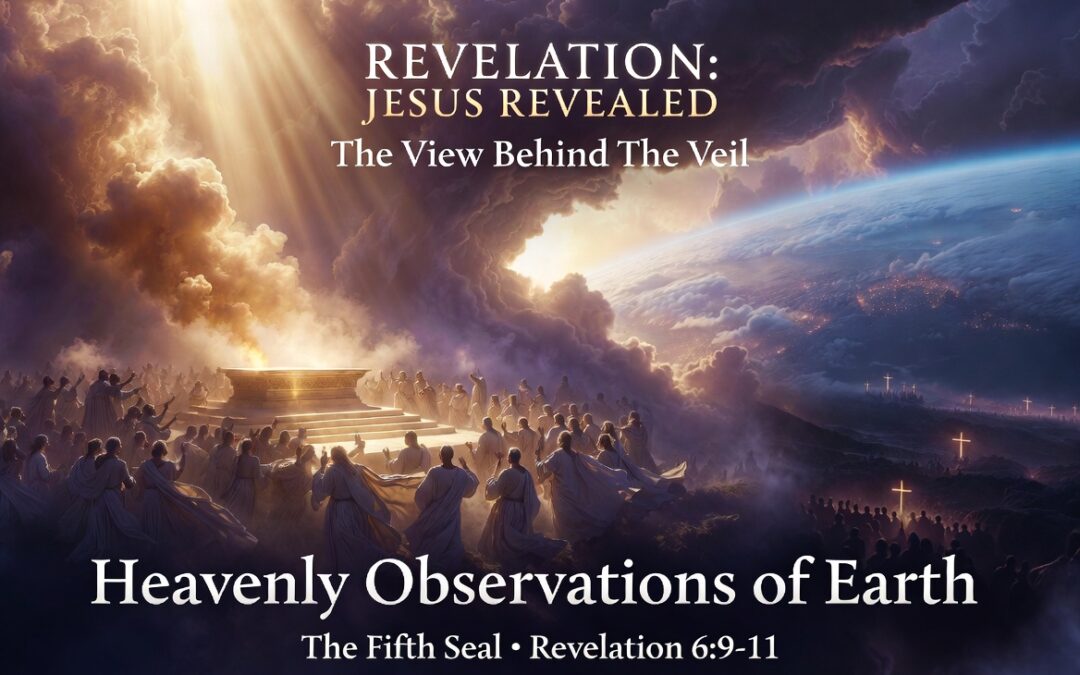
In the sermon “Heavenly Observations of Earth” from the Revelation: Jesus Revealed – The View Behind The Veil series, we examine the opening of the fifth seal in Revelation 6:9-11. The Apostle John sees the souls of faithful martyrs — slain for the word of God and their testimony — gathered under the heavenly altar. They cry out with a loud voice, “How long, O Lord, holy and true, until You judge and avenge our blood on those who dwell on the earth?”
Sermon Audio
Sermon Video
Sermon Notes:
Revelation 6:9 When He opened the fifth seal, I saw under the altar the souls of
those who had been slain for the word of God and for the testimony which they held.
Revelation 6:10 And they cried with a loud voice, saying, “How long, O Lord, holy
and true, until You judge and avenge our blood on those who dwell on the earth?”
Revelation 6:11 Then a white robe was given to each of them; and it was said to
them that they should rest a little while longer, until both the number of their
fellow servants and their brethren, who would be killed as they were, was completed.
Matthew 24:9 “Then they will deliver you up to tribulation and kill you, and you will be
hated by all nations for My name’s sake.
1) Is there life right after death?
2) Do people in heaven remember life on earth?
3) Do people in heaven see what is happening on earth?
The 5th Seal
I. THE CONTEXT OF THEIR MARTYRDOM.
Revelation 6:9 When He opened the fifth seal, I saw under the altar the souls …”
Revelation 3:12 He who overcomes, I will make him a pillar in the temple of My God,
Exodus 40:5 You shall also set the altar of gold for the incense before the ark
of the Testimony, and put up the screen for the door of the tabernacle.
Exodus 40:6 Then you shall set the altar of the burnt offering before the door of
the tabernacle of the tent of meeting.
Revelation 6:9 When He opened the fifth seal, I saw under the altar the souls …”
Revelation 8:3 Then another angel, having a golden censer, came and stood at the
altar. He was given much incense, that he should offer it with the prayers of all the
the saints upon the golden altar which was before the throne.
Revelation 8:4 And the smoke of the incense, with the prayers of the saints,
ascended before God from the angel’s hand.
II. THE CAUSE OF THEIR MARTYRDOM.
Revelation 6:9 When He opened the fifth seal, I saw under the altar the souls of
those who had been slain for the word of God and for the testimony which they held.
They were murdered for fulfilling the two greatest commandments–loving God and
loving people.
Revelation 2:13 “… And you hold fast to My name, and did not deny My faith even in
the days in which Antipas was My faithful martyr, who was killed among you,…”
According to a report from watchdog group, Open Doors US, in 2025
“388 million Christians suffered persecution last year with 4,849 murdered and 3,632
churches and Christian properties were either destroyed or attacked.while 4,712
Christians were detained.”
With North Korea, Somalia, and Yemen being the top 3 worst countries
Satan past, present and future has always used an ungodly governments to be the
greatest persecutor of the church.
III. THE CRY FROM THEIR MARTYRDOM.
Revelation 6:10 And they cried with a loud voice, saying, “How long, O Lord, holy
and true, until You judge and avenge our blood on those who dwell on the earth?”
Luke 18:6, “Jesus said, … Shall not God bring about justice for His elect who cry to
Him day and night, and will not God judge when His elect cry out to Him?”
Genesis 4:10 “…The voice of your brother’s blood cries out to Me from the ground …”
Revelation 6:10 “… will avenge our blood on those who dwell on the earth?”
IV. THE COMPLETION OF THE MARTYRDOM.
Revelation 6:11 Then a white robe was given to each of them; and it was said to
them that they should rest a little while longer, until both the number of their
fellow servants and their brethren, who would be killed as they were, was completed.
Revelation 2:10 Do not fear any of those things which you are about to suffer.
Indeed, the devil is about to throw some of you into prison, that you may be tested,
and you will have tribulation ten days. Be faithful until death, and I will give you the
crown of life.
V. THE CONTINUATION AFTER THEIR MARTYRDOM.
Revelation 6:9 (VOICE) When the Lamb broke the fifth seal, I saw under the
heavenly altar the souls of those murdered for holding fast to the word of God and
their testimony.
Revelation 6:10 They cried out in a great, singular voice. Murder Victims:
1. Death is Not the End. Life goes on after Death.
John 5:24 “Most assuredly, I say to you, he who hears My word and believes in Him
who sent Me has everlasting life, and shall not come into judgment, but has passed
from death into life.
2. The Martyred Souls Aren’t Sleeping.
Daniel 12:2 ‘And many of those who sleep in the dust of the earth shall awake,Some
to everlasting life, Some to shame and everlasting contempt.
1 Thessalonians 4:13 But I do not want you to be ignorant, brethren, concerning those
who have fallen asleep, lest you sorrow as others who have no hope.
1 Thessalonians 4:14 For if we believe that Jesus died and rose again, even so God
will bring with Him those who sleep in Jesus.
2 Corinthians 5:8 We are confident, yes, well pleased rather to be absent from the
body and to be present with the Lord.
Philippians 1:23 For I am hard-pressed between the two, having a desire to depart
and be with Christ, which is far better.
For unbelievers, death means everlasting punishment in hell (Luke 16:22–23).
Luke 16:22 “… the rich man also died, and was buried;
Luke 16:23 And in hell he lift up his eyes, being in torments, …”
3) People in Heaven Remember Life on Earth.
Revelation 6:10 (NLV) All those who had been killed cried out with a loud voice saying,
“How long will it be yet before You will punish those on the earth for killing us?
Lord, You are holy and true.”
4) People in Heaven See What is Happening on Earth.
Revelation 19:1 After these things I heard a loud voice of a great multitude in
heaven, saying, “Alleluia! Salvation and glory and honor and power belong to
the Lord our God!
Revelation 19:2 For true and righteous are His judgments, because He has judged
the great harlot who corrupted the earth with her fornication; and He has avenged
on her the blood of His servants shed by her.”
Luke 9:28 Now it came to pass, about eight days after these sayings, that He
took Peter, John, and James and went up on the mountain to pray.
Luke 9:29 As He prayed, the appearance of His face was altered, and His robe
became white and glistening
Luke 9:30 And behold, two men talked with Him, who were Moses and Elijah,
Luke 9:31 who appeared in glory and spoke of His decease which He was about
to accomplish at Jerusalem.
Do you realize that we really don’t know one another here on earth?
1 Corinthians 13:12 “… Now I know in part, but then I shall know just as I also am known.
5. Don’t Forget The Fans In The Stands.
Hebrews 12:1 Therefore we also, since we are surrounded by so great a cloud of
witnesses, let us lay aside every weight, and the sin which so easily ensnares us,
and let us run with endurance the race that is set before us,
The last invitation in the Book of Revelation is the last one in the Bible
Revelation 22:17 And the Spirit and the bride say, Come…
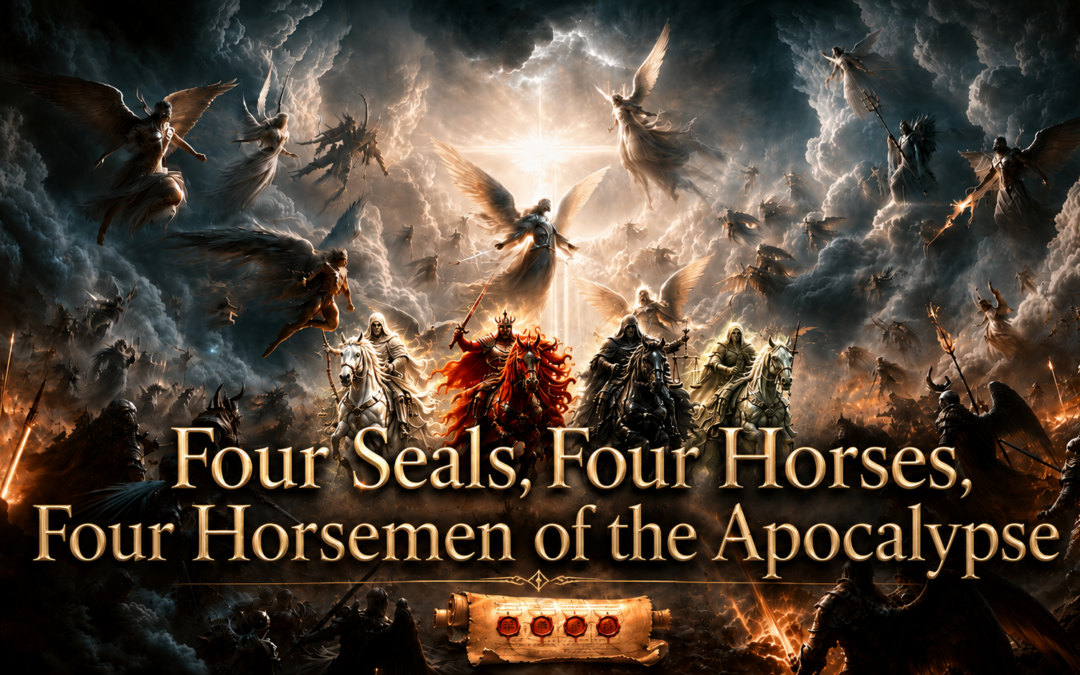
Explore the terrifying and prophetic vision of the Four Horsemen in Revelation 6 in this powerful Bible teaching. As the Lamb opens the first four seals, the world is shaken by deception, war, famine, and death.
Sermon Audio
Sermon Video
Sermoh Notes:
Revelation 6:1 Now I saw when the Lamb opened one of the seals; and I heard
one of the four living creatures saying with a voice like thunder, “Come and see.”
Revelation 6:2 And I looked, and behold, a white horse. He who sat on it had a bow;
and a crown was given to him, and he went out conquering and to conquer.
Revelation 6:3 When He opened the second seal, I heard the second living creature
saying, “Come and see.”
Revelation 6:4 Another horse, fiery red, went out. And it was granted to the one
who sat on it to take peace from the earth, and that people should kill one another;
and there was given to him a great sword.
Revelation 6:5 When He opened the third seal, I heard the third living creature say,
“Come and see.” So I looked, and behold, a black horse, and he who sat on it had
a pair of scales in his hand.
Revelation 6:6 And I heard a voice in the midst of the four living creatures saying,
A quart of wheat for a denarius, and three quarts of barley for a denarius; and do
not harm the oil and the wine.”
Revelation 6:7 When He opened the fourth seal, I heard the voice of the fourth
living creature saying, “Come and see.”
Revelation 6:8 So I looked, and behold, a pale horse. And the name of him who
sat on it was Death, and Hades followed with him. And power was given to them
over a fourth of the earth, to kill with sword, with hunger, with death, and by
the beasts of the earth.
Job 39:19 “Have you given the horse strength? Have you clothed his neck with
thunder?
Job 39:20 Can you frighten him like a locust? His majestic snorting strikes terror.
Job 39:21 He paws in the valley, and rejoices in his strength; He gallops into the
clash of arms.
Job 39:22 He mocks at fear, and is not frightened; Nor does he turn back from
the sword.
Job 39:23 The quiver rattles against him, The glittering spear and javelin.
Job 39:24 He devours the distance with fierceness and rage; Nor does he come
to a halt because the trumpet has sounded.
Job 39:25 At the blast of the trumpet he says, ‘Aha!’ He smells the battle from afar,
The thunder of captains and shouting.
THE 1ST SEAL: THE WHITE HORSE OF DECEPTIVE PEACE.
Revelation 6:1 Now I saw when the Lamb opened one of the seals; and I heard
one of the four living creatures saying with a voice like thunder, “Come and see.”
Revelation 6:2 And I looked, and behold, a white horse. He who sat on it had a bow;
and a crown was given to him, and he went out conquering and to conquer.
Opinions on who is the first rider is include:
1) Jesus Christ
2) the advance of the gospel,
3) False religion
4) the antichrist,
5) the spirit of conquest,
6) government persecuting Christians,
7) Satan’s servants in general.
8) Not a person but a personification
Revelation 6:8 So I looked, and behold, a pale horse. And the name of him who sat
on it was Death, and Hades
The horsemen are not persons, but personifications, representations
manifestations, embodiments,
It’s not that the four horses will actually ride over the earth, but are symbolical
representations of things that will happen
Revelation 6:4 Another horse, fiery red, went out. And it was granted to the one
who sat on it to take peace from the earth, …”
Daneil 11:21 And in his place shall arise a vile person, to whom they will not give
the honor of royalty; but he shall come in peaceably, and seize the kingdom by
Jeremiah 6:14 They have also healed the hurt of My people slightly, saying, ‘Peace,
peace!’ When there is no peace.
1 Thessalonians 5:3 For when they say, “Peace and safety!” then sudden destruction
comes upon them, as labor pains upon a pregnant woman. And they shall not escape.
THE 2ND SEAL: THE RED HORSE OF DESTRUCTIVE PUNISHMENT.
Revelation 6:3 When He opened the second seal, I heard the second living creature
saying, “Come and see.”
Revelation 6:4 Another horse, fiery red, went out. And it was granted to the one who
sat on it to take peace from the earth, and that people should kill one another; and
there was given to him a great sword.
Matthew 24:6 And you will hear of wars and rumors of wars. See that you are not
troubled; for all these things must come to pass, but the end is not yet.
Matthew 24:7 For nation will rise against nation, and kingdom against kingdom …”
Matthew 24:22 And unless those days were shortened, no flesh would be saved;
but for the elect’s sake those days will be shortened.
Albert Einstein said,”The unleashed power of the atom has changed everything
except our way of thinking. We shall require a substantially new manner of thinking
if mankind is to survive.”
President Ronald Reagon once said, “Man has used every weapon he has ever
devised … It takes no crystal ball to perceive that a nuclear war, is likely … In a
nuclear war, all mankind would lose.”
Former Soviet president Brezhnev once said, “Only he who has decided to
commit suicide can start a nuclear war.”
THE 3RD SEAL: THE BLACK HORSE OF DIVISIVE POVERTY.
Revelation 6:5 When He opened the third seal, I heard the third living creature say,
“Come and see.” So I looked, and behold, a black horse, and he who sat on it had
a pair of scales in his hand.
Revelation 6:6 And I heard a voice in the midst of the four living creatures saying,
A quart of wheat for a denarius, and three quarts of barleåy for a denarius; and do
not harm the oil and the wine.”
Lamentations 5:10 Our skin is hot as an oven, because of the fever of famine.
Lamentations 4:9 Those slain by the sword are better off than those who die of hunger;
For these pine away, stricken for lack of the fruits of the field.
Matthew 24:7 “… And there will be famines …
Mark 13:8 “… and there will be famines and troubles. These are the beginnings of sorrows.
Revelation 6:6 “… and do not harm the oil and the wine.”
THE 4TH SEAL: THE PALE HORSE OF DEADLY PLAGUES.
Revelation 6:7 When He opened the fourth seal, I heard the voice of the fourth
living creature saying, “Come and see.”
Revelation 6:8 So I looked, and behold, a pale horse. And the name of him who
sat on it was Death, and Hades followed with him. And power was given to them
over a fourth of the earth, to kill with sword, with hunger, with death, and by the
beasts of the earth.
Matthew 24:37 But as the days of Noah were, so also will the coming of the Son of
Man be.
Exodus 8:19 Then the magicians said to Pharaoh, “This is the finger of God.” But
Pharaoh’s heart grew hard, and he did not heed them, just as the Lord had said.
Revelation 9:20 20 But the rest of mankind, who were not killed by these plagues,
did not repent …”
Revelation 9:21 And they did not repent of their murders or their sorceries or their
sorceries or their sexual immorality or their thefts.
Song “I Wish We’d All Been Ready”
Life was filled with guns and war
And everyone got trampled on the floor
I wish we’d all been ready
Children died, the days grew cold
A piece of bread could buy a bag of gold
I wish we’d all been ready
There’s no time to change your mind
The Son has come and you’ve been left behind
Acts 17:31 because He has appointed a day on which He will judge the world in
righteousness by the Man whom He has ordained. He has given assurance of this
to all by raising Him from the dead.
Victory Baptist Church in Carthage, Missouri now offers a free Bible Reading Plan Generator on our website. Whether you want a 30-day sprint through Scripture, a balanced 90-day plan, or a full one-year journey, you can build a custom schedule and download a printable PDF in minutes.
Why Use a Bible Reading Plan?
A structured Bible reading plan removes the guesswork from daily devotions. Instead of wondering where to read next, you follow a clear path through God’s Word — one day at a time. Many Christians find that a printable plan with checkboxes helps them stay accountable and celebrate progress.
What Makes Our Generator Different?
Flexible duration — Choose 30, 60, 90, 120, 180, 365 days, or any custom length
Multiple plan types — Whole Bible, New Testament, Old Testament, Gospels, or Psalms & Proverbs
Free printable PDF — Download instantly, no signup required
Built for real life — Perfect for personal devotion, families, or small groups
Get Started Today
Visit our Free Bible Reading Plan Generator, pick your settings, and download your plan. We would love to see you grow in the Word — and if you are in the Carthage area, join us for worship and Bible study at Victory Baptist Church.
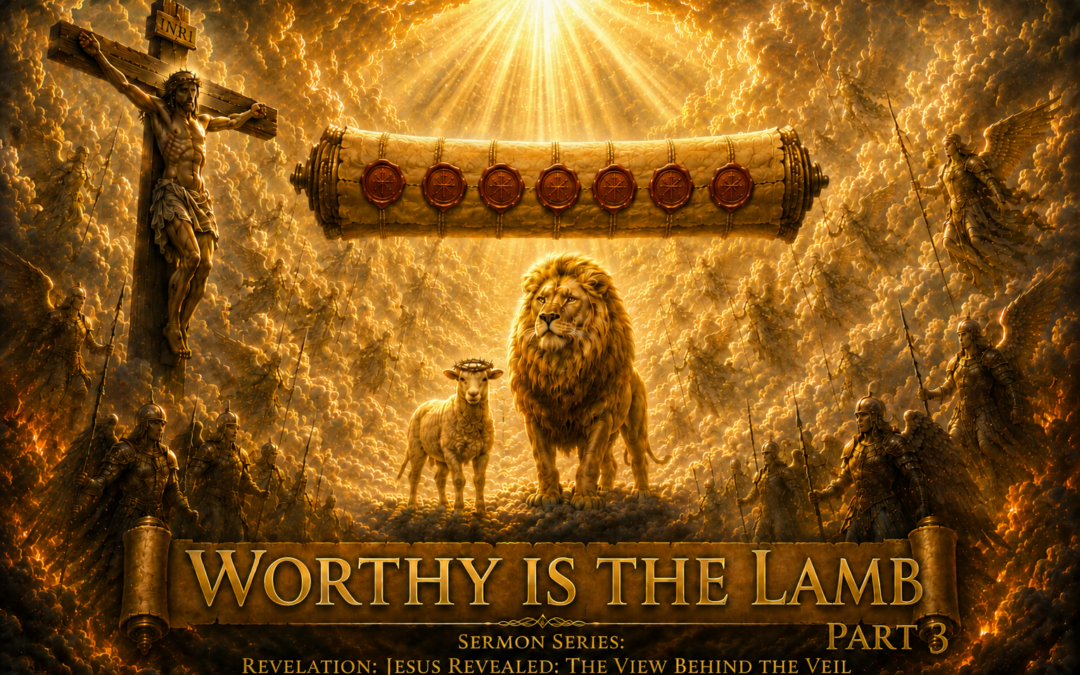
Worthy is the Lamb Part 3 is a Revelation 5 sermon about Jesus Christ as the Lamb who was slain, the only One worthy to open the scroll, redeem His people by His blood, and receive worship forever.
This Worthy is the Lamb sermon continues the study of Revelation 5 with audio, video, and sermon notes from Victory Baptist Church in Carthage, Missouri.
Revelation 5:1 And I saw in the right hand of Him who sat on the throne a scroll
written inside and on the back, sealed with seven seals.
Revelation 5:2 Then I saw a strong angel proclaiming with a loud voice, “Who is
worthy to open the scroll and to loose its seals?”
Revelation 5:3 And no one in heaven or on the earth or under the earth was able
to open the scroll, or to look at it.
Revelation 5:4 So I wept much, because no one was found worthy to open and
read the scroll, or to look at it.
Revelation 5:5 But one of the elders said to me, “Do not weep. Behold, the Lion
of the tribe of Judah, the Root of David, has prevailed to open the scroll and to
loose its seven seals.”
Revelation 5:6 And I looked, and behold, in the midst of the throne and of the
four living creatures, and in the midst of the elders, stood a Lamb as though
it had been slain, having seven horns and seven eyes, which are the seven Spirits
of God sent out into all the earth.
Revelation 5:7 Then He came and took the scroll out of the right hand of Him who
sat on the throne.
Revelation 5:8 Now when He had taken the scroll, the four living creatures and
the twenty-four elders fell down before the Lamb, each having a harp, and golden
bowls full of incense, which are the prayers of the saints.
Revelation 5:9 And they sang a new song, saying: “You are worthy to take the scroll,
and to open its seals; For You were slain, and have redeemed us to God by Your
blood out of every tribe and tongue and people and nation,
Revelation 5:10 And have made us kings and priests to our God; And we shall reign
on the earth.”
Revelation 5:11 Then I looked, and I heard the voice of many angels around the
throne, the living creatures, and the elders; and the number of them was ten
thousand times ten thousand, and thousands of thousands,
Revelation 5:12 saying with a loud voice: “Worthy is the Lamb who was slain to
receive power and riches and wisdom, and strength and honor and glory and blessing!”
Revelation 5:13 And every creature which is in heaven and on the earth and under
the earth and such as are in the sea, and all that are in them, I heard saying:
Blessing and honor and glory and power be to Him who sits on the throne, and to
the Lamb, forever and ever!”
Revelation 5:14 Then the four living creatures said, “Amen!” And the twenty-four
elders fell down and worshiped Him who lives forever and ever.
When we’ve been there ten thousand years bright shining as the sun.
We’ve no less days, to sing God’s praise, than when we first begun.
Christian author John Eldredge in his book, The Journey of Desire writes,
“Nearly every Christian I have spoken with has some idea that eternity is an unending
church service … We have settled on an image of the never-ending sing-along in the
sky, one great hymn after another, forever and ever, amen. And our heart sinks.
Forever and ever? That’s it? That’s the good news? And then we sigh and feel
guilty that we are not more spiritual. We lose heart, and we turn once more to the
present to find what life we can. ”
1 Corinthians 13:12 (EASY) At this time, we see things as if we were looking at them
in a mirror. What we see now is not clear. But the time will come when we do not
need a mirror. We will see everything clearly. Now we know only a part of what is true.
But then we will know everything completely. We will understand completely, just as
God understands us completely.
V. THE SAINT’S SONG FOR THE WORTHY ONE.
1. IT IS A WORSHIP SONG
Revelation 5:9 And they sang a new song, saying: “You are worthy …”
Like the song says “The Heart of Worship” proclaims
I’m comin’ back to the heart of worship
‘Cause it’s all about You
It’s all about You, Jesus
I’m sorry, Lord, for the thing I’ve made it
‘Cause it’s all about You
It’s all about You, Jesus,
2. IT IS A GOSPEL SONG
Revelation 5:9 “… For You were slain, and have redeemed us to God by Your blood…”
Revelation 5:6 “… and in the midst of the elders stood a Lamb as though it had been
slain …
Revelation 5:12 “… Worthy is the Lamb who was slain …
Redeemed how I love to proclaim it, Redeemed by the blood of the lamb.
There is power wonder working power in the blood of the Lamb
Are you washed in the blood,In the soul-cleansing blood of the Lamb?
3. IT IS A MISSIONARY SONG.
Revelation 5:9 “… out of every tribe and tongue and people and nation,
Send the light, the blessed gospel light; Let it shine from shore to shore.
Spread the tidings all around- Jesus saves! Jesus saves!
Rescue the perishing, Care for the dying, Snatch them in pity from sin and the grave;
4. IT IS A HEAVENLY PROPHETIC SONG.
Revelation 5:10 And have made us kings and priests to our God; And we shall reign
on the earth.
When we all get to heaven, what a day of rejoicing that shall be.
All hail the power of Jesus’ name! Let angels prostrate fall,
Bring forth the royal diadem, and crown him Lord of all.
Crown Him with many crowns, the Lamb upon the throne.
What a day that will be, when my Jesus I shall see,
And I look upon His face, The One who saved me by His grace
VI. THE SIGNIFICANT SOUND FOR THE WORTHY ONE.
Revelation 5:11 Then I looked, and I heard the voice of many angels around the
throne, the living creatures, and the elders; and the number of them was ten
thousand times ten thousand, and thousands of thousands,
Revelation 5:12 saying with a loud voice: “Worthy is the Lamb who was slain to
receive power and riches and wisdom, and strength and honor and glory and blessing!”
VII. THE SUBMISSION SCENE BEFORE THE WORTHY ONE
Revelation 5:13 And every creature which is in heaven and on the earth and under
the earth and such as are in the sea, and all that are in them, I heard saying: “Blessing
and honor and glory and power be to Him who sits on the throne, and to the Lamb,
forever and ever!”
1.THE SOURCE OF THE PRAISE
Revelation 5:13 And every creature which is in heaven and on the earth and under
the earth and such as are in the sea, and all that are in them, I heard saying …”
2. THE SUBJECT OF THE PRAISE
Revelation 5:13 “… I heard saying: “Blessing and honor and glory and power be to
Him who sits on the throne and to the Lamb forever and ever!”
3. THE SUBMISSION OF THE PRAISE
Revelation 5:14 Then the four living creatures said, “Amen!” And the
twenty-four elders fell down and worshiped Him who lives forever and ever.
Is anyone worthy? Is anyone whole?
Is anyone able to break the seal and open the scroll?
The Lion of Judah who conquered the grave
He is David’s Root and the Lamb who died to ransom the slave
From ev’ry people and tribe, ev’ry nation and tongue
He has made us a kingdom and priests to God to reign with the Son
Is He worthy? Is He worthy
Of all blessing and honor and glory?
Is He worthy? Is He worthy?
Is He worthy of this?
He is! He is!
On a bright Sunday morning here in Carthage, Missouri, the sanctuary at Victory Baptist Church fills with the warm sounds of familiar praise. As the pianist begins the introduction, voices across the pews lift in unison: “Come, Thou Fount of every blessing, tune my heart to sing Thy grace.” Whether you have worshipped with us for decades at our location on County Lane 117 or are visiting from elsewhere in Jasper County, this hymn touches something deep in the soul. It speaks of mercy that never runs dry and a Savior who pursues even the wandering heart.
But behind these beloved words lies a remarkable story—one of youthful rebellion, dramatic conversion, profound theological insight, and a lifelong struggle with the very human tendency to wander from the God we love. Today we explore the story of “Come Thou Fount of Every Blessing,” written by Robert Robinson in 1758, and why its message continues to minister so powerfully to believers in Southwest Missouri churches and around the world.
A Restless Heart in 18th-Century England
Robert Robinson was born on September 27, 1735, in the small town of Swaffham, Norfolk, England. Tragedy struck early when his father died while Robert was still a boy. His mother, determined to give him a trade, apprenticed the fourteen-year-old to a barber in the bustling city of London. What she hoped would provide structure instead exposed him to the rough streets and wild company of the capital.
Robinson quickly became the leader of a gang of troublemakers. Drinking, pranks, and mockery of religion filled his days. One afternoon, he and his friends visited a gypsy fortune-teller, partly for amusement and partly to harass her. The woman studied the young man’s face and declared that he would one day live to see his children and his grandchildren. The prophecy unsettled him more than he would admit. For the first time, perhaps, he began to wonder what his future might hold if he continued down his reckless path.
Young Robert Robinson, whose wild youth in England would lead to one of the church’s most cherished hymns.
Convicted by the Preaching of George Whitefield
At seventeen, Robinson’s life took an unexpected turn. He and his companions decided to attend an open-air meeting led by the fiery evangelist George Whitefield—not to seek God, but to mock and disrupt the “poor deluded Methodists.” Whitefield, one of the greatest preachers of the Great Awakening, stood and proclaimed the words of Matthew 3:7 with piercing power: “O generation of vipers, who hath warned you to flee from the wrath to come?”
The message struck Robert Robinson like a thunderbolt. Though he tried to shake it off, the conviction would not leave. For nearly three years he wrestled with his sin and the claims of Christ. On December 10, 1755, at the age of twenty, he finally surrendered. Robinson later described the moment he found “full and free forgiveness through the precious blood of Jesus Christ.” His wild heart was captured by grace.
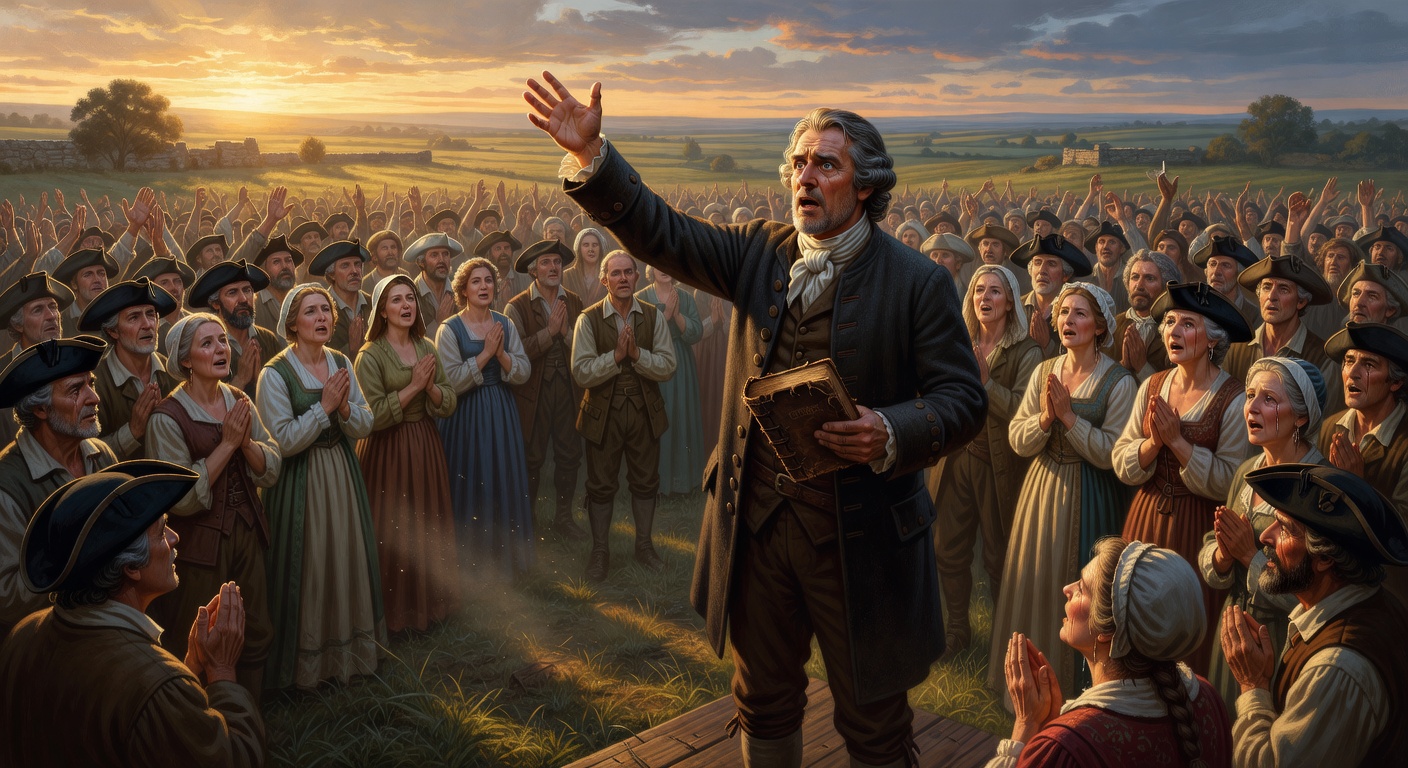
George Whitefield’s powerful open-air preaching that pierced the heart of young Robert Robinson and changed his life forever.
Robinson soon began preaching himself. After a season with the Methodists, he embraced Baptist convictions and pastored for many years at the St. Andrew’s Street Baptist Church in Cambridge. He became a respected scholar, writing a significant history of the Baptists. Yet the hymn he wrote in his early twenties would outlive all his other works and touch millions of hearts.
The Hymn Is Born: A Testimony of Redeeming Love
In 1758, at just twenty-two years old, Robert Robinson wrote “Come, Thou Fount of Every Blessing.” Some accounts suggest he composed it to accompany a sermon on Pentecost Sunday, the third anniversary of his conversion. First published the following year, the hymn is both a personal spiritual autobiography and a profound theological reflection on the nature of grace.
Its three stanzas move from praise of God’s abundant blessings, to remembrance of Christ’s saving work, to a heartfelt plea for grace to keep the wandering heart fixed upon the Lord. Every line is rich with Scripture and personal experience.
The Full Lyrics
Come, Thou Fount of every blessing, Tune my heart to sing Thy grace; Streams of mercy, never ceasing, Call for songs of loudest praise. Teach me some melodious sonnet, Sung by flaming tongues above; Praise the mount! I’m fixed upon it, Mount of Thy redeeming love.
Here I raise my Ebenezer; Hither by Thy help I’m come; And I hope, by Thy good pleasure, Safely to arrive at home. Jesus sought me when a stranger, Wand’ring from the fold of God; He, to rescue me from danger, Interposed His precious blood.
O to grace how great a debtor Daily I’m constrained to be! Let that grace now, like a fetter, Bind my wand’ring heart to Thee. Prone to wander, Lord, I feel it, Prone to leave the God I love; Here’s my heart, O take and seal it, Seal it for Thy courts above.
Streams of Mercy Never Ceasing: Verse-by-Verse Reflection
The opening lines establish the central theme: God Himself is the “Fount of every blessing.” All good gifts flow from Him alone. Robinson prays, “Tune my heart to sing Thy grace,” acknowledging that even the desire to praise must come from the Lord. The image of “streams of mercy, never ceasing” draws on the language of Scripture—think of the river of life in Revelation or the constant provision of manna in the wilderness. Mercy does not trickle; it flows in a mighty, unending stream.
Streams of mercy, never ceasing — the beautiful river scene that captures the endless grace celebrated in the hymn.
“Praise the mount! I’m fixed upon it, Mount of Thy redeeming love” points us to Calvary. The cross is the mountain upon which our hope is fixed. There, at the place of redeeming love, the fount was opened wide.
Here I Raise My Ebenezer
The second stanza contains one of the most distinctive phrases in all hymnody: “Here I raise my Ebenezer.” The word comes directly from 1 Samuel 7:12. After the Israelites repented and cried out to the Lord, Samuel prayed and God delivered them from the Philistines with thunder from heaven. In gratitude, Samuel set up a large stone and named it Ebenezer—“stone of help”—declaring, “Hitherto hath the Lord helped us.”
Robinson takes this Old Testament memorial and makes it personal. “Hither by Thy help I’m come.” Up to this point in my life, every step has been sustained by divine help. The line is both a testimony and a prayer of hope: “And I hope, by Thy good pleasure, safely to arrive at home.”
Here I raise my Ebenezer: a powerful symbol of God’s faithfulness — “Hither by Thy help I’m come.”
The stanza then turns to the gospel itself: “Jesus sought me when a stranger, Wand’ring from the fold of God; He, to rescue me from danger, Interposed His precious blood.” What a beautiful description of substitutionary atonement! Christ stood between the sinner and the wrath we deserved. He interposed—placed Himself in the gap—through the shedding of His own blood. This is the heart of Baptist preaching and the message we proclaim every week at Victory Baptist Church in Carthage, Missouri.
Prone to Wander, Lord, I Feel It
The final stanza is perhaps the most honest and beloved. “O to grace how great a debtor daily I’m constrained to be!” Grace creates a beautiful debt we can never repay, yet we are joyfully bound to the One who gave it. Robinson pleads, “Let that grace now, like a fetter, bind my wand’ring heart to Thee.” A fetter is a chain or shackle—here used positively. We want to be bound to Christ so tightly that we cannot stray far.
“Prone to wander, Lord, I feel it, prone to leave the God I love” is a confession every honest believer recognizes. Our hearts are deceitful and desperately wicked (Jeremiah 17:9). Even after conversion, the old nature pulls us away. The only hope is the sealing work of the Holy Spirit: “Here’s my heart, O take and seal it, seal it for Thy courts above.” This echoes Ephesians 1:13-14, where believers are sealed with the promised Holy Spirit as a guarantee of our inheritance.
The Stagecoach Encounter: When the Hymn Writer Heard His Own Song
Like many of us, Robert Robinson did not live in unbroken victory. Later in life he experienced seasons of spiritual coldness and doubt. Some accounts suggest he moved in circles that pulled him toward unorthodox views, though he continued to affirm core truths about Christ. The very words he had written as a young man—“prone to wander”—proved painfully true in his own experience.
One of the most moving (and often retold) stories associated with the hymn occurred during a stagecoach journey. A young woman passenger began softly singing or reading the words of “Come Thou Fount of Every Blessing.” She turned to the distinguished gentleman beside her and asked his opinion of the beautiful hymn.
With tears streaming down his face, Robinson replied, “Madam, I am the poor unhappy man who wrote that hymn many years ago, and I would give a thousand worlds, if I had them, to enjoy the feelings I had then.”
The legendary stagecoach moment: the hymn writer hears his own song and is moved to reflect on God’s pursuing grace.
The young woman is said to have responded with gentle encouragement, reminding him that the streams of mercy were still flowing and that it was not too late to return fully to the Lord. Whether every detail of the anecdote is historically verified or has grown in the telling, it perfectly embodies the message of the hymn itself. Even the author of these words needed the very grace he celebrated. God’s pursuing love does not give up on His children.
A Hymn That Still Sings in Carthage, Missouri
More than 265 years after it was written, “Come Thou Fount of Every Blessing” remains one of the most sung hymns in evangelical and Baptist churches across America—including right here in Southwest Missouri. At Victory Baptist Church in Carthage, we return to it often because it tells the whole gospel story with honesty and beauty.
In Jasper County, where life can be busy with work, family, school activities, and the ordinary pressures of living, the hymn’s confession rings true. We know what it is to feel “prone to wander.” We also know the joy of raising our own Ebenezers—looking back over answered prayers, preserved marriages, children brought to faith, and the faithful ministry of our local church.
The hymn’s popularity in our region is no accident. Its robust theology of grace aligns perfectly with the verse-by-verse, expository preaching we value. It reminds us that salvation is all of grace from beginning to end. Jesus sought us when we were strangers. He interposed His precious blood. And now the Holy Spirit seals us and keeps us.
Lessons for Believers in Jasper County and Beyond
What can we take away from Robert Robinson’s story and the hymn he gave the church?
God is the source. Every blessing—physical, spiritual, eternal—flows from the fount of His goodness. We contribute nothing but our need.
Our hearts are prone to wander. The most mature saint still feels the pull. We must daily cry out for grace to bind us to Christ.
Raise your Ebenezer. Keep memorials of God’s faithfulness. Write them down. Share them with your family. At Victory Baptist Carthage we often testify of God’s “hitherto” help in prayer meetings and around the table.
Christ interposed for you. The rescue came at infinite cost. Never grow casual about the precious blood.
The seal is sure. The Holy Spirit guarantees our arrival home. What a comfort when the road is long!
Whether you are a teenager navigating peer pressure in Carthage schools, a parent praying for a prodigal, a senior saint reflecting on decades of God’s care, or someone far from the Lord reading this on a screen in Jasper County—this hymn is for you.
Will You Raise Your Ebenezer Today?
The story of “Come Thou Fount of Every Blessing” is ultimately not about Robert Robinson. It is about the God who pursues rebels, opens fountains of mercy, interposes His own Son, and seals wandering hearts for glory. It is about the grace that is greater than all our sin and stronger than all our wanderings.
Here in Carthage, Missouri, at Victory Baptist Church, we want every person in our community to know this grace. If you do not yet know the Savior who sought you when you were a stranger, we invite you to come to the fount today. The streams are still flowing.
And for those of us who have tasted that grace, may we sing with renewed passion:
“Here’s my heart, O take and seal it, Seal it for Thy courts above.”
Will you join us this Lord’s Day? Whether you have attended for years or have never stepped inside our doors on County Lane 117, you are welcome. Come and lift your voice with brothers and sisters who, like Robert Robinson, have every reason to praise the Fount of every blessing.
Together, let us raise our Ebenezers and declare to the next generation: Hither by Thy help we’ve come—and by that same grace, we will arrive safely home.
Victory Baptist Church 9871 County Lane 117 Carthage, Missouri 64836 Sunday School 9:30 AM | Morning Worship 10:30 AM | Wednesday 6:30 PM We would love to worship the Lord with you.
Come, Thou Fount of every blessing—tune our hearts afresh to sing Thy grace.