Praise to the Lord, the Almighty: The Story Behind the Hymn
How a 30-year-old German schoolmaster living in a cave in a limestone valley wrote the greatest hymn of praise in the history of the Christian church — and why the valley where he found God in creation would one day give its name to Neanderthal Man
Introduction: A Hymn Worth 345 Years
Some hymns are products of their moment — born in a particular revival, suited to a particular theological controversy, loved by a particular generation, and then quietly retired to the back pages of hymnals that no one opens anymore. And then there are hymns like this one. Hymns that seem to belong not to any era but to every era. Hymns that the church of the 17th century sang and the church of the 21st century still sings, with equal conviction and equal joy, because the truth they carry is not fashionable truth but foundational truth — the kind that does not need to be updated because it was never merely current.
“Praise to the Lord, the Almighty, the King of creation” is that kind of hymn. Written in German in 1680 by a 30-year-old Reformed schoolmaster named Joachim Neander — who was, at the time, living in disgrace, dismissed from his position, and sheltering in a limestone cave in a valley on the Rhine — it has been described by hymnologist John Julian in his Dictionary of Hymnology as “a magnificent hymn of praise to God, perhaps the finest creation of its author, and of the first rank in its class.” It appeared in Queen Elizabeth II’s Diamond Jubilee service at Westminster Abbey. It is sung at state funerals, at college graduations, at baptisms and confirmations. It has been translated into dozens of languages. And every Sunday in thousands of churches around the world, its great ancient melody rings out — the same melody that was first published in the city of Stralsund on the Baltic coast of Germany in 1665.
But behind the grandeur of the hymn is a story that is anything but grand — at least by the world’s standards. It is the story of a short life, a dramatic conversion, a turbulent ministry, a season of exile, and a young man who found God most powerfully not in a cathedral but in a cave, not in success but in suffering, and not in the approval of his superiors but in the beauty of a wild limestone valley that — in one of history’s most remarkable coincidences — would one day give its name to an ancient species of human being.
Joachim Neander: A Life Burning Bright and Brief
Joachim Neander was born in 1650 in Bremen, a prosperous trading city in northern Germany near the mouth of the Weser River. His family had already shown a remarkable pattern: his grandfather was a musician, and his father was a Latin teacher — a combination of artistic sensibility and scholarly discipline that would shape the young Neander deeply. The family name was originally “Neumann,” a common German surname meaning “new man.” At some point — following the Renaissance fashion for Hellenizing surnames — the family adopted the Greek equivalent: Neander. It was a name that would prove prophetic in ways no one could have imagined.
As a young man, Neander showed little interest in either his family’s faith or his father’s scholarly discipline. By his late teens and early twenties he was living what contemporary sources describe as a “wild and godless life” — the specific details are lost to history, but the testimony of his later conversion makes clear that it was a genuine departure from Christian practice rather than mere youthful restlessness. He was, in other words, not someone who drifted away from faith gradually, but someone who actively rejected it.
The turning point came in 1670. Neander was 20 years old, a student of Latin and poetry, when he went with two friends to hear the preaching at St. Martin’s Church in Bremen. The three young men went with entirely wrong motives: they intended to mock the new pastor, Theodor Undereyck, and to criticize his theology. What happened instead is one of the classic conversion narratives of German Protestant history. Neander heard the Gospel preached with clarity and power, and something broke open inside him. He left St. Martin’s Church a changed man — converted to Christian faith and to the Calvinist-influenced Reformed theology that Undereyck preached.
The transformation was complete and lasting. Neander devoted himself immediately to theological study and became deeply influenced by two of the great Pietist thinkers of the era: Philipp Spener (1635–1705), the father of German Pietism whose call for a warmer, more experiential faith was reshaping German Protestantism, and Johann Jakob Schütz (1640–1690), himself a hymn writer and a man whose emphasis on personal devotion and Scripture meditation shaped the younger generation profoundly. These influences gave Neander’s faith a combination that was relatively unusual for the period: rigorous Reformed theology (God is sovereign, Scripture is supreme, worship is ordered) held together with warm Pietist devotion (personal relationship with Christ, the inner life matters, prayer and praise flow from the heart).
In 1674, at just 24 years of age, Neander was appointed Rector — headmaster — of the Latin School in Düsseldorf, a classical academy affiliated with the German Reformed Church. It was a position of real responsibility and real opportunity. He was recognized as a gifted teacher, a compelling preacher, and a man of uncommon spiritual depth for his age. The students respected him. The congregation he served alongside the school appreciated his gifts. For a time, things went well.
But Neander’s Pietist convictions eventually brought him into conflict with his more conservative Reformed superiors. His organizing of private devotional gatherings — prayer meetings, Bible studies, informal worship — was seen as a threat to the established church order. His evangelical zeal, which drew people in numbers that made the institutional church uncomfortable, led to accusations of separatism. In 1676, he was formally suspended from his teaching position and banned from preaching in Düsseldorf.
What did he do? He moved into a cave.
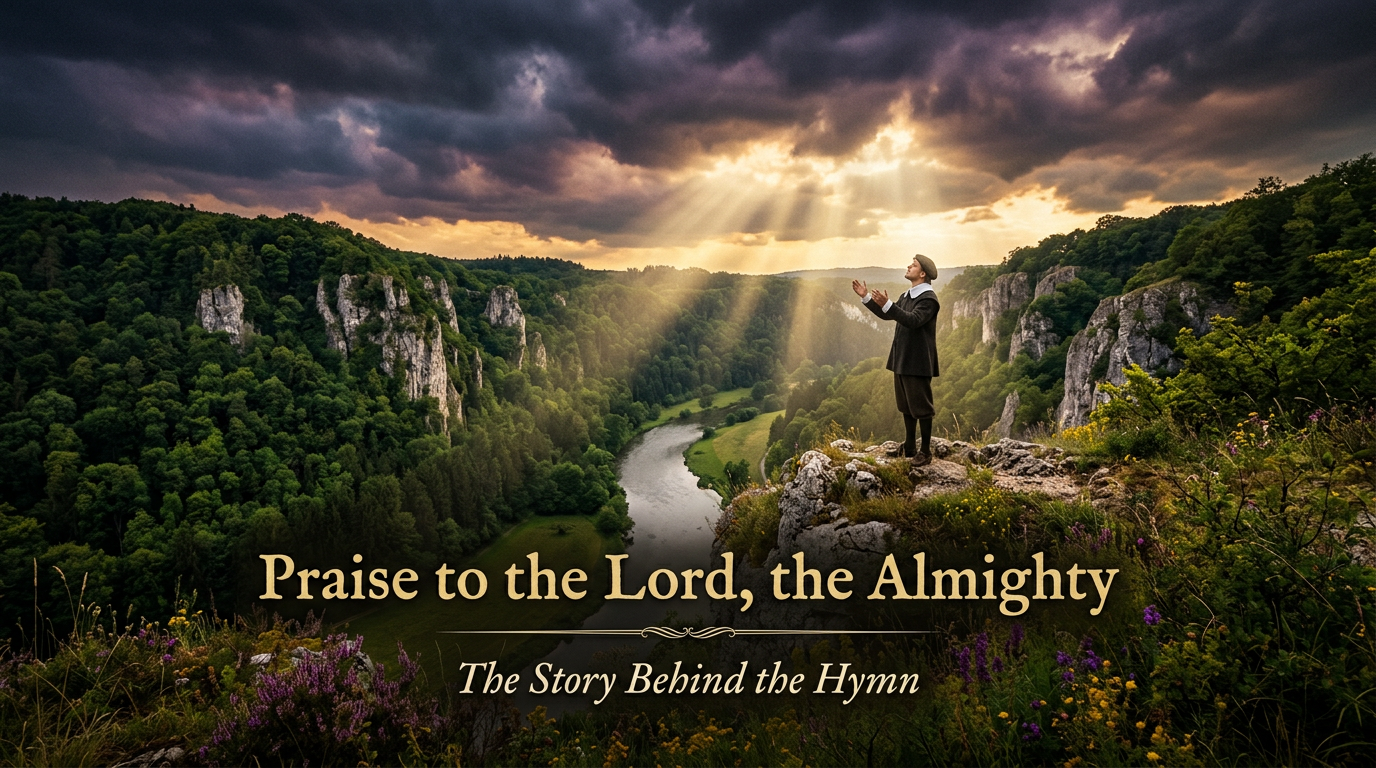
A few miles from Düsseldorf, on the banks of a small tributary of the Rhine called the Düssel, there was a wild and beautiful limestone ravine — deep rock faces, wooded slopes, caves, waterfalls, and a small river winding through the valley floor. Neander had discovered this valley during his years in Düsseldorf and had come to love it as a place of solitary prayer and reflection. When he was dismissed from his position and his lodgings at the school, he retreated there. He is said to have lived, at least in part, in one of the limestone caves — still known today as “Neander’s Cave” (Neandershöhle) — and to have spent this period of involuntary exile in prayer, Scripture meditation, and the writing of hymns.
It is from this extraordinary season of life that most of his approximately 60 hymns emerged. The beauty of the valley — its soaring cliffs, its living water, its birdsong and wildflowers, its silence and grandeur — filled his imagination and his theology. Creation was not merely scenery for Neander. It was a living sermon, a visible declaration of the majesty, power, and provision of its Creator. And from that conviction came the hymn that would outlive him by centuries.
He was eventually restored to his position — he returned to Bremen in 1679 to serve as assistant pastor at St. Martin’s Church, the very church where his conversion had taken place. But his health was already failing. Tuberculosis, the great destroyer of so many gifted young lives in the pre-antibiotic world, had taken hold. On May 31, 1680 — the same year his hymn collection was published — Joachim Neander died in Bremen at the age of 30. He had written more than 60 hymns and composed tunes for many of them in a Christian life of barely ten years.
The Neanderthal Connection: History’s Most Unlikely Footnote
Here is one of the most extraordinary coincidences in the history of both theology and paleontology. The limestone valley where Joachim Neander walked and prayed and wrote his hymns was named after his family — the Neander Valley, in German the Neanderthal (or Neandertal, in modern spelling). Nearly 200 years after Neander’s death, in the summer of 1856, workers quarrying limestone in the Neandershöhle — Neander’s Cave — discovered fossilized skeletal remains of a previously unknown species of ancient human being. Scientists named the species after the valley, and the valley after the hymnist: Homo neanderthalensis — Neanderthal Man.
Joachim Neander thus holds the singular distinction — unique in the entire history of religion — of being the only hymn writer after whom a species of hominid is named. Bach does not have a fossil. Luther does not have a fossil. Wesley does not have a fossil. Neander does. The man who wrote “All ye who hear, now to his temple draw near; join me in glad adoration” gave his name to a creature whose spiritual capacity — if any — we can only wonder at. It is either the most ironic or the most poetically perfect footnote in the history of praise.
The Tune: From Stralsund to the World
The melody to which “Praise to the Lord, the Almighty” is sung — known by its incipit as LOBE DEN HERREN — is itself older than Neander’s text. It first appeared in the Stralsund Gesangbuch of 1665, a Lutheran hymnal published in the Baltic port city of Stralsund (in what is now northeastern Germany). The composer is listed as anonymous, and the melody itself is believed to be based on an older German folk tune. It was first published there as a secular song, and several variants circulated through German musical life between 1665 and 1680.
When Neander wrote “Lobe den Herren, den mächtigen König der Ehren” in 1680, he chose this existing melody for his text — and the marriage of text and tune proved so perfect that virtually every subsequent version of the hymn has used the same melody. The tune is catalogued in the Zahn index as number 1912c. Its distinctive meter — 14.14.4.7.8 — is unusual, which is part of what gives the hymn its sweeping, majestic character: the long opening lines feel like the wide horizons of creation itself, and the shorter lines in the middle create a gathering intensity before the final long line releases the praise in full. It is music that feels as if it was designed to fill cathedrals — and yet it was written for ordinary German churchgoers in the 17th century.
The tune received its definitive English arrangement through William Sterndale Bennett (1816–1875) and Otto Goldschmidt (1829–1907), who harmonized it for Catherine Winkworth’s Chorale Book for England in 1863. This arrangement — stately, rich, and congregationally singable — is the version most widely used in English-speaking churches today.
Catherine Winkworth: The Woman Who Gave England a Treasure
Most English-speaking Christians who sing “Praise to the Lord, the Almighty” have never heard the name Catherine Winkworth — but they owe her an enormous debt. Born on September 13, 1827, in Holborn, London, Winkworth became the most important translator of German hymns into English in the 19th century, and arguably in all of Christian history. Her translations are distinguished by a quality that is genuinely rare in translation work: they are both faithful to the original and beautiful in the target language simultaneously. They do not sacrifice meaning for beauty or beauty for meaning. They do both.
Winkworth learned German during a year she spent in Dresden, Germany, and spent much of her adult life in Manchester, England. In 1855 she published Lyra Germanica, a collection of German hymns translated into English, which became an immediate success and went through numerous editions. In 1863 she published The Chorale Book for England, which paired her translations with their original German chorale melodies — edited by William Sterndale Bennett and Otto Goldschmidt. It was in this volume that her English translation of Neander’s “Lobe den Herren” appeared, and it became the standard English text almost immediately.
Winkworth died on July 1, 1878, near Geneva, Switzerland, at the age of 50. She is commemorated in the liturgical calendar of the Episcopal Church on July 1, and a stained glass window in the Bristol Cathedral honors her memory. Her contribution to English hymnody is immeasurable — she effectively gave English-speaking Christians access to the entire German chorale tradition, including not only Neander but Luther, Paul Gerhardt, and dozens of other Continental hymn writers whose riches would otherwise have remained locked behind a language barrier.
Scripture Roots: Psalms 103 and 150
“Praise to the Lord, the Almighty” is, at its core, a paraphrase of two great Psalms of the Hebrew Bible — and understanding those Psalms is essential to understanding what Neander was doing when he wrote it.
Psalm 103 opens with one of the most famous calls to personal worship in all of Scripture:
“Bless the LORD, O my soul, and all that is within me, bless his holy name! Bless the LORD, O my soul, and forget not all his benefits.” — Psalm 103:1–2
Neander’s opening line — “O my soul, praise him, for he is thy health and salvation” — is a direct echo of this Psalm’s personal, first-person summons. The psalmist is not merely describing God in the abstract. He is talking to himself, commanding his own inner life to wake up and worship. This is not cool theological observation. It is urgent, personal, passionate praise — the cry of a soul who knows what it means to be saved, healed, and sustained.
Psalm 150 is the great doxological finale of the entire Psalter — the explosion of praise that the whole book has been building toward:
“Praise him for his mighty deeds; praise him according to his excellent greatness… Let everything that has breath praise the LORD! Praise the LORD!” — Psalm 150:2, 6
Neander’s final stanza — “All that hath life and breath, come now with praises before him” — is almost a direct quotation of Psalm 150:6. The entire cosmos is being summoned to worship: not just the congregation, not just the church, not just humanity — but every breathing creature in creation. The hymn ends, as the Psalter ends, with a universal, all-inclusive, boundary-dissolving call to praise.
Beyond these two anchor Psalms, the hymn also draws on Psalm 61:4 (“Let me dwell in your tent forever; let me take refuge under the shelter of your wings”), Psalm 23:6 (“Surely goodness and mercy shall follow me all the days of my life”), and Psalm 91. The sheltering-wings imagery in verse two — “Shelters thee under his wings, yea, so gently sustaineth” — is a direct pastoral application of these protective-God texts. Neander was writing not just a hymn of abstract praise but a hymn of pastoral comfort: the God who is King of creation is also the God who shelters, sustains, and defends.
Lyrical Analysis: Verse by Verse
Verse 1 — The Universal Call
Praise to the Lord, the Almighty, the King of creation!
O my soul, praise him, for he is thy health and salvation!
All ye who hear, now to his temple draw near;
join me in glad adoration.
The opening salvo is breathtaking in its sweep. “The King of creation” — not the King of Israel, not the King of the church, not the King of the righteous — but the King of everything that exists. Neander was a Reformed Calvinist, and the sovereignty of God over all creation was not a peripheral doctrine for him but the foundation of everything. The second line turns immediately from the cosmic to the personal: “O my soul.” The same God who rules the universe is also the health and salvation of this one particular soul. The universal and the intimate are held in perfect tension from the very first verse. The final couplet extends the invitation outward: “All ye who hear” — whoever is within earshot of this hymn is being invited into the same praise. The temple is not a building. It is the presence of the living God, available to all who draw near.
Verse 2 — The Sheltering God
Praise to the Lord, who o’er all things so wondrously reigneth,
shelters thee under his wings, yea, so gently sustaineth!
Hast thou not seen how thy desires e’er have been
granted in what he ordaineth?
This verse reveals something of the pastoral heart behind the hymn. Neander was not a man who had experienced an easy life — he had been dismissed, exiled, and was at the time of writing slowly dying of tuberculosis. Yet he writes of a God who “wondrously reigneth” and “gently sustaineth.” The question at the end of the verse — “Hast thou not seen how thy desires e’er have been granted in what he ordaineth?” — is not a naïve assertion that God always gives us what we want. It is a deeper claim: that God’s purposes, even when they confound our plans, are ultimately the fulfillment of our deepest desires. When we look back on the story of our lives, we will see His hand in what He ordained. Providence is not always legible in the moment. It becomes clear in retrospect.
Verse 3 — The Defending God
Praise to the Lord, who doth prosper thy work and defend thee!
Surely his goodness and mercy here daily attend thee;
ponder anew what the Almighty can do,
if with his love he befriend thee.
“Ponder anew what the Almighty can do” — this single line may be the most memorable of the entire hymn. It is an invitation to theological imagination: stop and think, really think, about the capacities of the God you worship. If the Creator of the universe has chosen to befriend you — to make Himself your advocate, your defender, your daily companion — what then is impossible? The line does not make a specific promise. It opens a door. It invites the worshipper to bring every fear, every limitation, every impossible situation into the orbit of this one question: what can the Almighty do? The echo of Psalm 23:6 — “Surely goodness and mercy shall follow me all the days of my life” — is clear and intentional.
Verse 4 — The Universal Doxology
Praise to the Lord! O let all that is in me adore him!
All that hath life and breath, come now with praises before him!
Let the amen sound from his people again;
gladly for e’er we adore him.
The final verse is the great crescendo — the point at which the hymn bursts its banks and floods the world with praise. “All that is in me” — every faculty, every thought, every emotion, every desire — is summoned to adore Him. Then the circle widens: “All that hath life and breath” — a direct echo of Psalm 150:6, bringing every living creature into the doxology. And then the final instruction: “Let the amen sound from his people again.” The “amen” here is not merely a liturgical sign-off. It is a declaration of covenant faithfulness — a people saying together, “So be it. This is true. We stake our lives on this.” And then the last word: “gladly.” The praise is not reluctant, not dutiful, not performed. It is glad. It is joyful. It flows from a soul that has encountered the King of creation and been overwhelmed by what it found.
Timeline: 345 Years of Praise
| Year | Event |
|---|---|
| 1650 | Joachim Neander born in Bremen, Germany, son of a Latin teacher, grandson of a musician |
| 1665 | The tune LOBE DEN HERREN first published in the Stralsund Gesangbuch — an anonymous German folk-based melody that would later be paired with Neander’s text |
| 1670 | Neander converted to Christian faith after hearing pastor Theodor Undereyck preach at St. Martin’s Church, Bremen — he had gone intending to mock the preacher |
| 1674 | Appointed Rector (Headmaster) of the Latin School in Düsseldorf at age 24 |
| 1676 | Suspended from his position due to conflict with Reformed church authorities over his Pietist gatherings and evangelistic activities; retreats to the limestone valley near Düsseldorf now named Neanderthal |
| 1676–1679 | Period of exile in the Neander Valley; writes the majority of his approximately 60 hymns, including “Lobe den Herren”; lives at least in part in Neandershöhle (Neander’s Cave) |
| 1679 | Returns to Bremen; appointed assistant pastor at St. Martin’s Church — the site of his own conversion |
| 1680 | “Lobe den Herren, den mächtigen König der Ehren” published in Neander’s collection A und Ω. Joachimi Neandri Glaub- und Liebesübung; Neander dies of tuberculosis on May 31, aged 30 |
| 1800 | King Frederick William III of Prussia hears the hymn for the first time; reportedly declares it his favorite hymn — a royal endorsement that accelerates its spread across German-speaking lands |
| 1856 | Workers quarrying limestone in the Neandershöhle discover fossilized remains of an unknown ancient human species; named Homo neanderthalensis — Neanderthal Man — after the valley named after Neander |
| 1858 | Catherine Winkworth publishes an early English translation of the hymn in Lyra Germanica |
| 1863 | Winkworth’s definitive English translation published in The Chorale Book for England, with music arranged by Bennett and Goldschmidt; this becomes the standard English text used in hymnals worldwide |
| 1878 | Catherine Winkworth dies near Geneva at age 50; her translations already widely used across English-speaking denominations |
| Late 19th–20th century | The hymn enters virtually every major English-language hymnal — Lutheran, Methodist, Baptist, Anglican, Presbyterian, and Catholic |
| 1989 | Included in The United Methodist Hymnal (#139) as one of the most frequently sung historic hymns |
| 2004 | Passion / Christy Nockels records a contemporary live version for Hymns Ancient and Modern (sixstepsrecords/Sparrow), introducing it to a new generation |
| 2013 | Sung at Westminster Abbey during the service celebrating the 60th anniversary of Queen Elizabeth II’s coronation — the same British royal tradition that would inspire “Majesty” 36 years earlier |
| 2024–present | Continues to appear in new worship arrangements; listed as one of the top-ranked hymns in CCLI globally; sung in churches on every continent in dozens of languages |
Notable Recordings and Performances
| Artist / Context | Notes |
|---|---|
| Westminster Abbey Choristers | Performed at the 60th Coronation Anniversary service of Queen Elizabeth II, June 4, 2013; one of the most globally watched performances of the hymn in modern times |
| Passion / Christy Nockels | Hymns Ancient and Modern (2004, sixstepsrecords/Sparrow); live recording that introduced the hymn to a new generation of contemporary worshippers |
| T4G (Together for the Gospel) | Performed live at multiple T4G conferences; lyric video released 2020; one of the most-streamed versions among Reformed/evangelical audiences |
| Concordia Publishing House | Recorded for One and All Rejoice (2024); continues the Lutheran tradition of the hymn as a congregational standard |
| Nathan Drake / Reawaken Hymns | Contemporary acoustic arrangement (2021); widely used for modern worship settings |
| King’s College Cambridge | Multiple recordings across decades; the choir’s choral version remains one of the most beloved classical recordings of the hymn |
| Various German choirs | The original German “Lobe den Herren” continues to be sung in German Lutheran and Reformed churches; recordings by the Thomanerchor Leipzig and others |
Frequently Asked Questions
Who wrote “Praise to the Lord, the Almighty”?
The original German hymn “Lobe den Herren, den mächtigen König der Ehren” was written by Joachim Neander (1650–1680), a German Reformed schoolmaster and hymn writer from Bremen, Germany. The standard English translation was made by Catherine Winkworth (1827–1878), published in The Chorale Book for England in 1863.
What does “Lobe den Herren” mean in English?
“Lobe den Herren” is German for “Praise the Lord” — specifically, it is an imperative: a command to praise. The full original title, “Lobe den Herren, den mächtigen König der Ehren,” translates literally as “Praise the Lord, the mighty King of glory,” which Winkworth rendered as “Praise to the Lord, the Almighty, the King of creation.”
What Bible verses is “Praise to the Lord, the Almighty” based on?
The hymn is a paraphrase of Psalm 103 and Psalm 150. It also draws on Psalm 61:4 (sheltering under God’s wings), Psalm 23:6 (goodness and mercy), and Psalm 91. The final verse closely echoes Psalm 150:6: “Let everything that has breath praise the LORD.”
What is the connection between Joachim Neander and Neanderthal Man?
The limestone valley near Düsseldorf where Neander walked, prayed, and wrote his hymns was named the Neanderthal (Neander Valley) after his family. In 1856 — nearly 200 years after Neander’s death — fossilized remains of an ancient human species were discovered in the valley’s limestone caves and named Homo neanderthalensis — Neanderthal Man — after the valley. This makes Neander the only hymn writer in history after whom a species of hominid is named.
Where does the melody to “Praise to the Lord, the Almighty” come from?
The melody, known as LOBE DEN HERREN, was first published in the Stralsund Gesangbuch of 1665 — a Lutheran hymnal from the Baltic city of Stralsund, Germany. The composer is anonymous, and the tune is believed to be based on an older German folk melody. Its unusual meter (14.14.4.7.8) gives it the sweeping, majestic character that has made it so enduring.
Legacy: The Hymn That Outlasted an Empire
Joachim Neander died at 30 with no cathedral, no institution, no movement, and no monument to his name. He had been dismissed from his job, exiled from his community, and reduced to living in a cave. By any earthly measure, his was not a life of visible success. And yet the words he wrote in that cave — the words that poured out of him as he walked the limestone paths of the valley that bore his name, as he watched the light change on the cliffs and heard the river running below — those words have outlasted every institution that dismissed him.
They were sung at the coronation anniversary of a Queen. They were sung at the funerals of kings. King Frederick William III of Prussia made “Lobe den Herren” his personal favorite — he first heard it in 1800, over a century after Neander’s death, and it became the soundtrack of his devotional life. It has been included in virtually every major Protestant hymnal in every language for three and a half centuries. It was described by the greatest hymnologist of the 19th century as “of the first rank in its class.” And it is still being sung — in German, in English, in Korean, in Swahili, in Spanish — every Sunday in tens of thousands of churches around the world.
What made the difference? Not Neander’s position. Not his success. Not his vindication by his superiors or his institutional respectability. What made the difference was that he saw something in the valley — in the sweep of the cliffs and the light on the water and the wildflowers in the summer — that was more real to him than any of the things that had been taken from him. He saw the King of creation. And he could not stop praising Him.
That is why the hymn endures. Because creation is still magnificent. Because the King is still on His throne. Because there are still people — in valleys and cities and caves and cathedrals — who look at what has been made and feel, rising irresistibly in their chests, the only possible response: Praise to the Lord, the Almighty, the King of creation.
Text: “Lobe den Herren, den mächtigen König der Ehren” by Joachim Neander (1650–1680), first published in A und Ω. Joachimi Neandri Glaub- und Liebesübung, Bremen, 1680. English translation by Catherine Winkworth (1827–1878), first published in The Chorale Book for England, London, 1863. Tune: LOBE DEN HERREN, Anonymous (1665), first published in Stralsund Gesangbuch, 1665; harmonized by William Sterndale Bennett (1816–1875) and Otto Goldschmidt (1829–1907). Public Domain.