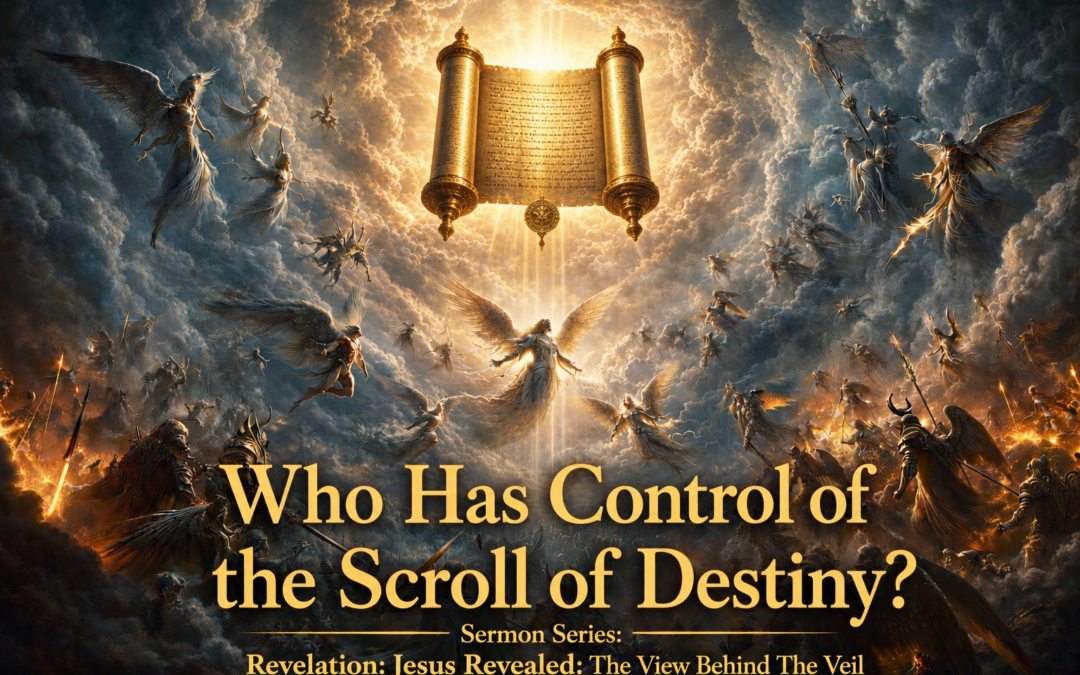
Revelation 5 sermon: In “Who Has Control of the Scroll of Destiny?” Victory Baptist studies the sealed scroll in Revelation 5 and why Jesus Christ, the Lamb of God and Lion of Judah, is worthy to open it. This sermon explains the scroll as the title deed to the earth, the dominion lost by the first Adam, and the redemption regained by the Last Adam through His victorious sacrifice.
Sermon Audio
Sermon Video
Sermon Notes
Revelation 5:1 And I saw in the right hand of Him who sat on the throne a scroll
written inside and on the back, sealed with seven seals.
Revelation 5:2 Then I saw a strong angel proclaiming with a loud voice, “Who is worthy
to open the scroll and to loose its seals?”
Revelation 5:3 And no one in heaven or on the earth or under the earth was able
to open the scroll, or to look at it.
Revelation 5:4 So I wept much, because no one was found worthy to open and
read the scroll, or to look at it.
Revelation 5:5 But one of the elders said to me, “Do not weep. Behold, the Lion
of the tribe of Judah, the Root of David, has prevailed to open the scroll and to
loose its seven seals.”
Revelation 5:6 And I looked, and behold, in the midst of the throne and of the
four living creatures, and in the midst of the elders, stood a Lamb as though
it had been slain, having seven horns and seven eyes, which are the seven Spirits
of God sent out into all the earth.
Revelation 5:7 Then He came and took the scroll out of the right hand of Him who
sat on the throne.
Revelation 5:8 Now when He had taken the scroll, the four living creatures and
the twenty-four elders fell down before the Lamb, each having a harp, and golden
bowls full of incense, which are the prayers of the saints.
Revelation 5:9 And they sang a new song, saying: “You are worthy to take the scroll,
and to open its seals; For You were slain, and have redeemed us to God by Your blood
out of every tribe and tongue and people and nation,
Revelation 5:10 And have made us kings and priests to our God; And we shall reign on
the earth.”
1. The Scroll in the Hands of the One on the Throne
Revelation 5:1 And I saw in the right hand of Him who sat on the throne a scroll
written inside and on the back, sealed with seven seals.
Here are seven views regarding the contents of the scroll
1. The book of the new covenant, which has yet to be instituted with Israel in
the millennial kingdom
2. A book of redemption (the Lamb’s book of life)
3. The title deed to the earth!
4. The events of the Tribulation (a doomsday book)
5. A bill of divorce—the Lamb divorcing unfaithful Israel
6. A record of the sins of mankind
7. A testament or will
2. The Scroll in the Hands of the First Adam
Genesis 1:26 Then God said, “Let Us make man in Our image, according to Our likeness;
let them have dominion over the fish of the sea, over the birds of the air, and over
the cattle, over all the earth and over every creeping thing that creeps on the earth.”
Genesis 1:28 Then God blessed them, and God said to them, “Be fruitful and multiply;
fill the earth and subdue it; have dominion over the fish of the sea, over the birds
of the air, and over every living thing that moves on the earth.”
Genesis 2:8 The Lord God planted a garden eastward in Eden, and there He put the
man whom He had formed.
Genesis 2:9 And out of the ground the Lord God made every tree grow that is pleasant
to the sight and good for food. The tree of life was also in the midst of the garden,
and the tree of the knowledge of good and evil.
3. The Scroll Stolen by the Hands of Satan
1 John 5:19 We know that we are of God, and the whole world lies under the sway
of the wicked one.
John 12:31 Now is the judgment of this world; now the ruler of this world will be
cast out.
2 Corinthians 4:4 (NLT) Satan, who is the god of this world, has blinded the minds
of those who don’t believe.
Matthew 4:8 Again, the devil took Him up on an exceedingly high mountain, and
showed Him all the kingdoms of the world and their glory.
Matthew 4:9 And he said to Him, “All these things I will give You if You will fall down
and worship me.”
4. The Scroll Regained into the Hands of the Last Adam
1 Corinthians 15:22 For as in Adam all die, even so in Christ all shall be made alive.
Romans 5:19 For as by one man’s disobedience many were made sinners, so also
by one Man’s obedience many will be made righteous.
1 Corinthians 15:45 And so it is written, “The first man Adam became a living being.”
The person doing the saving can’t have the same problem as the one who needs
to be saved.
Hebrews 2:9 But we see Jesus, who was made a little lower than the angels, for
the suffering of death crowned with glory and honor, that He, by the grace of God,
might taste death for everyone.
The book of Revelation completes the circle of Bible truths.
The first Adam sinned and lost dominion
The last Adam (Jesus) obeyed and regained the dominion the first Adam had lost
The first Adam was defeated and brought death to humanity
The last Adam (Jesus) was victorious and brought life to all who will trust in Him
The first Adam was the king of the old creation
The last Adam (Jesus) is the king of the new creation
Lyrics Woodstock
I came upon a child of god
He was walking along the road
And I asked him, where are you going
And this he told me
I’m going on down to Yasgurs farm
I’m going to join in a rock n roll band
I’m going to camp out on the land
I’m going to try an get my soul free
We are stardust, We are golden
And we’ve got to get ourselves back to the garden.
Luke 23:43 And Jesus said to him, “Assuredly, I say to you, today you will be with Me in Paradise.”
Revelation 11:15 Then the seventh angel sounded: And there were loud voices in
heaven, saying, “The kingdoms of this world have become the kingdoms of our Lord
and of His Christ, and He shall reign forever and ever!”
Revelation 5:10 And have made us kings and priests to our God; And we shall reign on
the earth.”
Romans 6:3 Or do you not know that as many of us as were baptized into Christ
Jesus were baptized into His death?
Romans 6:4 Therefore we were buried with Him through baptism into death, that
just as Christ was raised from the dead by the glory of the Father, even so we also
should walk in newness of life.
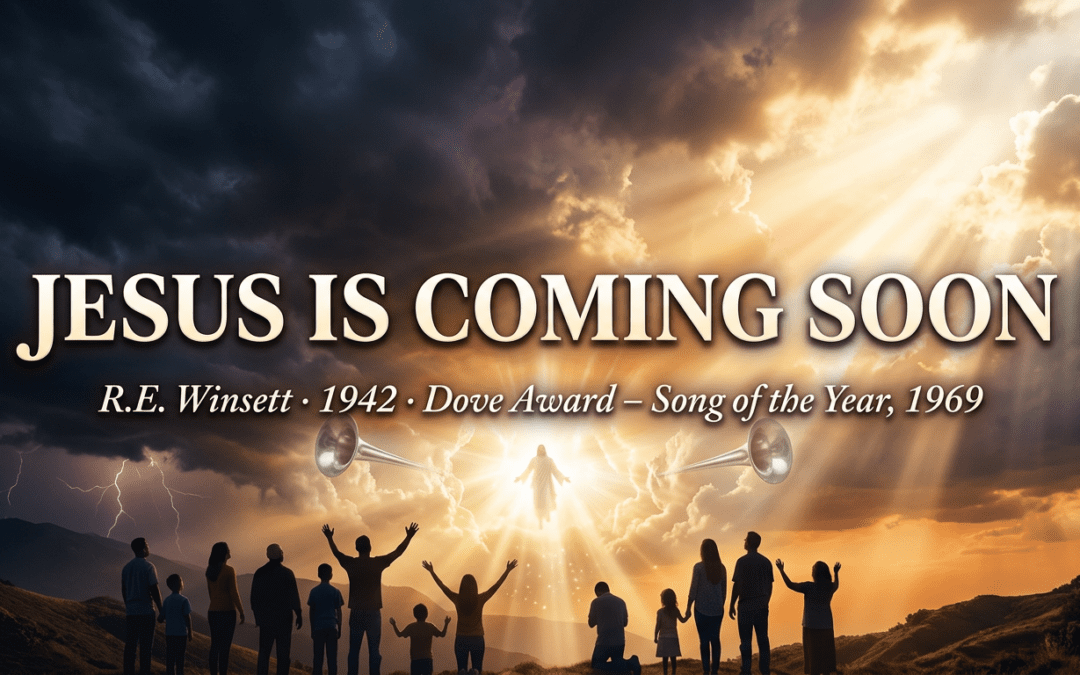
Songwriter: Robert Emmett (R.E.) Winsett | Written: 1942 | Genre: Southern Gospel / Worship Hymn | Award: GMA Dove Award – Song of the Year, 1969
Jesus Is Coming Soon song history: This article traces R.E. Winsett’s 1942 Southern Gospel hymn from its World War II setting to its Scripture-rich message about the Second Coming of Christ, its historic Dove Award recognition, and its lasting place in church worship.
The Origin Story: Born in the Shadow of World War II
There are songs that transcend their moment of writing—songs that feel like they were composed for every generation at once. Jesus Is Coming Soon is one of those songs. Written in 1942 by Robert Emmett Winsett, this timeless Southern Gospel anthem emerged from one of the darkest chapters in modern history.
When Winsett penned the opening line—“Troublesome times are here, filling men’s hearts with fear”—the United States had just been jolted into World War II following the attack on Pearl Harbor in December 1941. The Great Depression had already spent a decade hollowing out American communities. Freedom, as the song declares, was genuinely “at stake.” Winsett wasn’t writing metaphor; he was writing headlines.
In the midst of global upheaval, Winsett turned not to despair but to prophecy—anchoring his words in the New Testament’s great hope of Christ’s return. The song was published in 1942, yet it barely caused a stir at first. Winsett would never see it become the beloved standard it is today. He passed away on June 26, 1952, at age 76, unaware that his modest gospel tune was destined to top the charts, win the gospel world’s highest honor, and be sung in sanctuaries across generations and continents.
Songwriter Biography: Robert Emmett Winsett (1876–1952)
Early Life and Musical Formation
Robert Emmett Winsett was born on January 15, 1876, on a farm in Bledsoe County, Tennessee—a rural stretch of Appalachian foothills near the town of Pikeville. From the very beginning, music was woven into his DNA. By the age of seven, young Robert had already experienced a religious awakening and written his first song—a remarkable gift that hinted at a lifetime of sacred creativity.
Winsett was proficient on nine musical instruments and possessed a rare natural gift for harmony. He formalized his musical education at the Bowman Normal School of Music, graduating in January 1899. The training gave structure to his natural gifts, and within a few years he was ready to share them with the world.
Publisher, Evangelist, and Churchman
Around 1903, Winsett founded the R.E. Winsett Song Book Publishing Company in Dayton, Tennessee—one of the earliest gospel music publishing houses in the American South. His first solo compilation, Union Revival Songs, appeared in 1906. Over the next five decades, Winsett authored and compiled dozens of gospel songbooks, with his final publication—Best of All (1951)—selling over one million copies. Across all his titles, total sales exceeded ten million copies.
But Winsett was more than a publisher. He served as a Church of God preacher, evangelist, and pastor. He was also part of the originating committee of the Assemblies of God—one of the founding voices of the American Pentecostal movement—and played a role in establishing a town in Oklahoma during the land-rush era of American expansion. He was, in the truest sense, a builder: of music, of community, and of faith.
Legacy and Honors
In his lifetime, Winsett composed approximately 1,000 gospel songs—a staggering output by any measure. After his death, the gospel world gradually recognized the magnitude of his contribution. In 1969—seventeen years after he died—his song Jesus Is Coming Soon won the very first GMA Dove Award for Song of the Year, beating out the entire Southern Gospel catalog of the era. In 1973, he was inducted into the Gospel Music Hall of Fame, and in 2002 into the Southern Gospel Music Hall of Fame.
Scripture Foundation: What the Bible Says About Christ’s Return
Jesus Is Coming Soon is not simply a catchy chorus—it is a carefully constructed theological proclamation rooted in the New Testament’s teaching on eschatology (the doctrine of last things). Every verse and the chorus itself draw from specific scriptural threads.
Primary Texts
1 Thessalonians 4:16–17 — “For the Lord Himself will descend from heaven with a shout, with the voice of an archangel, and with the trumpet of God. And the dead in Christ will rise first. Then we who are alive and remain shall be caught up together with them in the clouds to meet the Lord in the air.” This passage is the direct inspiration for the chorus: “trumpets will sound… all of the dead shall rise… righteous meet in the skies.”
Matthew 24:42–44 — “Watch therefore, for you do not know what hour your Lord is coming… Therefore you also be ready, for the Son of Man is coming at an hour you do not expect.” The urgency of Christ’s unexpected return drives the entire song’s call to “Christians, awake!”
Revelation 22:12, 20 — “And behold, I am coming quickly, and My reward is with Me… Even so, come, Lord Jesus!” The title phrase “Jesus is coming soon” echoes Christ’s own words in the Revelation.
Matthew 24:12 — “Because lawlessness will abound, the love of many will grow cold.” Verse 2 draws directly on this imagery: “Love of so many cold… evils abound.”
Romans 2:5–16 — Paul’s teaching on the Day of Judgment undergirds the warning tone of the chorus: “Many will meet their doom.”
2 Peter 3:10 — “But the day of the Lord will come as a thief in the night.” The theme of sudden arrival connects to the song’s “morning or night or noon.”
The song’s theology is thoroughly evangelical and pre-millennial in its orientation—it treats the second coming as imminent, visible, and accompanied by a literal trumpet call and bodily resurrection. For congregations that hold to a futurist reading of Matthew 24 and Revelation, this song serves as a powerful affirmation of the blessed hope.
Verse-by-Verse Lyrical Analysis
Verse 1: “Troublesome Times Are Here”
Troublesome times are here, filling men’s hearts with fear, / Freedom we all hold dear, now is at stake; / Humbling your heart to God, saves from chast’ning rod, / Seek the way pilgrims trod, Christians awake!
Winsett opens in pure pastoral urgency. Written in 1942, “troublesome times” was not a vague spiritual metaphor—it was a live newspaper report. The world was at war; freedom was literally at stake as fascism and imperialism swept across Europe and Asia. Yet Winsett’s response is not despair or nationalism—it is humility before God. The phrase “chast’ning rod” alludes to Hebrews 12:6: “For the Lord disciplines the one He loves.” The call to “seek the way pilgrims trod” echoes the imagery of Hebrews 11’s Hall of Faith—the saints who walked by faith through their own troublesome times. The final two words, “Christians, awake!” function as an alarm bell: the song begins not with comfort but with a summons to spiritual alertness.
Verse 2: “Love of So Many Cold”
Love of so many cold, losing their home of gold, / This in God’s Word is told, evils abound; / When these signs come to pass, nearing the end at last, / It will come very fast; trumpets will sound.
Verse 2 is the most theologically dense and, for some interpreters, the most contested verse of the song. Winsett draws from Matthew 24:12 (“the love of many will grow cold”) and Luke 21:28 (“when these things begin to happen, look up”). The phrase “losing their home of gold” may allude to the parable of the Prodigal Son—the squandering of spiritual inheritance—or to the broader theme of Revelation’s imagery of heavenly treasure forfeited through unfaithfulness. The urgency intensifies: “it will come very fast.” This verse functions as a prophetic warning—a signal that those who miss or dismiss the signs will be caught unprepared. Notably, many contemporary worship recordings omit this verse, focusing instead on verses 1 and 3 for their more broadly applicable themes.
Verse 3: “Troubles Will Soon Be O’er”
Troubles will soon be o’er; happy forevermore, / When we meet on that shore, free from all care; / Rising up in the sky, telling this world goodbye; / Homeward we then will fly, glory to share.
If verse 1 is alarm and verse 2 is warning, verse 3 is pure doxology. The tone shifts dramatically from minor-key anxiety to major-key triumph. “Troubles will soon be o’er” mirrors 1 Corinthians 15:54—”Death is swallowed up in victory.” The image of meeting “on that shore” draws on the ancient hymnody of heaven as a promised land across the water—Canaan imagery applied to eternal life. “Rising up in the sky” is the rapture or resurrection in plain language, echoing 1 Thessalonians 4:17. “Telling this world goodbye” is one of the most memorable lines in Southern Gospel literature—a moment of joyful finality. And “glory to share” reminds believers that this homecoming is not private but communal: the entire redeemed company arrives together. This verse is the theological heart of the song’s hope.
The Chorus: “Jesus Is Coming Soon”
Jesus is coming soon, morning or night or noon; / Many will meet their doom, trumpets will sound; / All of the dead shall rise, righteous meet in the skies, / Going where no one dies, heavenward bound.
The chorus is a masterclass in compressed theology. In eight lines and fewer than 50 words, Winsett captures the full arc of eschatological teaching: the imminence of Christ’s return (“morning or night or noon”—alluding to Matthew 24:42 and the unexpected hour), the judgment (“many will meet their doom”), the resurrection (“all of the dead shall rise”—1 Thessalonians 4:16), the gathering of the redeemed (“righteous meet in the skies”—1 Thessalonians 4:17), and the eternal state (“going where no one dies”—Revelation 21:4). The final phrase “heavenward bound” became so iconic that the Singing News used it as a metaphor for the entire genre. The repetition of this chorus after each verse functions as a doxological refrain—a repeated proclamation of the church’s ultimate hope above every troublesome circumstance.
Historical Timeline
Year
Event
January 15, 1876
Robert Emmett Winsett born on a farm in Bledsoe County, Tennessee
~1883 (age 7)
Winsett experiences religious awakening and writes his first song
January 1899
Graduates from Bowman Normal School of Music
~1903
Founds R.E. Winsett Song Book Publishing Company in Dayton, Tennessee
1906
Publishes Union Revival Songs, his first solo songbook compilation
1914
Serves on originating committee of the Assemblies of God
1942
Jesus Is Coming Soon written and published; WWII context shapes its lyrics
1951
Publishes Best of All, his final songbook; sells over 1 million copies
June 26, 1952
R.E. Winsett passes away in Dayton, Tennessee, age 76
1967
The Sheltons record the first professional version on Halo Records (Heart Felt Gospel)
1968
The Inspirations record the song; debut it on Gospel Singing Jubilee TV program
1969
The Oak Ridge Boys record Jesus Is Coming Soon on album It’s Happening!
April 1969
Song wins Song of the Year at the 1st GMA Dove Awards—the first Dove Award ever given
January 1970
Song reaches #1 on inaugural Singing News airplay chart, held by multiple groups simultaneously
1973
R.E. Winsett posthumously inducted into the Gospel Music Hall of Fame
2002
R.E. Winsett inducted into the Southern Gospel Music Hall of Fame
Present
Song remains a staple in Southern Gospel, bluegrass gospel, and traditional church worship worldwide
Notable Recordings and Covers
Year
Artist / Group
Album / Label
Significance
1967
The Sheltons
Heart Felt Gospel (Halo Records)
First professional recording; discovered the song through a piano teacher; directly inspired the Inspirations
1968
Roger McDuff
—
Early recording that helped spread the song’s popularity
1968
The Inspirations
Jesus Is Coming Soon (Mark V Studios)
Pivotal recording; TV debut on Gospel Singing Jubilee launched the song into widespread popularity
1969
The Oak Ridge Boys
It’s Happening! (HeartWarming)
Album won Dove Award Album of the Year; their version became the most widely known recording
1969
Blue Ridge Quartet
—
One of several groups recording in the same year, reflecting the song’s viral spread
1969
The Prophets
—
Contributed to the multi-artist #1 charting on Singing News
1970
The Florida Boys
—
Featured prominently in the song’s multi-month Singing News #1 run
1971
J.D. Sumner & The Stamps Quartet
—
Brought the song to broader audiences through their vast touring reach
1971
The Easter Brothers
—
Bluegrass gospel interpretation
~1970s
Ralph Stanley
—
Bluegrass legend brought the song into Appalachian gospel tradition
~1970s
The Primitive Quartet
—
Traditional quartet arrangement in mountain gospel style
2009
Dailey & Vincent
—
Contemporary bluegrass-gospel duo reintroduced the song to new audiences
Frequently Asked Questions
1. Who wrote “Jesus Is Coming Soon” and when?
Jesus Is Coming Soon was written and composed by Robert Emmett (R.E.) Winsett in 1942. Winsett was a prolific Tennessee-born gospel songwriter, publisher, and Church of God minister who authored approximately 1,000 gospel songs in his lifetime. He wrote the tune—officially titled “Troublesome Times”—against the backdrop of World War II and published it through his own R.E. Winsett Song Book Publishing Company in Dayton, Tennessee.
2. What award did “Jesus Is Coming Soon” win?
The song won Song of the Year at the very first GMA Dove Awards ceremony in 1969—making it the inaugural recipient of what became gospel music’s most prestigious honor. The Dove Awards are hosted annually by the Gospel Music Association, and “Jesus Is Coming Soon” holds the distinction of being the first song ever to receive the Song of the Year award. Notably, the same awards night also saw the Oak Ridge Boys’ album It’s Happening!—which featured the song—win Album of the Year, and Bill Gaither win Songwriter of the Year.
3. What Scripture is “Jesus Is Coming Soon” based on?
The song draws primarily from 1 Thessalonians 4:16–17, which describes the Lord descending from heaven with the trumpet of God, the dead in Christ rising first, and believers being caught up to meet Him in the air. Additional scriptural threads include Matthew 24:42–44 (the call to watchfulness and readiness), Revelation 22:12 and 20 (Christ’s own declaration “I am coming soon”), Matthew 24:12 (love growing cold, referenced in verse 2), and 2 Peter 3:10 (the Day of the Lord coming unexpectedly). The song essentially compresses the New Testament’s eschatological hope into three verses and a chorus.
4. Why is the second verse sometimes left out of recordings?
Verse 2—with lines like “love of so many cold,” “evils abound,” and “when these signs come to pass”—draws from Matthew 24:12 and Luke 21:28, passages that some theologians interpret as referring to the destruction of Jerusalem in A.D. 70 rather than the end times. For congregations and groups that hold to a preterist or amillennial reading of these passages, the verse’s application to the Second Coming is theologically disputed. As a result, many recordings and hymnals opt to use only verses 1 and 3, which carry the more universally applicable themes of spiritual urgency and eschatological hope without the sign-watching framework of verse 2.
5. How can this song be used in worship today?
Jesus Is Coming Soon is a powerful worship tool for any context focused on Advent, eschatology, evangelism, or simple congregational encouragement. Its fast, singable tune makes it accessible to all ages, while its theological depth rewards deeper study. In a worship service, it pairs naturally with sermon series on 1 Thessalonians 4–5, the Olivet Discourse (Matthew 24–25), or Revelation. It can also serve as an altar-call song, given its urgency to “Christians, awake!” and its warning that “many will meet their doom.” For churches with piano or organ traditions, the original four-part harmony arrangement is especially effective. Modern worship bands can also reimagine it with contemporary instrumentation while preserving the integrity of the original lyrics and message.
Have a worship song you’d like to see featured? Leave a comment below or contact us at vbccarthage.org. This post is part of our ongoing Worship Song Deep Dive series.
Church instruments 200 years ago looked and sounded different from what many congregations know today. Around the 1820s, church music was usually led by human voices first. Instruments, when they were used, helped the congregation find the pitch, keep the tune steady, and sing together with confidence.
That means the most important “instrument” in many churches was the gathered congregation. The people sang psalms, hymns, and spiritual songs, often with a song leader, a small choir, or a precentor guiding the melody.
Voices came first
In many Baptist, Methodist, Presbyterian, and frontier churches, singing was simple and practical. Some congregations sang without accompaniment. Others used a tuning fork, pitch pipe, or song leader to begin the hymn. In places where hymnals were scarce or not everyone could read music, a leader might “line out” the hymn by speaking or singing a phrase before the congregation repeated it.
This kind of singing put the words in the center. The goal was not performance. It was worship, memory, doctrine, and congregational participation.
Common instruments in churches 200 years ago
The exact instruments depended on the church, the region, and the people available to play. A rural congregation might have no instrument at all, while a town church might have a small group of musicians. Common church instruments 200 years ago included:
Bass viols or cellos to support the lower part and keep the singing grounded.
Fiddles or violins to carry the melody in smaller churches or singing schools.
Flutes, fifes, clarinets, and bassoons where trained players were available.
Serpents and horns in some congregations, especially where a stronger bass line was needed.
Organs in some established city churches, though many smaller churches did not have one.
In some English and American traditions, singers and instrumentalists sat in a gallery, which is why historians often call this “gallery music” or “west gallery music.” These groups were not bands in the modern worship-service sense. They were local singers and players helping the whole church sing.
Why some churches avoided instruments
Not every church welcomed instruments. Some believers thought instrumental music could distract from the words of the hymn. Others associated certain instruments, especially the fiddle, with dances, taverns, and entertainment. Cost also mattered. A church might want an organ, but a small congregation on the frontier often could not buy or maintain one.
So the question was not simply, “Did churches have music?” They certainly did. The better question is, “How did each congregation help ordinary people sing?” For many churches, the answer was strong voices, familiar tunes, and a leader who knew the hymn well.
What changed over time?
During the 1800s, church music changed quickly. More churches bought organs or pianos. Hymnals became more common. Singing schools taught people to read shaped notes and harmonies. Choirs became more organized. By the late 19th and early 20th centuries, the sound of many American churches was much closer to what people recognize today.
Still, the older pattern has something to teach us. Church instruments 200 years ago were usually servants of congregational singing. Whether a church used only voices, a bass viol, a flute, or a small organ, the aim was to help the Word dwell richly among the people of God.
A simple takeaway for today
The instruments have changed, but the purpose remains. Music in church should help God’s people sing truthfully, clearly, and together. A congregation can thank God for every faithful tool, old or new, that supports that purpose.
Some homes and public places had pianos, but many churches around the 1820s were more likely to sing without accompaniment or use voices, a bass instrument, wind instruments, or an organ where one was available.
Was the organ common in every church?
No. Organs were more common in established and better-funded churches. Many rural and frontier congregations sang without an organ.
What mattered most in church music?
Congregational singing mattered most. Instruments were helpful when they supported the voices of the church.
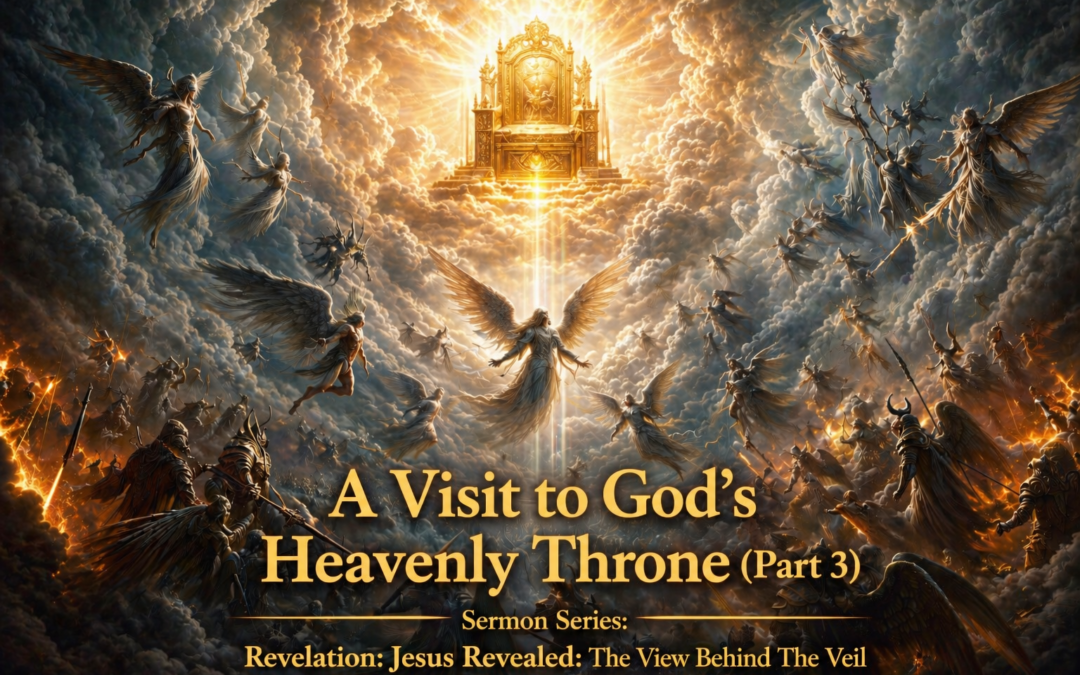
Step through the open door into heaven’s throne room in Part 3 of our Revelation series! In “A Visit to God’s Heavenly Throne,” we witness the breathtaking vision of Revelation 4 — the radiant One seated on the throne, surrounded by 24 elders, four living creatures, a sea of glass, and the ceaseless worship of heaven. Discover the seven awe-inspiring elements around God’s throne and explore four life-changing aspects of true praise: its permanence, the glorious Person we worship, the humble posture of worship, and its power to lift our perspective from earth to heaven. Be renewed in worship as Jesus is revealed behind the veil!
Audio Only:
Video:
Sermon Notes
Revelation 4:1 After these things I looked, and behold, a door standing open in
heaven. And the first voice which I heard was like a trumpet speaking with me,
saying, “Come up here, and I will show you things which must take place after this.”
Revelation 4:2 Immediately I was in the Spirit; and behold, a throne set in heaven,
and One sat on the throne.
Revelation 4:3 And He who sat there was like a jasper and a sardius stone in
appearance; and there was a rainbow around the throne, in appearance like
an emerald.
Revelation 4:4 Around the throne were twenty-four thrones, and on the thrones
I saw twenty-four elders sitting, clothed in white robes; and they had crowns of
gold on their heads.
Revelation 4:5 And from the throne proceeded lightnings, thunderings, and voices.
Seven lamps of fire were burning before the throne, which are the seven Spirits of God.
Revelation 4:6 Before the throne there was a sea of glass, like crystal. And in the
midst of the throne, and around the throne, were four living creatures full of eyes
in front and in back.
Revelation 4:7 The first living creature was like a lion, the second living creature like
a calf, the third living creature had a face like a man, and the fourth living creature
was like a flying eagle.
Revelation 4:8 The four living creatures, each having six wings, were full of eyes
around and within. And they do not rest day or night, saying: “Holy, holy, holy,
Lord God Almighty, who was and is and is to come!”
Revelation 4:9 Whenever the living creatures give glory and honor and thanks to
Him who sits on the throne, who lives forever and ever,
Revelation 4:10 the twenty-four elders fall down before Him who sits on the throne
and worship Him who lives forever and ever, and cast their crowns before the throne,
saying:
Revelation 4:11 “You are worthy, O Lord, to receive glory and honor and power;
For You created all things, and by Your will they exist and were created.”
There are Seven Things Around the Throne of God
1. SEATED UPON THE THRONE IS THE TRIUNE GOD.
2. SURROUNDING THE THRONE IS A RAINBOW.
3. SITTING AROUND THE THRONE ARE THE 24 ELDERS.
4. SOUNDING FORTH FROM THE THRONE ARE LIGHTNINGS,
THUNDERS AND VOICES.
5. SPREAD BEFORE THE THRONE IS A SEA OF GLASS.
6. SITUATED IN THE MIDST OF THE THRONE ARE THE FOUR
LIVING CREATURES.
7. SHARING PRAISE TOWARD THE ONE ON THE THRONE ARE
THE CREATURES AND THE ELDERS.
Revelation 4:8 The four living creatures, each having six wings, were full of eyes
around and within. And they do not rest day or night, saying: “Holy, holy, holy,
Lord God Almighty, Who was and is and is to come!”
1. THE PERMANENCE OF PRAISE.
Revelation 4:8 “… And they do not rest day or night, saying: “Holy, holy, holy, Lord
God Almighty, Who was and is and is to come!”
Isaiah 6:3 And one cried to another and said: “Holy, holy, holy is the Lord of hosts;
Psalm 136:1 …. For His mercy endures forever.
Psalm 136:2 …. For His mercy endures forever.
Quote
When we are really in love, we don’t count the number of times we say “I love you!”,
especially if the one we love really loves to hear it.
The same way, God really loves to hear our words of love towards Him, even when
we only say “I love You” over and over again.
2. THE PERSON OF PRAISE.
Revelation 4:9 Whenever the living creatures give glory and honor and thanks to
Him who sits on the throne, who lives forever and ever,
Lyrics “I Write The Songs”
I’ve been alive forever
And I wrote the very first song
I put the words and the melodies together
I am music, and I write the songs
Ephesians 5:18 And be not drunk with wine, wherein is excess; but be filled with the
Spirit;
Ephesians 5:19 Speaking to yourselves in psalms and hymns and spiritual songs,
and making melody in your heart to the Lord;
Revelation 4:9 Whenever the living creatures give glory and honor and thanks to
Him who sits on the throne, who lives forever and ever,
John 1:14 And the Word became flesh and dwelt among us, and we beheld His glory
3. THE POSTURE OF PRAISE.
Revelation 4:10 the twenty-four elders fall down before Him who sits on the
throne and worship Him who lives forever and ever, and cast their crowns before
the throne, saying:
The word “worship” means to prostrate one’s self,
Revelation 7:11 And all the angels stood round about the throne, and about the elders
and the four beasts, and fell before the throne on their faces, and worshipped God,
Revelation 11:16 And the four and twenty elders, which sat before God on their seats,
fell upon their faces, and worshipped God,
Revelation 19:4 And the four and twenty elders and the four beasts fell down and
worshipped God that sat on the throne, saying, Amen; Alleluia.
Matthew 4:9 And he said to Him, “All these things I will give You if You will fall down
and worship me.”
Matthew 4:10 Then Jesus said to him, “Away with you, Satan! For it is written,
‘You shall worship the Lord your God, and Him only you shall serve.’
Psalm 95:6 Oh come, let us worship and bow down; Let us kneel before the Lord
our Maker.
Quote
There are times I get down on my face to pray and it’s like I just can’t even get my face
deep enough in the carpet. It just seems like I can’t humble myself enough before God
Revelation 4:10 “… and worship Him who lives forever and ever, and cast their
crowns before the throne …”
Hebrews 11:1 Now faith is the substance of things hoped for, the evidence of things
not seen.
Hebrews 11:3 By faith we understand that the worlds were framed by the word of
God, so that the things which are seen were not made of things which are visible.
Hebrews 11:16 But now they desire a better, that is, a heavenly country. Therefore
God is not ashamed to be called their God, for He has prepared a city for them.
4. THE PURPOSE OF PRAISE.
Revelation 4:11 “You are worthy, O Lord, to receive glory and honor and power;
For You created all things, and by Your will they exist and were created.
Praise is not praise unless it’s expressed.
2 Corinthians 5:17 Therefore, if anyone is in Christ, he is a new creation; old things
have passed away; behold, all things have become new.
Worship lifts our perspective from the earthly to the heavenly.
Colossians 3:1 If then you were raised with Christ, seek those things which
are above, where Christ is, sitting at the right hand of God.
Colossians 3:2 Set your mind on things above, not on things on the earth.
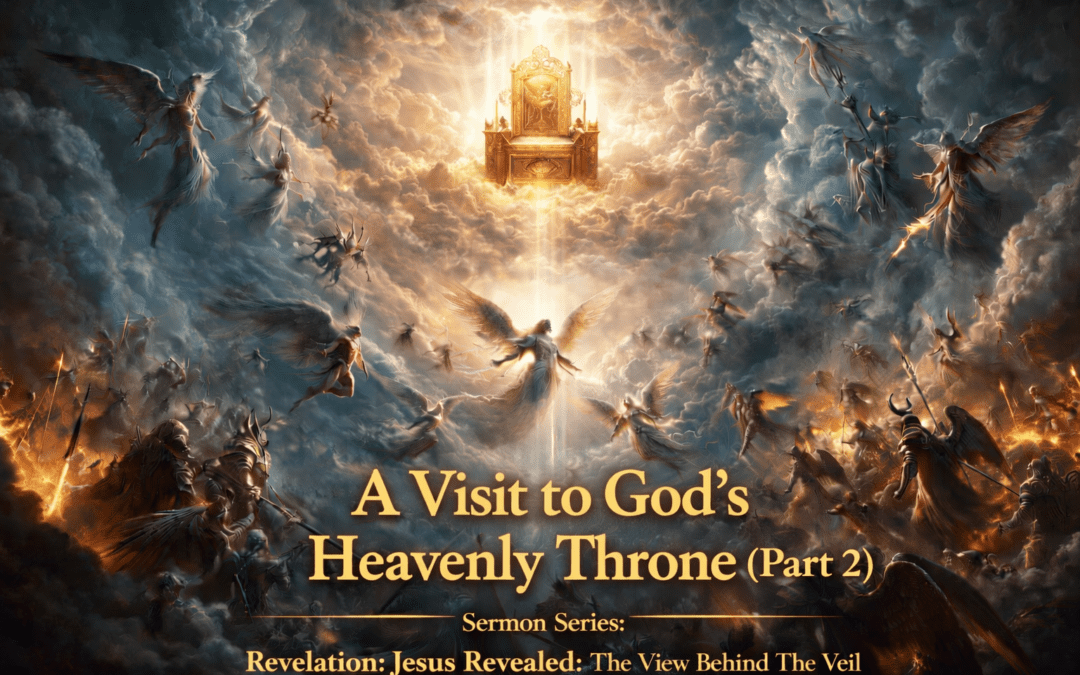
This Part 2 sermon from Victory Baptist Church in Carthage explores Revelation 4:1–7 verse-by-verse, where Apostle John enters through an open door to witness God’s majestic throne room. We unpack six key elements revealing God’s glory, sovereignty, and the worship surrounding His throne.
Listen to the full Revelation 4 sermon:
Sermon Outline: Six Elements of God’s Heavenly Throne
1. An Open Door in Heaven (Revelation 4:1)
John hears a trumpet-like voice inviting him to see future events.
Revelation 4:1 After these things I looked, and behold, a door standing open in heaven. And the first voice which I heard was like a trumpet speaking with me, saying, “Come up here, and I will show you things which must take place after this.”
2. The Throne and God Seated On It (Revelation 4:2–3)
God’s appearance like jasper and sardius stones, encircled by an emerald rainbow symbolizing mercy.
Revelation 4:2–3 Immediately I was in the Spirit; and behold, a throne set in heaven, and One sat on the throne. And He who sat there was like a jasper and a sardius stone in appearance; and there was a rainbow around the throne, in appearance like an emerald.
3. Twenty-Four Elders (Revelation 4:4)
Revelation 4:4 Around the throne were twenty-four thrones, and on the thrones I saw twenty-four elders sitting, clothed in white robes; and they had crowns of gold on their heads.
Revelation 4:5 And from the throne proceeded lightnings, thunderings, and voices. Seven lamps of fire were burning before the throne, which are the seven Spirits of God.
5. Sea of Glass (Revelation 4:6a)
Revelation 4:6a Before the throne there was a sea of glass, like crystal.
6. Four Living Creatures (Revelation 4:6b–7)
Like lion, calf, man, eagle — identified as cherubim (Ezekiel 1, 10).
Revelation 4:6b–7 And in the midst of the throne, and around the throne, were four living creatures full of eyes in front and in back. The first living creature was like a lion, the second living creature like a calf, the third living creature had a face like a man, and the fourth living creature was like a flying eagle.
Key Cross-References
Psalm 99:1 — The Lord reigns; He dwells between the cherubim.
Psalm 80:1 — You who dwell between the cherubim, shine forth!
1 Samuel 4:4 — The ark of the covenant of the Lord of hosts, who dwells between the cherubim.
Colossians 1:16 — By Him all things were created… thrones or dominions or principalities or powers.
Discussion Questions
What does the rainbow around the throne reveal about God’s character?
How do the 24 elders represent believers before God?
What do the four living creatures teach us about creation worshiping God?